Archbishop Elpidophoros on Ukraine: a critical analysis of the interview
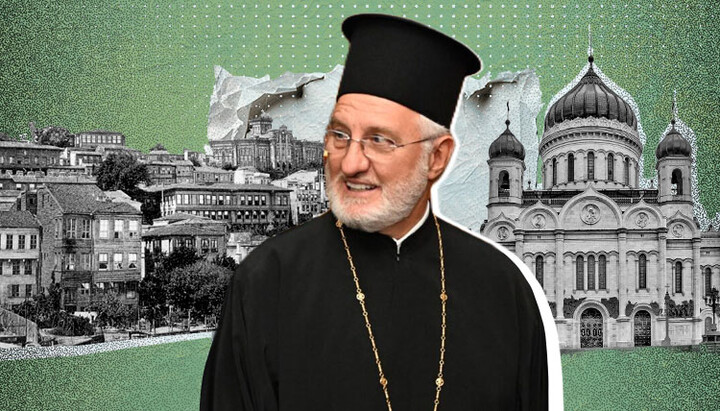
Archbishop Elpidophoros. Photo: UOJ
On January 27, 2026, Archbishop Elpidophoros of America (the Patriarchate of Constantinople) gave an interview in which he expressed several theses that necessitate a response from the standpoint of the faithful of the Ukrainian Orthodox Church.
This is not a polemical text for the sake of polemics. It is an attempt to honestly examine the arguments and facts presented by a hierarch of the Patriarchate of Constantinople and to compare them with the reality that laypeople and clergy of the Ukrainian Orthodox Church experience daily.
On accusations against the ROC: fair criticism or double standards?
Archbishop Elpidophoros begins his interview by criticizing a statement by Russian security services against Patriarch Bartholomew and expresses outrage at state interference in church affairs. He notes that the ROC has historically served as an instrument of the state – from the tsarist period through the communist era and up to the present day.
In a way, there is a grain of truth in his words. Excessively close cooperation between the Russian Orthodox Church and the state structures of the Russian Federation is a fact that has been repeatedly covered on our website. First and foremost, this refers to the support for the war against Ukraine on the part of Patriarch Kirill and the hierarchy of the Russian Orthodox Church, which has no theological justification and contradicts the Gospel commandments.
However, a question arises: why does similar criticism not apply to the rapprochement between the state and the Church in Ukraine? After all, it is no secret that the very process of granting the Tomos to the OCU was initiated by the then-President of Ukraine, Petro Poroshenko, who himself presented autocephaly as a key theme of his election campaign. Moreover, the interaction between the then Kyiv Patriarchate and the President on the issue of granting autocephaly was so close that Petro Poroshenko’s name was even included in the text of the Tomos itself.
Can one speak of church independence when the process of granting autocephaly is so deeply intertwined with the political interests of secular authorities? It should be noted that this question primarily concerns honesty in principle: if we condemn the fusion of state and Church in Russia, why do we remain silent about the even closer interaction between the OCU and the Ukrainian authorities? If this is not double standards, then what is it?
Even more strange in this context is Archbishop Elpidophoros’s statement that “no state can dictate to the Church what to do, what to say, how to behave, or who is to be the church leader”. Which state does he mean? Is it Ukraine? Because it is precisely the Ukrainian state that dictates to the Church what to do, what decisions to make, what to renounce, and what to proclaim. Yet no, the high-ranking hierarch of Constantinople, giving an interview to a Ukrainian outlet, speaks only about Russia and the Russian Orthodox Church. If this is not double standards, then what is it?
The Kyiv Metropolis and the 1686 Tomos
The central argument of Archbishop Elpidophoros is that Ukraine is historically the canonical territory of the Patriarchate of Constantinople, and that the act of 1686 was merely a temporary permission granted to Moscow to ordain the metropolitans of Kyiv, and did not envisage the full transfer of the Kyiv Metropolis to the Moscow Patriarchate.
Indeed, the 1686 Synodal Letter contains ambiguous wording. However, historical reality is more complex than the legal nuances of the seventeenth century.
For more than 330 years, the Kyiv Metropolis remained under the omophorion of the Moscow Patriarchate. Generation after generation, Ukrainian believers lived precisely within this reality. One cannot say that this was an occupation or an act of violence. No, it was a living ecclesial tradition in which the spiritual life of millions of people was formed, and which gave rise to a great many saints.
Therefore, when Constantinople annulled the decision of 1686 in 2018, it acted not only contrary to its own previous position – namely, non-interference in the affairs of the Kyiv Metropolis for centuries – but also erased three and a half centuries of ecclesial tradition.
At the same time, Archbishop Elpidophoros repeatedly insists that the reasons why Ukrainian schismatics did not receive autocephaly before 2018 were exclusively political rather than ecclesiastical. “From a church point of view, everything is clear,” he claims.
But if everything is so clear from an ecclesiastical perspective, why have the majority of Orthodox Churches worldwide still not recognized the OCU? As of 2025, the autocephaly of the OCU has been recognized by only a few Local Churches: of Constantinople, Alexandria, Greece, and Cyprus (and even there, not all hierarchs agree with this decision). All other Churches do not recognize the OCU.
Can Archbishop Elpidophoros confirm that the Churches which do not recognize the OCU are guided exclusively by political considerations? No, of course not. Because in reality, there are legitimate ecclesiological and canonical doubts regarding both the manner in which autocephaly was granted and to whom exactly it was granted. After all, when the Synod of the Church of Greece recognized the OCU in 2019, this decision provoked strong opposition among the Greek clergy and laity. Many highly authoritative metropolitans, including Metropolitan Seraphim of Piraeus and Metropolitan Nektarios of Corfu, spoke out against it.
For example, Metropolitan Seraphim believes, “Granting autocephaly to cursed, deposed schismatics without their repentance, and their reinstatement beyond the legal jurisdiction prescribed by the sacred canons, unfortunately leads the Orthodox Church onto dangerous paths.” In his view, the Patriarchate of Constantinople does have the right to grant autocephaly; however, this process must take place in line with the canons and the approval of the fullness of the Church.
“In this case, the question is not whether the Ecumenical Patriarchate gave Autocephaly for good or bad, but the question is to whom it gave it. He gave it not to the canonical Church under Metropolitan Onuphry that all the Orthodox Churches recognized until that day, but to a crowd of sedentary, deceitful, handcuffed and cursed people who to this day appear unworthy of the highest stage,” he said in January 2022.
We should particularly emphasize Archbishop Elpidophoros’s words that the non-granting of the Tomos to the OCU before 2019 was due to political reasons: “Pressure from above by Russia did not allow the local Church to grow and develop its autocephaly and independence. This pressure from Russia was exercised for political reasons, not ecclesiastical ones.”
As we know, autocephaly in Constantinople was granted not to the canonical UOC, but to the members of the UOC-KP and the UAOC: structures that never had any contacts with Russia and were hostile and antagonistic toward it. The question is: how could Russia prevent these people from “developing their autocephaly and independence”? It seems that there is no answer to this question.
Appeals of UOC hierarchs to Patriarch Bartholomew
One of the most sensitive issues raised in the interview concerns the public appeals of UOC hierarchs to Patriarch Bartholomew. These appeals did indeed take place. Metropolitan Antony, Metropolitan Theodosiy of Cherkasy, Metropolitan Meletiy of Chernivtsi, and other UOC hierarchs addressed the Ecumenical Patriarch, calling on him to restrain the aggression of his subordinates from the OCU and, more broadly, to reconsider the situation with the Tomos.
However, Archbishop Elpidophoros describes these appeals as inconsistent: “How can you ask someone for help if you call into question their jurisdiction to help you?”
This remark could be logical if not for several reasons.
The bishops appeal to the Primate of Constantinople not because they see him as an arbiter in complex ecclesiastical situations, and certainly not because they consider him their Patriarch. The reason is different: he bears responsibility for the actions of those whom he himself recognized as legitimate hierarchs and priests.
UOC hierarchs ask the Patriarch to intervene in the situation with church seizures, assaults on believers, and the desecration of holy sites. And this request is entirely legitimate: after all, it was Patriarch Bartholomew who legalized OCU members, continues to support them, and in fact pressures other Local Churches to recognize them. Moreover, he is precisely the one who can and should influence the cessation of these lawless acts, both by virtue of his primacy and because of his direct responsibility for those he himself legitimized.
There is no doubt that Archbishop Elpidophoros fully understands all of this. He uses the interviewer’s question (which, of course, was coordinated in advance) to advance his own thesis: namely, to call on the UOC to commemorate Patriarch Bartholomew and recognize his authority over them.
The implication is that the Patriarch cannot respond to any appeals right now because the UOC does not recognize his jurisdiction. But as soon as you do recognize it, he will immediately begin to help.
It was most likely for the purpose of promoting this thesis that Archbishop Elpidophoros’s interview was organized in the first place. The fact is, he is an active initiator of granting the UOC the status of an exarchate of the Ecumenical Patriarchate.
As we know, this topic has recently been advanced by many speakers, both ecclesiastical and non-ecclesiastical. The first step in implementing this project should be the “restoration of Eucharistic communion” with the Ecumenical Patriarchate. But for this to happen, bilateral actions must be taken. Surely, you cannot demand the restoration of Eucharistic communion from the Church suffering over the lawless actions of those backed by Patriarch Bartholomew, over whom he refuses to act.
First, he must openly and honestly condemn church seizures and hold the OCU leadership accountable. Only after that can there be a talk of restoring communion with the Ecumenical Patriarchate. Otherwise, such restoration would not appear as a return to the Church’s “canonical order” but as a legalization of church seizures, an implicit acceptance of them. Naturally, the UOC hierarchy sees this as a betrayal of ordinary believers, who have lost their churches and are forced to pray outdoors, under constant pressure from the authorities and “patriots” of the OCU.
Commemoration of Patriarch Kirill
Even more striking are Archbishop Elpidophoros’s words that UOC bishops and “Metropolitan Onuphry refuse to commemorate the Patriarch of Russia”.
“How can they claim to be a canonical Church? How can you be a canonical Church if you commemorate no one?” Archbishop Elpidophoros wonders.
First of all, Metropolitan Onuphry does commemorate Patriarch Kirill (among other Primates), which can easily be verified by watching any video of a service in which he participates.
Second, the archbishop promotes the criticism of “not commemorating” Patriarch Kirill with the same straightforward purpose – to push the UOC to commemorate Patriarch Bartholomew. The implication is that you should commemorate someone. And since commemorating Kirill during the war is impossible, the solution, according to him, is to recognize Bartholomew as their head.
‘It is not enough to simply say: “I condemn Patriarch Kirill’s statements” … Therefore, if we truly want to move forward and make progress in the church situation in Ukraine, I believe that the hierarchs under Onuphry’s omophorion, and Metropolitan Onuphry himself, if they truly mean what they say about dialogue with Constantinople, should begin by commemorating the Patriarch of Constantinople, that is, by commemorating him during services,” Archbishop Elpidophoros insists.
Moreover, he implies that coming under Constantinople is the only way for the UOC to prove its loyalty to Ukrainian society. Condemning Russian aggression is, according to him, no longer enough, because Moscow still considers the UOC part of itself:
“I understand the statements of UOC hierarchs that we are against the invasion, against the war, that we even condemn the statements of Patriarch Kirill, who justifies the war and fratricidal bloodshed. But how can you be convincing to the world when, on the one hand, you claim to condemn everything Patriarch Kirill says and the official position of the Russian Orthodox Church, and on the other hand, the entire Russian propaganda mechanism – both state and church – continues to act in support of you?”
The fact that the UOC cannot influence Russia’s “propaganda mechanism” does not seem to bother Archbishop Elpidophoros. His goal is clear: by any means, to compel the UOC to accept the authority of the Constantinople Patriarchate.
On who commemorates whom
Archbishop Elpidophoros highlights that “we still commemorate, we still pray for the Russian Orthodox Church, for Patriarch Kirill, and for all the hierarchs of the Russian Orthodox Church, because we are members of one Body.”
It should be noted that these words are essential because they clearly show that, in addition to administrative ties, there are also sacramental bonds in the Church that do not depend on administrative boundaries. Yet, if to follow the logic of DESS and Yelensky, Archbishop Elpidophoros’s words (“we are members of one Body”) could just as well be interpreted to mean that the Phanar has a direct connection to the ROC. The conclusions that follow from this are obvious.
On the other hand, while reproaching the UOC for its hierarchs not commemorating Patriarch Kirill (although, again, Metropolitan Onuphry does commemorate him among other Primates), Archbishop Elpidophoros remains silent about Dumenko’s refusal to commemorate the ROC Patriarch. Once again, if this is not a double standard, then what is?
Pressure from the security services
Archbishop Elpidophoros’s words caused great surprise: ‘The reason many hierarchs did not join this autocephalous Church (the OCU – Ed.) was the unfair pressure they experienced from the security services, intelligence agencies, Russian services, which blackmailed them with personal files, pressured, harassed, or even threatened hierarchs to prevent them from joining.” One can’t help but ask: who told him this? Where did he get this information?
In fact, it was exactly the opposite: Ukrainian security services were exerting intense pressure on UOC hierarchs to make them attend the so-called “Unification Council” of the OCU. In some cases, UOC bishops were even abducted, taken away, and directly threatened. In the end, only two out of 100 hierarchs (Oleksandr Drabinko and Simeon Shostatsky) succumbed to this pressure. The rest did not.
There is another aspect in the words of the Constantinople hierarch. The claim that Russian security services can freely pressure and threaten the entire UOC episcopate in modern Ukraine is an outright humiliation of the SBU in favor of the FSB.
Violating another Church’s canonical territory, or that’s different?
Archbishop Elpidophoros spoke at length about the “encroachment” of the ROC into the canonical territory of the Patriarchate of Alexandria.
Recall that in December 2021, the ROC established a Patriarchal Exarchate of Africa. He asks: “How, after such a clear canonical violation of another Church’s territory, can one claim that another Church is acting uncanonically?”
But let us remind the high-ranking hierarch of Constantinople that the creation of the ROC Exarchate in Africa was a response to the recognition of the OCU. In other words, it happened after the Phanar itself violated the canonical boundaries of another Church. The ROC considers these actions “symmetrical”, and their cause lies precisely in the identical actions of the Ecumenical Patriarchate in Ukraine, not simply because they “felt like it”. We do not claim that this is correct – both sides acted in the same way, violating the canons. To ignore this is to distort the truth.
The most striking part is that Archbishop Elpidophoros clearly understands this—at least regarding the ROC, though not the Phanar. He says: “If we truly want to be honest with ourselves and speak about observing and respecting the canons, rules, and norms of the Orthodox Church, the answer does not lie in violating the canons on another Church’s territory. This means that we are, in fact, indifferent to the canons; we are, in fact, indifferent to the Church.” Considering everything happening in Ukraine, it is hard not to agree with him – the Constantinople Patriarchate has indeed acted as a Church “indifferent to the canons.”
Moreover, he also asserts that “We have the highest authority in the Orthodox Church.”
So, Constantinople’s decisions are beyond court or appeal? Apparently, that is how the Phanar hierarch understands it. But has the See of Constantinople never had heretics? Did the Patriarchs of Constantinople never convene “robber councils”? Did they never sign decisions that were not accepted by the Church? As a professor of canon law, Archbishop Elpidophoros cannot be unaware of all this. This means the Phanar’s authority is not as impeccable as he would like it to be.
Criticism of the “Russian world”
Archbishop Elpidophoros sharply criticizes the ideology of the “Russian world”:
“The world is not Russian. The world is Christian, a world created by Jesus Christ, God, for all people. Not just for Russians, not just for Greeks, not just for any single nation in the world. It is for everyone.”
We can agree with that. The ideology of the “Russian world” in its modern form contradicts the universality of Christianity. The Gospel knows no national or ethnic privileges: “There is neither Jew nor Greek” (Gal. 3:28).
However, one must ask: are we not witnessing the creation of a “Greek world” or a “Ukrainian world” as a replacement for the “Russian” one? Does the struggle against the “Russian world” risk creating new forms of ethnophyletism?
The paradox is that any sermon by Dumenko or other “hierarchs” of the OCU can be seen as a classic example of the “Ukrainian world”. All the arguments used by OCU representatives about the need for the independence of the Ukrainian Church are based solely on the necessity of creating their own church – “Ukrainian” rather than Christ-centered – with a “Ukrainian identity,” a “Ukrainian liturgical language”, and generally everything “Ukrainian”. Isn’t all this another form of ethnophyletism, the heresy condemned by the Constantinople Council of 1872? Not to mention “Hellenism”, the significance of the Greek language, and generally everything Greek that is promoted by hierarchs of the Greek-speaking Churches.
Why is the “Russian world” worse than the one proposed by the “patriots” of the OCU? Only because it supports the aggression of the Russian state? And if it didn’t support it, would it be acceptable?
In our view, the ideologies of both the “Russian” and the “Ukrainian” world should have no place in the Church. Yet, apparently, for Archbishop Elpidophoros: “Quod licet Iovi, non licet bovi” (What is permitted to Jupiter is not permitted to the ox).
What’s next?
In his interview, Archbishop Elpidophoros speaks of pain – the pain of the Ukrainian people, of mothers losing their children to the war. These are sincere words, and they resonate in the hearts of all Ukrainians, regardless of their church affiliation.
But there is another pain, which, for some reason, representatives of the Ecumenical Patriarchate ignore – the pain of the UOC faithful, caught between two fires. On the one hand, there is the pressure from Ukrainian authorities. On the other hand, there is harassment, raids, moral and physical violence from OCU representatives. In this situation, the suffering of Ukrainian believers is especially great, because they endure aggression both from Russia and from Ukraine. Their children die on the front lines defending their country, while they themselves, mourning their children, have to defend the Church in which they were baptized. These people cannot simply be cast aside or forced to renounce their millennia-old Christian roots.
Archbishop Elpidophoros speaks of the need for dialogue. Yes, we agree that dialogue is necessary. But it must begin not with demands and ultimatums, but with the acknowledgement of the suffering of those who endure. It must be based on the Gospel principles of love, not on political expediency or the need to “create a Phanar exarchate” in Ukraine.
When Archbishop Elpidophoros urges UOC believers to “recognize the authority” of Constantinople, it would be only fair for Constantinople in turn to acknowledge the suffering of those offered this path. Not to accuse them of some murky “political interests”, not to offer them an exarchate with a promise “to forgive everything” but to perceive this pain as the sincere cry of souls who wish to remain faithful to their Lord and their Church. Only then, perhaps, might something truly change.
Read also
Why OCU hierarchy lacks canonical ordination: what Local Churches say
The OCU head refuses to address invalidity of his ordinations. But almost all Local Churches speak of it – even those that recognized the OCU.
Why nation-first advocates do not call for peace
Ukraine’s population is declining by nearly one million people a year, and experts are warning of the nation’s demographic extinction. Yet the leaders of the Orthodox Church of Ukraine (OCU) and the Ukrainian Greek Catholic Church (UGCC) continue to call for war and mobilization.
The deception that decided the fate of the Tomos
In 2008, the "Filaret problem" derailed Yushchenko's plan. In 2018, Poroshenko solved it in just one hour – with a police escort for the Greeks and verbal promises to Filaret.
Lawyers in the crosshairs: How UOC is being stripped of its right to defense
Activists harass UOC lawyers outside courthouses, call them “traitors” on air, and promise them a “warm welcome” at hearings. The Church’s right to a legal defense is at stake.
How to respond to persecution: Lessons from St. Silouan the Athonite
The Church can and should be defended, but without malice. Why love for persecutors is not weakness but the only way to preserve the Spirit of Christ in the midst of the struggle.
Where the Spirit of the Lord is, there is freedom
Reflections on the controversies surrounding the creation of the OCU.