Holy "trash": Chalice from a tin can
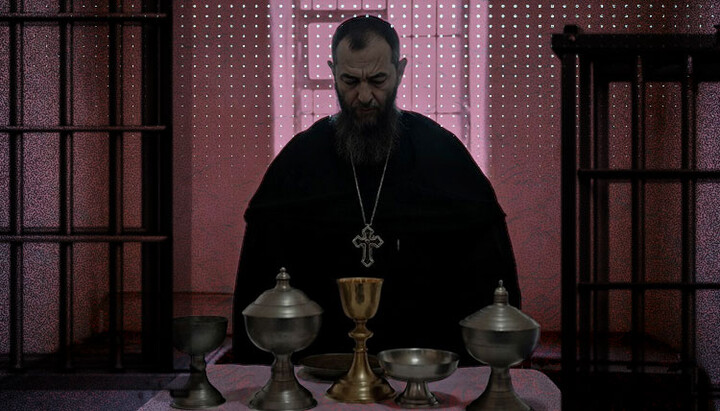
Liturgy in the prison cells of the camps. Photo: UOJ
In the display case of the Museum of the New Martyrs, in the dimly lit hall where the exhibits are illuminated by spotlights, lies a tin can. Rusty, dented on the side, its label peeling, though you can still make out the word “sprats.” Diameter: eight centimeters. Height: five. Volume: roughly two hundred milliliters. The edges are uneven, sharp in places, cut hastily, with a knife or a shard of glass. On the bottom are dark stains that have not come off even after decades. This is not dirt. These are traces of wine, or of what they called wine in the camp.
A plaque nearby reads: “Chalice. Solovetsky Special Purpose Camp, 1930s. Presumably used for celebrating the Divine Liturgy by imprisoned clergy.” Dry, museum-like. But behind these words lies a story worth more than any golden chalice. Gold is forged in a workshop. Holiness is forged in suffering.
This can traveled a path from trash to the Altar. And one must follow that path with it to understand what human faith truly is when everything has been taken away, except Christ.
Ordinary parcel
Arkhangelsk transit prison, winter 1932. Prisoner Mikhail Alexandrovich receives a parcel from his wife. Inside are three cans of sprats in tomato sauce, a piece of lard, hardtack, and some tobacco. A standard survival kit. He eats the sprats straight from the can, with a tin spoon given during prisoner transfer. The fish is salty, almost inedible, but it is calories. And in the camp, calories are life.
He does not throw the can away. In the camp, nothing is thrown away. Tin is used to patch pots, to make improvised knives, for anything. But this can is destined for something else. Because Mikhail Alexandrovich is not just inmate #Щ-234. He is Father Mikhail, a priest from a provincial town, convicted under Article 58-10 for “anti-Soviet agitation.” In reality, for refusing to remove the cross from the church dome and not handing over a list of parishioners.
In the barracks where he lives, there are three other priests. One is a former bishop, the other two rural pastors. They do not disclose their rank. In the camp, that is dangerous. Criminals despise “priests,” the administration sees them as “ideological enemies.” But at night, when the barracks falls asleep after exhausting work in the forest, they whisper prayers. And dream the impossible – to serve the Liturgy.
For that, they need a Chalice. And Father Mikhail understands: this can is from God.
Night reforging: how trash becomes a relic
Night. Frost outside the barracks, −30 °C (Celsius). Inside, slightly warmer, around −15 °C (Celsius). The stove barely smolders –firewood is scarce. A hundred men on the bunks, in padded jackets and hats, breathing out steam that settles as frost on the walls. Snoring, coughing, teeth grinding from scurvy. An ordinary camp night.
Father Mikhail is sitting on his bunk, in a corner of the barracks, his back to the others. Before him is a can of sprats and a shard of glass. He is working slowly, carefully, so as not to wake his neighbors. He is trimming the sharp edges, trying to make them smooth. The glass is scraping against the metal. The tin resists. His fingers are frostbitten and stiff. He cuts himself twice. Blood drips onto the can, mixing with remnants of fish oil. He wipes the blood with the edge of his sleeve and continues.
An hour later, the can is ready. The edges smoothed as much as possible. Inside, he cleans it with snow brought from outside, then with sand scraped from the gaps between the floorboards. He rubs until the tin begins to shine dimly in the moonlight seeping through the roof. It is not gold, not even silver. It is rusted iron, which tomorrow will begin to oxidize again. But tonight, it is clean.
He wraps the can in cloth and hides it under the bunk. Tomorrow, the antimension must be retrieved. The bishop has a scrap of white fabric, cut from an undershirt. A cross is drawn on it in pencil, with the words: “In the name of the Father, and of the Son, and of the Holy Spirit.” That is all he has. And it is enough.
Liturgy under the threat of death
Sunday morning, or what they consider Sunday morning as in the camp, days of the week are erased, leaving only a countdown to the end of the term. But the priests keep a calendar on a scrap of paper hidden in the lining of a coat. Today is Sunday, the Lord’s Day.
Their prisoner work detail is sent to the forest to do the logging. Good luck. In the forest, they can hide. The guards are lazy in the cold, they stand by the fire and do not enter the thicket as long as they hear work sounds. The four priests arrange with the foreman, a political prisoner secretly sympathetic to them. He allows them half an hour “for necessity” into the depths of the forest.
They move through snowdrifts up to their waists until they find a small clearing, enclosed on all sides by pines. Here, they are unseen. Father Mikhail takes the bundle from his coat. He unwraps it. Inside is a can of sprats, wrapped in a scrap of white cloth with a drawn cross.
The bishop spreads the antimension on a cut tree stump. This stump becomes the Altar.
The bread is a dark piece of the ration that Father Mikhail did not eat yesterday, even though his stomach ached with hunger. The wine is cranberry juice pressed from frozen berries gathered along the way. In the tin can, the juice looks almost like wine: dark red and thick. It is not canonical. But the bishop standing nearby, Confessor Athanasius, who has spent over ten years in the camps and will spend another twenty, says, “The Lord accepts not the substance, but the heart. And our hearts – here they are, before Him.”
The bishop serves. No vestments, only a padded jacket and an earflap. No epitrachelion, instead he put a scarf around his neck, with crosses drawn in charcoal. No censer, but his breath in the cold looks like incense. The three other priests stand behind him, waist-deep in snow, quietly singing along. Their voices are muffled, softened by the snow and fear. They fear the guards will hear. But they cannot stop singing.
The Liturgy lasts only twenty minutes. The bishop whispers the words of consecration over the bread and the juice in the tin can. His fingers are blackened from frostbite and labor. He holds the can with both hands so as not to drop it. The can is cold. The juice is nearly frozen.
But when he utters the words, “Take, eat; this is My Body,” in this forest, in this clearing, something happens that neither physics nor chemistry can explain.
They take Communion. One by one. From the rusty can. The bread crumbles in the cold. The juice burns their lips with chill. Yet this is Christ. They know it as clearly as they know they are breathing.
When they finish, the bishop rinses the can with snow and wraps it back in cloth. The antimension is hidden. They return to the work detail. The guards do not even notice their absence. No one knows that a Sacrament has just taken place in that clearing.
Gold vs tin
Saint John Chrysostom wrote in the 4th century: “There were times when the chalices were wooden, and the hearts golden. Now the chalices are golden, and the hearts wooden.”
He did not know that fifteen hundred years later there would be times when the chalices would be made of tin, and the hearts, forged in the furnaces of the GULAG, harder than any metal.
We celebrate the Liturgy in churches with marble iconostases. Our chalices are silver and gilded. Our vestments are brocade and velvet. We complain if the church is cold or if the sermon drags on. We assume that faith requires comfort, beauty, and order.
But they served in the forest, in thirty-below-zero cold, in padded jackets, from a tin can, risking their lives for every word spoken. And they were happy. Because Christ was in their hearts.
This does not mean that beauty in the church is wrong. God deserves the most beautiful things. But when beauty becomes a requirement for faith, when we cannot pray without golden domes and choirs, we become slaves to comfort.
The New Martyrs showed us: God is not in the walls. God is not in gold. God is wherever two or three are gathered in His name. Even if those two are exhausted prisoners in the forest. Even if the Altar is a stump. Even if the Chalice is a tin can.
Fate of the can and the priests
Father Mikhail did not live to see liberation. He died in the camp in 1937 from exhaustion and tuberculosis. Before his death, he handed the can to Bishop Athanasius. The bishop survived the camps. He was released in 1954, after twenty-two years of imprisonment. He took the can with him, hiding it in the lining of his coat. It was his treasure, more precious than life itself.
After his release, he served in a parish in a remote village, where he had been sent in exile. He kept the can at home, wrapped in a clean cloth. Sometimes, when the faithful came to visit him, he would take it out and tell its story. People wept. Some kissed the edges of the can, as one would kiss holy relics.
When Bishop Athanasius died in the 1960s, the can was handed to a church museum. At first it lay in storage. Later, when the canonization of the New Martyrs began, it was placed in a display case. Now it is here. Rusty, dented, with dark stains at the bottom. A witness that the Church is alive not because of buildings or gold, but because of people willing to cling to Christ even when Christ is all they have.
We stand before the display case, looking at this can. What do we see? A museum artifact? A relic of the past? Or a mirror of an era?
The New Martyrs did not live in some distant world. They lived here, on this land, less than a century ago. Their children and grandchildren are still alive. Their story is not a legend. It is a document. An account presented to us.
They risked their lives for every Liturgy. We risk only being late for work. They took Communion from a rusty tin and thanked God. We take Communion from golden chalices and leave dissatisfied because the service was long.
This can is a silent accusation to each of us.
Because it shows that faith lives in any conditions. In a camp, in a forest, in a basement, in a ruined house. Faith does not depend on comfort. Faith depends on whether we are willing to cling to Christ when everything else is taken from us.
Today, many are being stripped of their churches. Driven out of the buildings. Forbidden to serve. And the question arises: what should one do? How can one live without a church?
The New Martyrs answer: serve wherever you are. A stump is an Altar if Christ is upon it. A tin can is a Chalice if it contains His Blood. A forest is a cathedral if two or three are gathered there in His name.
The tin can lies in the display case and speaks to everyone who looks at it: you still have everything ahead of you. You still have freedom, health, and loved ones. You still have time. What will you do with it? Complain about discomfort? Or take what is at hand and turn it into a holy thing?
Read also
Why holy monasteries turned into state prisons
The history of Christian Europe has preserved the memory of times when monasteries became places of state exile. The fates of monarchs and righteous men were decided there.
A shepherd boy with a letter from Christ to French king
In the summer of 1212, thousands of pilgrims carrying staffs waited for the sea to part before them. Later chroniclers added ships, slave traders, and a pope's lament to their story.
Facade of bones and facade of light
Antoni Gaudí spent forty-three years building a church in Barcelona, knowing that this construction was for the ages.
Trial of a dead pope
Once in Rome, the body of a deceased pope was seated on the throne and put on trial. The accusation relied on a church canon that had once saved his see.
Monastery built in defiance of king
When Orthodox believers in Minsk were left with just one church, townspeople decided to build another – and even a royal decree did not stop them.
Young Mother and Sleeping Christ
Michelangelo carved a Virgin Mary who looks younger than her Son – and signed his name in marble for the only time in his life. Neither of these peculiarities was accidental.