Can a Christian participate in Jewish rituals?
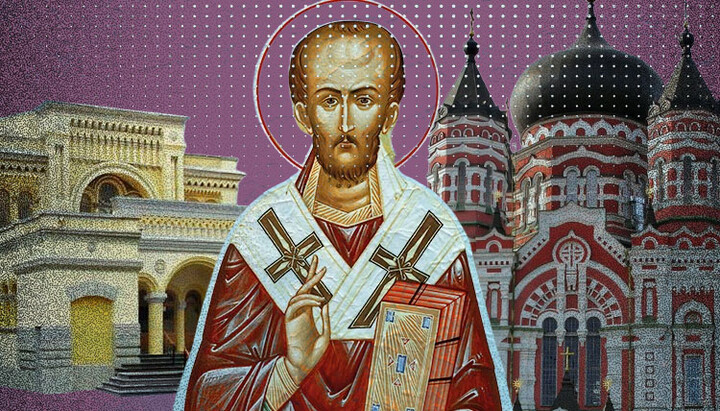
John Chrysostom forbids Christians from participating in Jewish rituals. Photo: UOJ
At the beginning of February, the head of the State Emergency Service of Ukraine, Yelensky, and the deputies of the President’s Office reported in the USA on how Ukraine is combating anti-Semitism. Many readers reacted with a slight smile, since in light of what the authorities are doing today to the communities and monasteries of the UOC, this information really seems comical. Judaism in Ukraine does not appear to be in need of protection. Actually, the opposite is true.
For several years in a row, the largest Jewish menorah in Europe has been installed on Kyiv’s Maidan. The mayor of the capital, V. Klitschko, takes part in its ceremonial lighting. President Zelensky invites rabbis to the President’s Office to light the menorah. The same is done by Prime Minister Svyrydenko in the Cabinet of Ministers. The current head of the President’s Office, K. Budanov, also regularly lights the menorah at the synagogue. Similar events are attended by the Commander of the National Guard of Ukraine, O. Pivnenko. Other Ukrainian politicians and top officials do not lag behind. At the same time, they often present themselves as Orthodox Christians. For example, according to OCU cleric Konstiantyn Kholodov, K. Budanov is such a devout parishioner of the OCU that he does not miss a single service. How does all this fit with the idea that Ukraine is an Orthodox country with a thousand-year history? Or is it no longer so?
This question is far from rhetorical. For example, Israeli Rabbi Daniel Bulochnik explains the meaning behind politicians lighting Hanukkah candles. The essence is as follows: “Where we have won, we light the candles.”
It’s possible that our political leaders don’t fully grasp the significance of what’s happening. Perhaps they see it as a harmless, purely ceremonial ritual. And, after all, the menorah is not lit only by Zelensky or Klitschko. It’s also lit by Trump, Putin, and many other leaders of different countries. If politicians do not understand the true meaning of Jewish rituals and see no particular obstacle to participating in them, that is understandable. But the problem is that the same is done by Christian clergy. For example, the ceremony of lighting the menorah near the Intercession Church of the OCU on the grounds of Kyiv’s military hospital is regularly conducted by the rector of that church, former UOC priest Oleh Sknar.
Archbishop Elpidophoros (Lambriniadis), head of the American Archdiocese of the Constantinople Patriarchate and author of the theory of the Constantinople Patriarch’s supremacy “First without equal,” even calls to “tear down the supposed walls that seem to separate us.” At the same time, Archbishop Elpidophoros claims that all religions are “myriad paths leading to the same place.”
Overall, it can be said that this kind of “fraternization” with Jews is a fairly widespread phenomenon among ecumenically minded Christians. They seem eager to win the favor of representatives of Judaism, to obtain something like approval from them, or at least recognition of the right to exist. For example, another former UOC priest, now an OCU priest, A. Dudchenko, on one podcast tried to convince his interlocutor, Torah instructor Y. Radchenko, that Christians and Jews share the same Messiah.
Notably, all these “steps toward rapprochement” are observed only on the part of Christians. We do not see any rabbi seeking prayerful communion with Christians or, for instance, attempting to participate in church rituals. Why is that?
Replacement Theology
It is commonly held that Christianity’s attitude toward Judaism is described by the so-called replacement theology. Its essence is that the Christian Church is the New Covenant Israel and that it has replaced Old Covenant Israel – that is, the Jewish people – as God’s chosen community.
This theory developed in the 2nd–3rd centuries, when Christianity finally separated from Judaism and there arose a need to define its relationship to it.
The Church of Christ has always affirmed that the Old Testament prophecies were fulfilled in Christ. The purpose of the Mosaic law was to prepare people for the coming of Christ. As the Apostle Paul explains:
"So the law was our guardian until Christ came that we might be justified by faith. Now that this faith has come, we are no longer under a guardian. So in Christ Jesus you are all children of God through faith, for all of you who were baptized into Christ have clothed yourselves with Christ. There is neither Jew nor Gentile, neither slave nor free, nor is there male and female, for you are all one in Christ Jesus. If you belong to Christ, then you are Abraham’s seed, and heirs according to the promise," (Galatians 3:24–29).
Similarly, in the Epistle to the Romans: "Christ is the culmination of the law so that there may be righteousness for everyone who believes," (Romans 10:4).
In the 2nd century, Saint Justin Martyr wrote that those who believe in Christ, that is, Christians, are the “spiritual Israel,” which “was brought to God through the crucified Christ.” One of the most influential theologians of the early Church, Origen (3rd century), asserted that the Jewish people “have the Kingdom of God taken away… and it is given to those who believe” in Christ. Saint Augustine of Hippo (4th–5th centuries), in his writings, developed the idea that the Church of Christ is the true “people of God,” in whom the promises made to Abraham are fulfilled.
In the 20th century, after World War II and the Holocaust, replacement theology was reviewed. At the Second Vatican Council (1962–1965), the Catholic Church adopted the declaration Nostra Aetate, which stated: "Although the Church is the new people of God, the Jews should not be presented as rejected or accursed by God, as if this followed from the Holy Scriptures."
However, it must not be forgotten that it is not God who rejects the Jews. Contemporary so-called post-Temple Judaism, however, rejects Jesus Christ as the incarnate God and Savior of the world. God does not reject or curse anyone. On the contrary, it is humanity that rejects God and turns away from Him.
“Beware of circumcision”
The Apostle Paul, a Jew, a Pharisee, and a disciple of the most famous rabbi of the time, Gamaliel, was quite categorical in his attitude toward the Old Testament law, or more precisely, its ritual aspect. Paul believed that the ritual law had already fulfilled its purpose, bringing believers to Christ, and no longer held any special significance. Therefore, to continue observing this law was to rely on it rather than on Christ. He wrote about this, for example, to the Philippians: "Beware of dogs, beware of evil workers, beware of the mutilation! For we are the circumcision, who worship God in the Spirit, rejoice in Christ Jesus, and have no confidence in the flesh, though I also might have confidence in the flesh. If anyone else thinks he may have confidence in the flesh, I more so: circumcised the eighth day, of the stock of Israel, of the tribe of Benjamin, a Hebrew of the Hebrews; concerning the law, a Pharisee; concerning zeal, persecuting the church; concerning the righteousness which is in the law, blameless. But what things were gain to me, these I have counted loss for Christ," (Philippians 3:2–7).
While the New Testament mentions instances of Jewish converts continuing, by tradition, to observe circumcision and other rites, for converts from the Gentiles this was considered unacceptable. In 386, Saint John Chrysostom, still a presbyter in Antioch, delivered his eight-word homily “Against the Jews”, addressing Christians who believed they could combine faith in Christ with participation in Jewish fasts, rituals, and even circumcision.
Here is what he wrote on the matter: "Another, even more grievous, disease is caused by our tongue and requires its healing – a disease that has struck the body of the Church. …> What kind of disease is this? …> Many of those who are considered ours (Christians) and claim to believe in our way, some merely go to observe these festivals, while others even participate in the festivals and fasts (Jewish). This evil custom I now wish to expel from the Church."
St. John Chrysostom asserts that this is both a sin and a harmful habit: “…Those who serve the Old Law, even in some respect… are deprived of the grace of Christ.”
John Chrysostom: I warned you
Another quote from John Chrysostom’s “Against the Jews” seems almost directly addressed to modern politicians and religious leaders who call themselves Orthodox and participate in Jewish rituals.
"Today I bear witness to you by heaven and earth: if any of you, whether present here or absent, goes to see the trumpets (Jewish), or goes to a synagogue, …> or participates in a fast (Jewish) or Sabbaths, or performs any other small or great Jewish ritual, I am clean of the blood of all of you. These words will stand before both me and you on the day of our Lord Jesus Christ. If you obey, they will bring you great boldness; but if you do not obey and cover for anyone daring to commit such acts, they will confront you as strict accusers."
The warning is quite severe. Chrysostom cautions that on Judgment Day, Christians who participated in Jewish rituals will not be able to excuse themselves by claiming ignorance that such acts were forbidden.
Moreover, the saint’s rhetoric toward Jews is so harsh that it is shocking today. He wrote that “the synagogue is not only a brothel and a theatre; it also is a den of robbers and a lodging for wild beasts.”
"If, then, the Jews fail to know the Father, if they crucified the Son, if they thrust off the help of the Spirit, who should not make bold to declare plainly that the synagogue is a dwelling of demons? God is not worshipped there. Heaven forbid! From now on it remains a place of idolatry," said St. John Chrysostom.
Apostolic Canons
There are also a number of canonical rules prohibiting participation in Jewish rituals. For example:
65th Canon of the Holy Apostles: "If any clergyman or layman shall enter into a synagogue of Jews or heretics to pray, let the former be deposed and let the latter be excommunicated."
70th Canon of the Holy Apostles: "If any bishop, presbyter, or deacon, or any one of the list of clergy, keeps fast or festival with the Jews, or receives from them any of the gifts of their feasts, as unleavened bread, any such things, let him be deposed. If he be a layman, let him be excommunicated."
Conclusion
Why, then, do Orthodox politicians and religious leaders participate in Jewish rituals?
First, it is a matter of financial – and therefore political – influence of Judaism representatives. Second, modern Christians fail to grasp one thing that the early Church understood perfectly.
Today, many are convinced that contemporary Judaism is a continuation of the ancient, true Old Testament Judaism – the main trunk of the tree. Christianity is seen as a branch that grew from this trunk, inheriting much from it and drawing sustenance from its sap. This branch is alive only insofar as it remains connected to Judaism. Hence the flirting with Judaism.
In reality, Christianity asserts the exact opposite.
Christ fulfilled the Old Testament prophecies. The prophets awaited Him – Jesus of Nazareth. “Your father Abraham rejoiced to see My day, and he saw it and was glad” (John 8:56). Those who believe in Christ are the true children of Abraham. Christianity is the main and only trunk of this tree. Those who have rejected Christ have also rejected the God of the Old Testament. “Who is a liar but he who denies that Jesus is the Christ? He is the antichrist who denies the Father and the Son. Whoever denies the Son does not have the Father either; he who acknowledges the Son has the Father also,” (1 John 2:22–23).
Accordingly, those who participate in Jewish rituals are already on the path of rejecting the Father and the Son. This is why the Church canons and the Holy Fathers strictly forbid such practices. Modern, so-called post-Temple Judaism differs significantly from Old Testament Judaism, though it retains some common features. But that is another topic.
Read also
Can UOC eparchies be dissolved before court ruling on Metropolia?
DESS is launching separate proceedings against UOC eparchies, monasteries, and institutions while the case involving the Kyiv Metropolia is still pending.
Two murders, one silence
Zelensky condemned the killing of a Catholic priest in Poland the very same day. A month earlier, a UOC monk was murdered at the Sviatohirsk Lavra – and the president has remained silent ever since.
A bow to Phanar? Why did UOC academy congratulate Constantinople’s exarch?
A delegation from the Kyiv Theological Academy congratulated the Phanar’s exarch, who has remained silent about the persecution of the UOC. Who authorized this gesture, and why did even OCU supporters fail to appreciate it?
“De-Moscowize” for unity: Shevchuk’s recipe for bringing Ukrainians together
The head of the UGCC assures that internal division threatens the country's existence, while simultaneously calling to fight against the "wrong" ones. Is this cognitive dissonance or something more?
Thank you, God, that I am not like these Ukrainian Moskals
The Holy Fathers taught Christians to see their own sins. Where the Fathers are no longer read, repentance becomes a calendar topic for sermons rather than a way of life.