Ukraine’s MinCult permits excavations at site where SS “Galicia” killed Poles
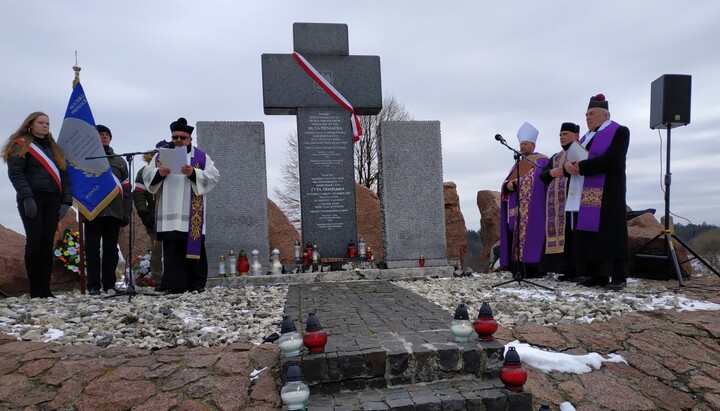
Memorial to the victims in Huta Peniatska. Photo: fttc
Ukraine’s Ministry of Culture has issued a permit for search-and-recovery work in the area of the former village of Huta Peniatska, Lviv region, where mass killings of civilians took place on February 28, 1944. The work will be carried out by a joint Ukrainian–Polish expedition.
In the ministry’s official statement, the victims of the tragedy are described in deliberately vague terms: “The work concerns the search for and localization of burial sites of villagers who died during World War II.” The statement does not say who destroyed the village.
Yet the circumstances of the tragedy are well known. On February 28, 1944, the 4th Police Regiment of the SS Volunteer Division “Galicia,” with the participation of UPA units, surrounded and burned Huta Peniatska. More than 1,000 residents – Polish villagers, women, children, as well as Jews who had taken refuge in the village – were killed. About 500 were burned alive in the church and in their homes. After the punitive operation, fewer than 50 people survived. The village was never rebuilt after the war.
The permit was issued by the Ministry of Culture on the basis of a request from the Polish side dated February 16, 2026, and rests on the agreements of the Ukrainian–Polish working group on historical memory, formalized at the meeting of Presidents Zelensky and Nawrocki in Warsaw in December 2025. If remains are discovered, exhumation and reburial are planned.
Similar permits had previously been issued for the villages of Ostrivky and Volia Ostrovetska in Volhynia, as well as for the former village of Puzhnyky in the Ternopil region. Work in the village of Uhly in the Rivne region is scheduled for spring 2026.
In closing, the Ministry of Culture “emphasizes the importance of honoring the dead with dignity and preserving their memory.”
The memorial at the site of the tragedy in Huta Peniatska, unveiled in 2005 with the participation of the presidents of Poland and Ukraine, has repeatedly been targeted by vandals. In January 2017, unknown perpetrators defaced the commemorative plaques with nationalist symbols and SS runes, after which the memorial was blown up using explosives. Ukrainian authorities and the head of the Institute of National Memory, Viatrovych, called what happened “a Russian provocation.”
Earlier, the UOJ reported that Poland is demanding systematic exhumations of victims of the Volhynia massacres.
Read also
Khust Eparchy honors memory of St. Job of Uholka
A Liturgy is served in Mala Uholka, a birthplace of St. Job of Uholka, on the saint's feast day.
UOC parish in Cologne donates ultrasound machine to Kharkiv region hospital
In Cologne, UOC believers raised funds for an ultrasound machine for the Kehychivka district hospital in the Kharkiv region.
Shevchuk tells Pope Leo of Ukraine's preparations for "another harsh winter"
The head of the UGCC expressed "special gratitude" to the Pope for his phone calls with Putin and Zelensky.
Berlin hierarch comments on Phanar document published by UOJ-USA
Metropolitan Mark called the information about the 2018 "Unification Council" alarming if confirmed, and expressed hope that Patriarch Bartholomew will reconsider his position.
UOC marks Synaxis of All Saints of Volyn Land at Lutsk cathedral
Metropolitan Serhiy of Ternopil and Kremenets led the Liturgy on the feast day of the Lutsk cathedral of All Saints of the Volyn Land.
SBU detains OCU cleric who organized draft evader's escape for money
In Transcarpathia, law enforcement officers detained a clergyman of the OCU who arranged for a draft evader to be smuggled into Slovakia for $15,000.