Anatomy of forgiveness: how to reconcile with God and stop judging yourself
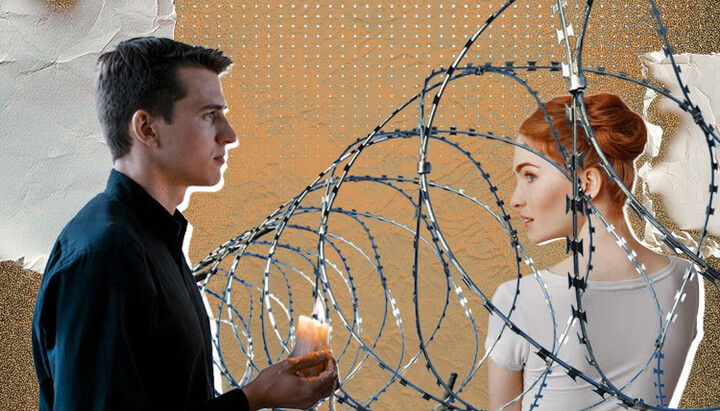
Forgiveness destroys the wall of enmity. Photo: UOJ
On Forgiveness Sunday, we will traditionally ask each other for forgiveness … usually from those we have wronged in no way. Likewise, people ask us for forgiveness even when we have nothing against them. Of course, this is a lovely and touching way to begin Great Lent, but still, let us reflect on true forgiveness. Are we truly able to forgive our enemies, God, and ourselves?
How to forgive enemies?
The word "forgiveness" in relation to enemies will be conditional. Indeed, how can one forgive someone who killed your children? How to forgive a scoundrel who builds his well-being on the blood and suffering of innocent people? How to forgive those who not only call evil good, but elevate it to the rank of holiness?
We do not know how and cannot either love or even forgive enemies, because this is not our measure.
Let us be honest: even if we try to imitate love for enemies, nothing but hypocrisy will result. Therefore, here we need to act pragmatically, guided primarily by the technique of spiritual security.
And here we must think not about enemies, but about ourselves. The fact is that hatred is a cancerous tumor of the psyche. It makes us its slaves. When we hold the image of an enemy inside our mind, it becomes part of our personality. It reflects in our consciousness and transmits its properties to us.
Forgiving an enemy is not about justification but about surgery. An enemy is a psychological implant in our consciousness that needs to be removed as soon as possible. This introject deprives us of the right to belong to ourselves.
Hatred toward an enemy is, in essence, an acknowledgment that he has enormous power over us. Forgiveness is devaluing his ability to cause us pain.
We must not give our enemies the pleasure of being executioners who come to us in the form of suffocating thoughts of revenge and malice. Forgiveness is cutting the umbilical cord of hatred that connects us to the enemy.
Bonds of hatred
We must know: hatred is the strongest form of attachment. Much stronger than love. It connects us to the enemy 24/7, generating colossal destructive energy. This energy determines the state of our souls, and the same thing happens as in passionate love – interpenetration. He who fights with dragons becomes a dragon himself – this is an eternal law. Hatred is a clone of the enemy, growing up in our heart. If the enemy has made your soul turn into a clot of unquenchable hatred, you're defeated.
Of course, this does not mean that we have no right to defense and resistance. But forgiveness in this context is freeing the heart from the "toxic rent" by our enemy. Revenge is always turned to the past, while life requires a future. We need to be realists and understand: during wars and social upheavals, gray masses become the cogs through which the global system implements its plans. They cannot think independently, and their will is completely zombified by propaganda.
These people are more like social animals, devoid of critical thinking and guided primarily by selfish benefit and emotions. They are blind and effective instruments of destruction that have received the "right to violence." First, such power intoxicates with impunity and permissiveness. And second, executioners subconsciously fear becoming victims and therefore are always ready to carry out any criminal orders. These people deserve only pity, not hatred.
To forgive (especially in wartime) means to affirm one's humanity at the moment when they are trying to dehumanize you.
This is an act of highest nobility: you acknowledge that the law of God's truth and love is higher than the law of force and power. The price for this may be physical death and even martyrdom, but the undoubted reward will be eternal life. And we live precisely in such times.
The human in the killer
In general, we need to understand that we do not forgive "crimes" – we forgive "the human in the killer." And we do this not for the sake of the criminal himself, but in order to remain human ourselves where everyone is being massively dehumanized. The Gospel does not require any sympathy from us toward killers. Christ on the Cross does not say: "They are good." He says: "They know not what they do." One who commits terrible atrocities for money or benefit is already dead. Their souls are in a state of decay that is more terrible than physical death.
To forgive these people means to say to God: "Lord, I am too weak to stop hating. I give You my anger. Judge them Yourself, because Your judgment is righteous, while mine is biased." Thus we free ourselves from the role of executioner, delivering enemies to God's judgment, while leaving ourselves freedom and light. This is the only way of spiritual survival in a world poisoned by propaganda of hatred.
How to forgive God?
There are times in life when it seems that God has flown away to another universe, and instead of Him the devil has sat on the throne. It seems He does not see or hear the terrible pictures of grief and groans of people who have no one to ask for help. This causes bewilderment. Why did God used to respond so readily even to the smallest request, but when His help became a matter of life and death, He seemed to deliberately close the shutters, turn the angelic singing up to full volume, and pretend not to hear you pounding with all your might on the door of His house?
Here we must understand an important thing. We judge God from the position of a "consumer of meanings." We want the world to be a logical and understandable puzzle, but we encounter an abyss that surpasses our understanding.
To forgive God means to acknowledge His right to be God, not a "heavenly waiter." To forgive God is to stop demanding an account from Him for every tear and to trust His silence, which is higher than our words.
This is releasing resentment toward life and exhaling: "Thy will be done," spoken not from slavish submission, but from the trust of a child lost in fog but feeling the Father's hand.
We forgive God not for His sins (there are none), but for His incomprehensibility. For the times when His “yes” often follows our “no.” This forgiveness is trust. Our categories of “justice” are like the scale of an ant trying to critique the master plan of an architect. Forgiveness is the maturation of the spirit, the acceptance of the tragedy of existence even when we do not understand its meaning. To forgive God means to consent to the mystery of suffering without demanding an explanatory note from Him. It is precisely to such forgiveness that He responds with His Silence.
How to forgive yourself?
First of all, we should understand that self-flagellation is a perverted form of pride. Thinking that our sin is "too great" for forgiveness, we place ourselves above God. Often we carefully store in the closet the "skeletons" of our past selves and periodically open it to mourn them again and again. We judge our present selves for the mistakes of our past selves, forgetting that then we did not have our present experience.
Perhaps that very experience of falling was necessary for the soul to turn away from sin once and for all—to learn firsthand the sorrow that error brings. Our falls are notes in the symphony of life just as much as our virtues. Once bitten, twice shy. But first, you must be bitten.
To forgive yourself means to acknowledge your human fragility and understand that we can do nothing without God. To see oneself “in the full glory” of one’s weaknesses and yet not turn away in disgust or despair requires great faith and willpower. If God, who sees the depths of our being, forgives us, then who are we not to forgive ourselves?
Self-forgiveness is not amnesia but the transformation of guilt into responsibility.
Not a pat on the head with the words “it’s okay,” but an honest look into the abyss of oneself. This is a replacement of useless self-flagellation with active repentance. Forgiveness Sunday is the holocaust of our ego. In it, we burn old grievances, worldly scores, our “rightness,” and judgmental thoughts. All that remains is ash and a bare soul. It is on these ashes that the seeds of God’s gracious harvest start to take root.
Read also
Brother of tax collector and brother of Lord
The Gospel is silent about the son of Alphaeus, and commentators have argued for centuries over who he was. And the Church commemorates two apostles named James in close proximity.
Prayer commemorations instead of loving embraces
At every Orthodox wedding, the choir sings a hymn to the martyrs. For families separated by war, these words carry a special meaning.
Honest atheism vs. spiritual hypocrisy
The 70th anniversary of Albert Camus’s Nobel Prize recalls an uncompromising challenge to Christianity. An honest unbeliever brings theology back to the mystery of the Cross.
The valley of trouble and the gateway of hope
One soldier buried an expensive cloak and some gold beneath his tent. Because of this, all Israel lost a battle. Why did one man’s sin bring disaster upon an entire nation?
From love spells to bishop's throne
Antioch’s most powerful sorcerer sent demons against a devout young Christian woman three times – and failed every time. In the end, a demon himself revealed the truth that led to his conversion.
The Weeping Queen of Blachernae
On the night of the Feast of the Protection, only two people witnessed the miracle in the Church of Blachernae. Everyone else prayed and saw nothing. Yet they, too, received grace.