The Bible and the Third Temple: What lies behind the U.S.–Israel war in Iran
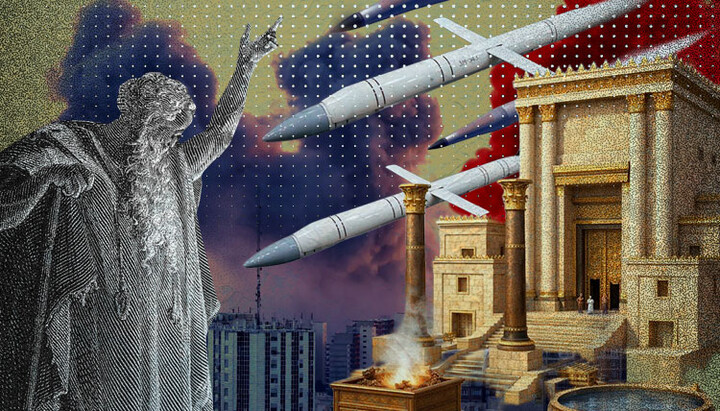
Are Israel and the United States banking on the restoration of the Third Temple? Photo: UOJ
On February 28, 2026, Israel and the United States carried out a coordinated strike on Iran. Israel dubbed the operation “Shield of Yehudah,” while the U.S. called it “Epic Fury.” Israel later changed its own codename to “Roaring Lion.” The targets included Iranian nuclear facilities, military bases, and senior command. The strike became the culmination of a long buildup of tensions that had begun well before Iran’s nuclear program.
Yet to truly understand what is unfolding in the Middle East, it is not enough to track headlines about missile strikes and diplomatic talks. Behind Washington’s geopolitical decisions stands, in fact, a religious doctrine that forms the worldview of tens of millions of American voters and directly influences White House policy. That doctrine is called dispensationalism.
In this article, we will try to unpack how a nineteenth-century theology became a political force in the twenty-first century, why many American Christians regard support for Israel as close to a “divine imperative,” what role Iran plays in biblical prophecy – and what Iranian Christians themselves think about all this as they endure severe persecution.
What dispensationalism is and where it came from
Dispensationalism is a theological system that divides the whole of biblical history into several “dispensations” (eras), in each of which God interacts with humanity in a distinct way.
The founder of this system is commonly considered to be John Nelson Darby (1800–1882), a leader of the Plymouth Brethren movement in England. Darby introduced the principle of a literal reading of biblical prophecy and divided salvation history into separate eras – “dispensations” – in each of which God, as the system presents it, acts by particular rules.
Darby’s key idea was that Israel and the Church are two entirely different “peoples of God,” with different destinies. Israel should be understood as an ethnic nation originating from Abraham, while the Church is a community of believers that emerged on the day of Pentecost. In dispensationalist thought, the Church is something like an “insertion” – a pause in God’s plan for Israel. When the Church is “raptured” (taken up into heaven – an event dispensationalists call the Rapture), the prophetic clock for Israel begins ticking again.
In the United States, Darby’s ideas were carried over by late-nineteenth-century evangelicals – James Inglis, James Hall Brookes, and Dwight Moody. A special role was played by the so-called Niagara Bible Conferences, and later by Bible institutes founded to train preachers.
The real explosion in dispensationalism’s popularity came in 1909, when pastor Cyrus Scofield published his famous Scofield Reference Bible. This was not a new Bible translation, but the standard text of the King James Bible supplied with extensive notes. Those notes functioned, in effect, as a dispensationalist interpretation of Scripture. The edition circulated widely across American Protestant seminaries, churches, and Bible schools, including the massive Southern Baptist Convention.
The book became a runaway bestseller – by various estimates, around 35 million copies were sold. It was the best-selling nonfiction book in the United States in the 1970s.
Hal Lindsey took a simple approach: he took complex dispensationalist theology and presented it in accessible, almost journalistic language, tying biblical prophecy directly to current political events.
The creation of Israel in 1948, the Six-Day War of 1967, the emergence of the USSR, the European Economic Community – all of it, Lindsey argued, was the fulfillment of prophecies in Ezekiel, Daniel, and Revelation. He predicted that “the end times” would arrive within one generation (roughly forty years) after the founding of Israel – that is, around 1988.
Lindsey’s ideas became so influential that the historian of religion Crawford Gribben noted the enormous impact his book had on Ronald Reagan’s administration. According to available accounts, Lindsey held briefings for Pentagon staff, military intelligence committees, and the State Department. It was in his 1983 speech to the National Association of Evangelicals that Reagan delivered his famous phrase about the “evil empire,” referring to the USSR.
Lindsey’s predictions did not come true, and his reputation was damaged by multiple divorces – but the ideas outlived the man. The Left Behind series by Tim LaHaye and Jerry Jenkins (1995–2007), built on the same theology, sold in the millions and was adapted for film.
Why American Christians support Israel
For American Protestants shaped by Lindsey’s teaching, the establishment of the State of Israel in 1948 is not merely a geopolitical event, but the fulfillment of biblical prophecy about “the return of the Jews to their land.” According to a 2015 LifeWay Research survey, 60 percent of American evangelicals believed Israel was created as the result of fulfilled biblical prophecy. Seventy percent believed God has a “special relationship” with the modern State of Israel, and 73 percent were convinced that events in Israel form part of the prophecies of the Book of Revelation.
According to historian George Marsden, dispensationalist theology holds that the return of Jews to Palestine in the twentieth century and the birth of the State of Israel were key prophetic markers pointing to the Second Coming of Christ. A line from Genesis 12:3 – “I will bless those who bless you, and him who dishonors you I will curse” – became the strongest “theological argument” in debates over support for Israel. For many evangelicals, the verse is read literally as meaning that America will be blessed by God so long as it supports Israel, and cursed if it turns away.
And a great many Americans truly believe this. These are precisely the voters who backed Trump. According to 2024 election exit polls, white evangelical and “born-again” Christians voted for Donald Trump by 82 percent to 17 percent over Kamala Harris. Why? Because
more than 60 percent of white evangelical Protestants agree with the statement that “God ordained Donald Trump to win the 2024 election,” and therefore Trump must carry out the mission entrusted to him.
What mission?
In 2006, pastor John Hagee founded Christians United for Israel (CUFI). Today it is the largest pro-Israel organization in the United States, with more than 10 million members – more than AIPAC, J Street, and other Jewish lobbying groups combined.
Hagee is the founder and senior pastor of Cornerstone Church in San Antonio, Texas, with more than 22,000 active members. Since 1981, his church has held annual “Night to Honor Israel” events that have raised more than $100 million over time for Jewish charities and Israel’s needs.
Hagee personally knows every Israeli prime minister since Menachem Begin. He delivered the benediction at the opening of the U.S. Embassy in Jerusalem in 2018. Why? Because his theological position is straightforward: we are living in the last days, and supporting Israel is a biblical command for every believing Christian.
Critics note that Hagee has repeatedly made strange statements, including claiming that Hitler was sent by God to force Jews to move to Israel. He has also asserted that “all Muslims have a mandate to kill Christians and Jews,” and that the Antichrist will be “half-Jewish.”
At the same time, it would be a serious mistake to present all American Christians as a monolithic bloc of dispensationalist supporters. Within evangelicalism, serious theological disputes continue, and the statistics bear this out. According to a 2023 study, support for Israel among evangelicals under 30 fell by more than 50 percent over three years. Younger evangelicals increasingly move toward theological positions that assign Israel no special eschatological role.
Professor Charles Hill of Reformed Theological Seminary, a former dispensationalist, explains his departure from the doctrine by arguing that the New Testament apostles have “a more Christ-centered rather than Israel-centered approach.”
Moreover, Reformed, Anglican, and many mainline Protestant denominations in the United States generally reject dispensationalist theology – though they may still support Israel for pragmatic reasons.
The Third Temple: a dream turned into a political program
According to dispensationalist eschatology, before Christ’s Second Coming the Third Temple must be rebuilt in Jerusalem. This teaching is grounded in several key New Testament texts, including Matthew (chapters 24–25) and 2 Thessalonians (2:1–12), which dispensationalists interpret as describing a temple yet to be built.
In the view of figures such as Hal Lindsey and Tim LaHaye, the Third Temple will be restored when the Antichrist brokers a peace agreement between Israel and its neighbors. The Antichrist will permit Jews to rebuild the temple, but after three and a half years he will desecrate it by placing his image there – the “abomination of desolation” foretold by the prophet Daniel. This triggers the Great Tribulation – a seven-year period of disasters, wars, and epidemics that ends with Christ’s Second Coming and the battle of Armageddon.
Thus, for many U.S. evangelical Christians, the construction of the Third Temple is a foretold stage of God’s plan. Any political steps that increase Israel’s control over the Temple Mount are therefore perceived as steps toward prophecy’s fulfillment.
At the same time, the Temple Mount in Jerusalem is likely the most politically and religiously sensitive patch of ground on the planet. The First and Second Jerusalem Temples once stood here, destroyed in 587 BC and AD 70, respectively. Today the site is home to the Al-Aqsa Mosque and the Dome of the Rock – Islam’s third holiest shrine.
Although Jerusalem has been under Israeli control since 1967, the Temple Mount is formally administered by the Jordanian Waqf. A waqf (Arabic: waqf) is an Islamic religious endowment – a form of inalienable property dedicated permanently to religious or charitable purposes. Property declared waqf is considered consecrated to God and cannot be sold, gifted, or inherited. It is managed by a special administration (trustees or religious bodies) responsible for preserving the property and using it strictly as intended. In practice, the waqf is a key element of the so-called Jerusalem status quo, and any change to its authority can trigger major international crises.
Jews may visit the Temple Mount, but they are prohibited from praying there. Meanwhile, the movement to build the Third Temple – long treated as marginal – has become increasingly mainstream in Israel in recent years. For example, in 2021 alone, 31 members of Israel’s parliament (the Knesset) from right-wing and religious-nationalist parties expressed support for the Temple movement.
One of the most unusual examples of cooperation between American evangelicals and Israel’s Temple movement is the story of the red heifers. According to Numbers (chapter 19), ritual purification requires a flawless red cow. The Temple Institute in Jerusalem, founded by the American rabbi Chaim Richman, has for years worked to prepare the ritual items for a future temple – including priestly garments, a half-ton pure-gold menorah, and an altar.
In the spring of 2024, it became known that red heifers had been obtained for ritual purification. The animals were raised on evangelical farms in Texas and transported to Israel with support from House Speaker Mike Johnson. For evangelicals, this is one of the key preparations for the temple’s restoration. For Palestinians, it is a direct threat to Al-Aqsa. As one Newsweek contributor noted at the time, “The true epicenter of the war in the Holy Land is not the devastated Gaza Strip, under Israeli assault since Hamas' bloody raid last October sparked the region's deadliest conflict in decades. It is a few dozen miles away in Jerusalem, at the holiest and most fiercely contested hilltop on Earth.”
At first glance, this might sound like a story about groups of people holding particular religious beliefs. How could that possibly affect policy? In the most direct and practical way.
Many of Donald Trump’s appointments to key posts in the U.S. government clearly demonstrate the influence of Christian Zionism. For example, the current U.S. Secretary of Defense, Pete Hegseth, speaking at a conference in Jerusalem in 2018, said: “There’s no reason why the miracle of the reestablishment of the Temple on the Temple Mount is not possible. I don’t know how it would happen. You don’t know how it would happen, but I know that it could happen, that's all I know.”
Just before the strike on Iran in February 2026, Republican Mike Huckabee sent Trump a public letter urging him to “listen to heaven” in making his decision. He wrote: “God saved you in Butler, Pennsylvania, to be the most consequential president in a century, and perhaps ever.”
Iran in biblical prophecy: “Persia” in Ezekiel
Chapters 38–39 of the prophet Ezekiel describe a future invasion of Israel by a vast coalition of peoples led by “Gog of the land of Magog,” who will bring with him “Rosh, Meshech, and Tubal.” Among his allies are explicitly named: “Persia, Cush, and Put” (Ezek. 38:5) – which, in contemporary reading, are Iran, Ethiopia, and Libya.
This prophecy has been debated for centuries, but beginning in the twentieth century dispensationalists started identifying “Magog” with Russia (based on perceived phonetic echoes such as “Rosh”–“Russia” and “Meshech”–“Moscow”), and “Persia” with Iran. During the Cold War, this interpretation was especially popular. After the collapse of the USSR, the focus shifted toward Islamic nations, above all Iran.
In his book, Hal Lindsey described a scenario in which an Arab–African alliance of Libya, Ethiopia, and Iran invades Israel, with Russia (Magog) backing them from the north. After a double betrayal, the Antichrist from a united Europe attacks Russia, China betrays the Antichrist – and the conflict ends in nuclear catastrophe and the Second Coming.
When Israel launched an operation against Iran in June 2025, its name – Rising Lion Operation – was immediately recognized by evangelicals as a biblical reference. All the more so because, on the eve of the strike, Prime Minister Netanyahu visited the Western Wall and placed a note between the stones with words from Numbers 23:24: “Behold, the people shall rise as a great lion, and lift up himself as a young lion: he shall not lie down until he eats of the prey, and drinks the blood of the slain.”
Around the same time, evangelical pastor Greg Laurie wrote on his blog: “This is a biblical foreshadowing... The Bible predicted the scattering of the Jewish people and their return – and that was fulfilled with the founding of Israel in 1948 and the reunification of Jerusalem in 1967. From then, the prophetic time clock began to tick.” He also pointed to Ezekiel’s prophecy in chapters 38 and 39 describing a coalition that includes Persia (Iran) rising against Israel. “While what we are seeing today is not the full fulfillment of that prophecy, it is certainly a foreshadowing,” Laurie concluded.
Another evangelical, William Koenig, declared: “It is an incredible time when you know what to look at in the Scriptures … We are living in the days Isaiah, Jeremiah, Zechariah, Daniel, and others spoke of... We know that 85% or 90% of Persians do not favor the Islamic government of [Ayatollah] Khamenei. Look at Scripture: they are a powerhouse, and then they are defeated.”
Formally, the strike on Iran was explained as necessary to stop Iran’s nuclear program. However, the facts cited above suggest that for a significant part of Trump’s electoral base this war has, above all, a sacred meaning: it is viewed as yet another step toward the fulfillment of biblical prophecy. That is precisely why, after Iran’s missile strike on Israel in April 2024, Hagee said: “Prophetically, we are on the verge of the Gog-Magog war that Ezekiel described in chapters 38 and 39,” adding that "we don’t need to de-escalate." Instead, Christians United For Israel held an “emergency fly-in” Monday to visit lawmakers in Washington, D.C., in order to “tell them to stop shuffling papers and do something to help Israel.”
The seriousness – and, in a sense, the irony – of the situation is that Iran is also the site of one of the world’s fastest-growing underground Christian movements. And it is these Christians who face harsh persecution from the Islamic regime. According to the organization Article 18, which monitors persecution of Christians in Iran, in 2024 at least 139 Christians were arrested, 80 were detained, and 77 faced formal charges. Ninety-six Christians were sentenced to a combined 263 years in prison – a sixfold increase compared with 2023, when 22 people received a combined 43.5 years.
In 2025, the situation deteriorated further. Although the number of convicted Christians fell to 73, the combined sentence length rose to 280 years, indicating a trend toward harsher punishments. At least 11 Christians received sentences of 10 years or more.
It should be noted that more than 70 percent of the charges against Christians in 2024 were brought under the amended Article 500 of Iran’s Criminal Code, adopted in 2021. This article provides heavy punishments for anyone engaged in “any deviant educational or proselytizing activity that contradicts or interferes with the sacred law of Islam.”
In Iran, conversion from Islam to Christianity is effectively treated as a crime against the state and punished accordingly. Defendants are accused of “propaganda activity that violates Islamic law” and “membership in anti-state groups.”
In addition, more than 900 people were executed in Iran in 2024, and many death sentences were issued on religiously colored charges.
Iran’s Constitution, adopted after the 1979 revolution, extensively quotes the Qur’an and instructs the armed forces “to fulfill the ideological mission of jihad in the path of Allah” – that is, to spread the sovereignty of Allah’s law throughout the world.
It is also worth noting that the Israel–Iran conflict has directly intensified pressure on Iranian Christians. According to Open Doors, immediately after a ceasefire at least 54 Christians were arrested. Iranian state television accused these 54 Christians of espionage, alleging links between evangelicals and foreign intelligence services – a narrative that turns an entire religious community into a target for security agencies.
Conclusions
What we see, then, is that behind the Middle East conflict stands a complex system of religious beliefs whose representatives are not a marginal sect, but a movement that shapes the worldview of tens of millions of American voters and a number of key figures in Trump’s administration.
Within this worldview there is a clear chain in which events must follow one another: the creation of Israel (1948), the return of Jerusalem (1967), the re-establishment of the Third Temple, the appearance of the Antichrist, the Great Tribulation, the battle of Armageddon, and the Second Coming. In this system, Iran (Persia) is not merely a geopolitical adversary, but a biblical enemy whose defeat was foretold by the prophet Ezekiel 2,600 years ago.
This logic helps explain why, for part of American society, war against Iran carries not so much a rational as a sacred character. And this is also why traditional diplomatic settlement repeatedly runs into a wall of religious worldview – a worldview in which “peace with Israel’s enemies” is tantamount to “resisting God’s plan.”
Whether this is truly the decisive factor – we will see very soon.
Read also
Lawyers in the crosshairs: How UOC is being stripped of its right to defense
Activists harass UOC lawyers outside courthouses, call them “traitors” on air, and promise them a “warm welcome” at hearings. The Church’s right to a legal defense is at stake.
How to respond to persecution: Lessons from St. Silouan the Athonite
The Church can and should be defended, but without malice. Why love for persecutors is not weakness but the only way to preserve the Spirit of Christ in the midst of the struggle.
Where the Spirit of the Lord is, there is freedom
Reflections on the controversies surrounding the creation of the OCU.
Pentarchy with Rome: A return to the roots or a new schism?
Patriarch Bartholomew wants to revive a council of five patriarchates, including Rome. What would reunion with Catholics look like, and what role would be left for the other Churches?
Concubine or daughter? On words that cannot be used about the Church
An archon of the Church of Constantinople likened the UOC to Moscow’s “concubine.” But for St. Epiphanius of Cyprus, “concubines” are heresies.
Shameful chronicle of one week: how the OCU was born
Exarchs under escort, a call from the operations room, and 36 votes for Epifaniy: what a member of the Phanar delegation revealed about the 2018 "Council".