A secret letter by Abp. Elpidophoros against UOC defenders in America
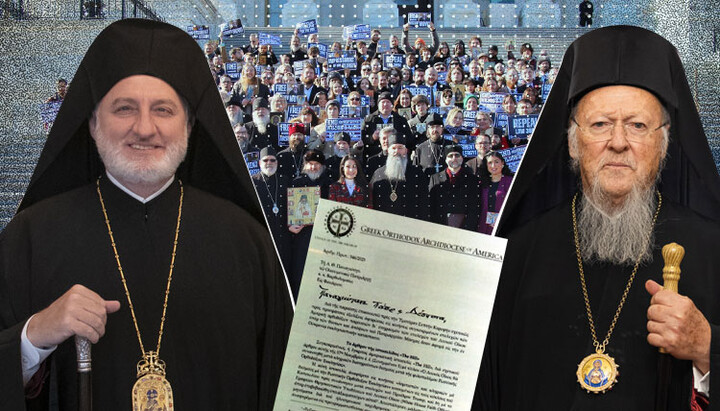
The publication of Archbishop Elpidophoros' letter to his Patriarch caused a scandal. Photo: UOJ
In early March 2026, a document that under other circumstances would never have left the confines of private church correspondence became publicly available. The multi-page letter from Archbishop Elpidophoros of America, sent to Ecumenical Patriarch Bartholomew on November 21, 2025, was anonymously handed to the UOJ in America – the very edition that is repeatedly called a “Russian propaganda resource” in the text of the letter.
The irony of this circumstance is not accidental and is itself part of the story. The letter, written to inform the Phanar about threats and successes in countering “pro-Russian lobbyists,” ended up in the hands of precisely those people against whom it was directed. And it was precisely they who published its full text in English, providing extensive commentary.
In this article, we will examine this document from several angles: as a political manifesto, as an internal church report, as a symptom of a deep crisis in the Orthodox diaspora, and as evidence of the failure of Constantinople’s information strategy on the Ukrainian church question in the United States.
Context: what developed in the fall of 2025
To understand the letter, it is necessary at least briefly to reconstruct the chronology of the events that gave rise to it. In the autumn of 2025, a large-scale campaign in defense of the UOC unfolded in Washington. Its organization was undertaken by the "Society of St. John of Shanghai and San Francisco," a structure that brings together American Orthodox Christians from different Local Churches in the United States.
In November 2025, a delegation including hierarchs, clergy, and laypeople from several Orthodox jurisdictions in the USA conducted a series of meetings on Capitol Hill with American politicians.
Simultaneously, the reputable American website The Hill published material directed against the action in defense of the UOC (accusing the defenders of ties with the ROC), and a group of congressmen led by Joe Wilson sent a request to Attorney General Pamela Jo Bondi asking to investigate whether Orthodox structures in the USA are instruments of foreign influence.
It was against this backdrop that Archbishop Elpidophoros and Protopresbyter Alexander Karloutsos undertook a trip to Washington with the aim — as explicitly stated in the letter — "to prevent the further development of events and to inform officials of the White House, the State Department, and Congress about the real facts and the situation in Ukraine." In parallel,
according to Elpidophoros, work was being conducted to disrupt meetings of the “pro-Russian group” with government officials.
However, despite the efforts of Archbishop Elpidophoros and Karloutsos, some meetings still took place. Moreover, in December of the same year, 2025, a large-scale "Day of Action" was held – a pan-Orthodox event in Washington, as a result of which Metropolitan Arseniy of Sviatohirsk was transferred from custody to house arrest.
The letter as a political report
Formally, Abp. Elpidophoros's letter is an informational report to his ecclesiastical leadership. However, upon careful reading, it reveals features of a completely different genre – a political report.
The document is written in language atypical for church correspondence. It contains such expressions as “coordinated efforts,” “information letters to Congress members,” “disruption of meetings,” “inform officials about real facts.”
This is the language not of a clergyman, but of a politician working in conditions of confrontation with an “enemy”.
The Archbishop describes Orthodox Christians from jurisdictions that are in eucharistic communion with his own Church precisely in categories of political opponents. They are called “representatives of Russian interests,” “pro-Russian circles,” and the UOJ – a “Russian propaganda resource” and “main organ of Russian propaganda”. At the same time, no evidence of connections between specific individuals or the UOJ website with Russian state structures is provided in the letter.
Admission of failure: the key phrase of the letter
Among the many remarkable passages in the letter, one stands out particularly. In the section “Comments and Observations,” Abp. Elpidophoros writes the following:
“It seems that the Ukrainian side is unable to convince international public opinion of the correctness of the measures taken by the Ukrainian Government against Onuphry personally, his hierarchs and clergy, and his entire ecclesiastical presence in the country. Exploiting this, the other side projects Ukraine internationally as a country trampling on religious freedoms and persecuting the Orthodox Church.”
This is an exceptionally important admission.
The context of the letter demonstrates that the Patriarchate of Constantinople is acting on the same team as the Ukrainian authorities persecuting the UOC. At the same time, Abp. Elpidophoros acknowledges that the arguments of this team do not work in the West. The issue of religious persecution is perceived in Western political space as a real problem.
The closure of monasteries, criminal cases against the clergy, anti-church laws – all of this automatically falls into the category of “violations of religious freedom” in the American political arena, which is extremely sensitive for American legislators, especially the Republican camp.
Moreover, between the lines literally seeps the fear that the “Ukrainian church issue” will become established in the perception of American politicians as a question of religious freedoms. And this fear, judging by subsequent events, proved to be quite justified.
Attempt to interfere in American politics
Perhaps the most scandalous aspect of the letter is the open admission that the head of the Archdiocese of the Patriarchate of Constantinople in the USA undertook targeted efforts to disrupt meetings of American Orthodox citizens with representatives of federal authorities. Quote:
“Following these very troubling reports, after consultation with the Very Rev. Grand Protopresbyter Alexander Karloutsos, we decided to travel in the coming days to Washington in order to prevent developments and inform officials of the White House, the State Department, and Congress regarding the real facts and the situation in Ukraine. At the same time, we took steps to cancel the meetings of this pro-Russian group with the aforementioned government officials.”
The Archbishop directly reports that his goal was not simply to convey “his version of events” to American officials, but to deprive the other side of the opportunity to be heard. “Prevent developments” is, of course, not informing but direct counteraction.
This fact deserves special attention.
American Orthodox citizens who came to meet with their legally elected representatives in Congress faced targeted attempts to block these meetings. Moreover, these attempts were undertaken by a hierarch subordinate to a church center in Istanbul and reporting to it.
The situation becomes particularly acute in light of the fact that it was precisely the participants in the meetings in defense of the UOC who were accused of foreign interference in American politics. Abp. Elpidophoros’s letter prompts the question: who are these accusations primarily directed at?
The scandal with the Archons' statement
One of the key episodes of the letter is a detailed account of the crisis caused by the statement of the Order of Archons of the Ecumenical Patriarchate. This episode deserves detailed consideration, as it exposes several layers of hidden conflicts existing in the American Archdiocese of the Phanar.
Abp. Elpidophoros wrote that on November 19, 2025, at the height of the Washington events, the head of the Order of the Archons of the Ecumenical Patriarchate, Anthony Limberakis, sent a draft statement directly to Abp. Elpidophoros. Before the hierarch could even read it, within two hours it had already been published by the Order’s media. It was “habitually” republished on the website of the Phanar Archdiocese in the USA.
The Archons' statement was written in harsh terms and sweepingly characterized all participants in the Washington meetings as “agents of Russia.” These words caused an immediate and harsh reaction from the participants in the action defending the UOC.
The reaction was so sharp that it threatened the very existence of the Assembly of Canonical Orthodox Bishops of America, which includes representatives of different Local Churches in the USA and is headed by Apb. Elpidophoros. The Archbishop describes what was happening as follows:
“The reaction, due to the harsh language and content of the statement, was great and distressed the brother hierarch-members of the Orthodox Episcopal Assembly, because it characterized everyone collectively as agents of Russia. And the fact that the social media of the Holy Archdiocese republished this statement was perceived by them as expressing my own views on this and adopting the harsh expressions in it.”
This is an extremely important passage. It means that the publication of the Archons' statement brought the Orthodox Episcopal Assembly to the brink of collapse. Hierarchs of the Archdiocese of Antioch, the Serbian Orthodox Church, and possibly other jurisdictions considered the possibility of a complete withdrawal from the structure, which under other circumstances serves as a forum for inter-Orthodox dialogue in America..
Such a position by the Assembly members caused panic in the Archdiocese, and Abp. Elpidophoros undertook everything possible to extinguish the flaring conflict. He personally notified bishops that the Archons' statement did not express his position; gave instructions to remove the reprint of the statement from the Archdiocese's media; published his own statement as an anti-crisis measure.
The Archbishop was forced to undertake these measures, although it is obvious that this fact did not please him.
Another point that deserves special attention. In the section “Comments and Observations,” Elpidophoros draws an important conclusion about the Order of the Archons: the situation “revealed a tendency of it to act independently without consultation with their own shepherd, the Archbishop of America.” He directly proposes that the Phanar influence the Archons for closer cooperation between the Order and the Archdiocese.
This means that parallel to the external crisis – dissatisfaction of other Orthodox jurisdictions – there is also an internal crisis. The Order of the Archons, formally subordinate to the Ecumenical Patriarchate, acts as an independent structure, not coordinating its steps with the Archbishop. And it was precisely this lack of coordination that nearly led to irreparable consequences.
The OCA case: “so-called”
Abp. Elpidophoros's rhetoric regarding the Orthodox Church in America is quite telling. In one place, the Archbishop calls it the “so-called autocephalous 'Orthodox Church in America,'” and in another – simply the “so-called OCA.” In quotation marks. It should be noted that this is an internal document in which there is no place for diplomacy. Here people write what they really think.
The Patriarchate of Constantinople should comment on these formulations, as they sound extremely offensive.
Let us recall that the OCA is a canonical jurisdiction that is in Eucharistic communion with the entire Orthodoxy, including Constantinople.
The UOJ as an “organ of Russian propaganda”
It is precisely in this context that the American UOJ website is mentioned several times in the letter. It is characterized each time in unsubstantiated terms: “the Russian propaganda outlet,” “the main organ of Russian propaganda,” a publication “exceeding the limits of objective journalistic deontology” and engaging in “propaganda and militant journalism.”
But what specifically is charged against the UOJ? From the text of the letter, it follows only that the outlet covered meetings of Orthodox delegates with representatives of the American government and published statements from participants in these meetings. In other words, it was doing journalistic work.
The irony is that it was precisely this resource that ultimately received the text of the confidential letter. Moreover, the anonymous sender of the letter to the UOJ-USA editorial office wrote the following:
“You will see that not the Archons, but Archbishop Elpidophoros is your chief and most dangerous enemy – the enemy of all American Orthodoxy. I cannot tell you all the details. He is hypocritical and cautious, but is currently doing everything for your destruction. Only public exposure can stop him.”
This comment is itself serious evidence that within either the Archdiocese or structures close to it, there exists a deep internal conflict that has already spilled outward.
“Enemies and allies”
It is also interesting that Abp. Elpidophoros in his letter indicates who exactly, in his opinion, acts in American politics in Russian interests. These are:
- jurisdictions of ROCOR, OCA, Antiochian and Serbian Patriarchates;
- the legal team led by Peter Flew, representing the interests of the UOC;
- Robert Amsterdam, “hired by Russian-Ukrainian magnate” Vadym Novynskyi;
- Catherine Whiteford, Co-Chair of the Young Republican National Federation;
- Tucker Carlson, “a popular former Fox television host”;
- Vice President J.D. Vance and the MAGA movement in general.
Thus, the document places Orthodox hierarchs, American politicians, media personalities, and the US Vice President side by side. For a church figure, this is extremely unusual. Abp. Elpidophoros looks at the situation not as a church conflict, but as a political confrontation, which cannot but cause surprise.
As an ally in the confrontation with the “pro-Russian coalition,” Abp. Elpidophoros names Pastor Mark Burns, “advisor to President Trump.” The letter provides an extensive quote from Burns's statement, in which he calls the ROC a “documented tool of the Kremlin.” This is quite remarkable in itself: the head of the Phanar Archdiocese in the USA essentially positions an evangelical pastor as an ally of Constantinople in church-political confrontation.
What the delegation was actually seeking
It is quite telling that Abp. Elpidophoros lists the demands with which Orthodox delegates appealed to American officials:
- the repeal of Law 3894, banning on the UOC;
- the release of Metropolitan Arseniy of Sviatohirsk and other imprisoned clergy and the provision of medical care to detainees in accordance with international law;
- the cessation of the conscription of clergy into the armed forces;
- Guarantees that American financial aid to Ukraine is not used to persecute Christians. The letter particularly emphasizes: the delegation did not seek cessation of military aid to Ukraine.
Is there anything “pro-Russian” in these demands? For an unbiased reader, the answer is obvious.
However, according to the Archbishop, all these demands are elements of “propaganda” and “cover for Russian interests.” He never asks whether the demands of UOC defenders are connected to the real situation. Everything is reduced to protecting the interests of the Phanar – even if these interests diverge from the evangelical principles that guided the UOC defenders.
Why the letter leak is an event of historical scale
The publication of this letter is not just a media scandal. This is an event whose consequences will long make themselves known both in the life of Orthodox America and in inter-Orthodox relations.
The letter contains a direct admission: the Archbishop undertook targeted efforts to disrupt meetings of American citizens with their legal representatives. This circumstance has potential legal consequences – especially in a context where the issue of foreign influence on politics is actively discussed in the USA.
At the same time, the letter turns out to be an unexpected ally of those against whom it is directed. Abp. Elpidophoros himself admits: the Ukrainian authorities are incapable of convincing the international community of the legitimacy of their actions against the canonical Church. He states that the theme of religious persecution in the American political space “works” against the Phanar and Kyiv, that congressmen take it seriously. Essentially, the Archbishop provides documentary confirmation of the key arguments of the very people he refers to as "pro-Russian propagandists."
Conclusions
The Ukrainian church conflict has moved far beyond the borders of Ukraine and has become a factor in American domestic politics. The attempt to portray all defenders of the UOC as "agents of Russia" has failed. Archbishop Elpidophoros’s letter is evidence of this. The information strategy of Kyiv and its allies on the Ukrainian church issue has proven ineffective in the West: arguments about "Russian influence" have not outweighed the evident facts of religious persecution.
There is a serious governance crisis within the Constantinople-affiliated structures in America. The Order of Archons acts autonomously; there is opposition within the Archdiocese itself, and the letter ended up in the hands of those against whom it was directed.
Orthodox America stands on the threshold of serious restructuring. Abp. Elpidophoros's letter is not just a report but an indicator of a systemic crisis whose resolution is still ahead.
Read also
How to respond to persecution: Lessons from St. Silouan the Athonite
The Church can and should be defended, but without malice. Why love for persecutors is not weakness but the only way to preserve the Spirit of Christ in the midst of the struggle.
Where the Spirit of the Lord is, there is freedom
Reflections on the controversies surrounding the creation of the OCU.
Pentarchy with Rome: A return to the roots or a new schism?
Patriarch Bartholomew wants to revive a council of five patriarchates, including Rome. What would reunion with Catholics look like, and what role would be left for the other Churches?
Concubine or daughter? On words that cannot be used about the Church
An archon of the Church of Constantinople likened the UOC to Moscow’s “concubine.” But for St. Epiphanius of Cyprus, “concubines” are heresies.
Shameful chronicle of one week: how the OCU was born
Exarchs under escort, a call from the operations room, and 36 votes for Epifaniy: what a member of the Phanar delegation revealed about the 2018 "Council".
Can UOC eparchies be dissolved before court ruling on Metropolia?
DESS is launching separate proceedings against UOC eparchies, monasteries, and institutions while the case involving the Kyiv Metropolia is still pending.