French TV compares Christian cross to Nazi symbolism
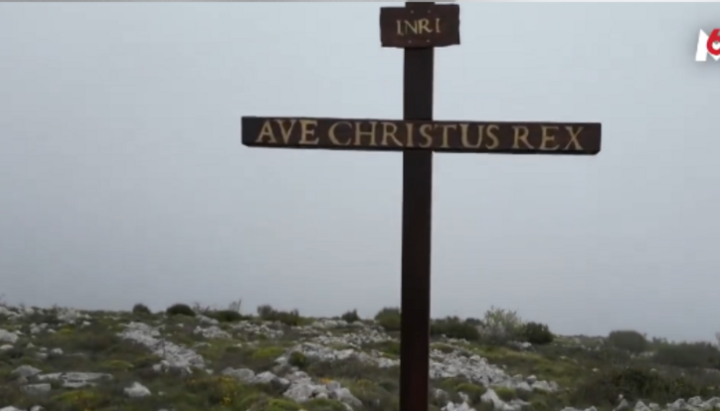
A cross bearing the inscription “Hail Christ the King” installed on a hill near Nice. Photo: Tribune Chrétienne
On April 22, 2026, French television channel M6 aired a report in which Christian crosses were likened to neo-Nazi symbolism, prompting sharp criticism, Tribune Chrétienne reports.
The report concerned crosses erected on the hill of Baou de Saint-Jeannet near Nice. They bore the inscription Ave Christus Rex (“Hail Christ the King”). Two crosses appeared there in recent weeks: the first was officially removed, while the second was later cut down. The incident sparked debate over the legality of their installation.
The hill is part of a protected natural area where unauthorized structures are prohibited. In addition, French secularism laws regulate the placement of religious symbols in public spaces, so the installation of the crosses without permission raised legal questions.
The controversy intensified after the television segment compared the crosses with neo-Nazi symbols and slogans that had previously appeared in the same area. One example cited was the slogan “Nice is Germany.” Such graffiti has been used by far-right groups as a provocative symbol associated with Nazi ideology and the events of the Second World War.
That comparison was voiced on air by a guest sociologist, who presented the crosses as part of an ideological symbol system. It was precisely this interpretation that caused the greatest outrage. Critics said such parallels were unacceptable, since the Christian cross is a religious symbol, whereas such slogans are linked to extremist ideology.
Public opinion has been divided – some view the installation of the crosses as a provocation and a violation of the law, while others condemn their destruction as an act of vandalism. At the same time, commentators stress that debate over such issues should not lead to identifying Christian symbolism with Nazism.
Earlier, the UOJ reported that vandals in France had smashed a Roman Catholic church altar with an axe.
Read also
Met. Meletiy consecrates house of worship for UOC community in Dankivtsi
Members of the persecuted UOC Intercession parish in Dankivtsi have converted a house into a place for communal prayer and worship services.
OCU eparchy sells church center site to developer for housing
The OCU’s Volyn Eparchy sold land intended for a spiritual center to a private developer planning to build townhouses and residential buildings.
SBU names UOC priest’s wife a suspect in Cherkasy region
The SBU accused Matushka Kateryna Prykotenko of “spreading enemy propaganda” through correspondence with parishioners.
UGCC cleric calls Russian Orthodox literature dangerous for clergy
While examining the causes of divisions within the UGCC, Yustyn Boiko concluded that Russian Orthodox literature had influenced Greek Catholic clergy.
UOC will play major role in achieving peace, says Vadym Novynskyi
UOC Protodeacon Vadym Novynskyi believes the Church will help bring about reconciliation within Ukrainian society after the war ends.
Catholic media outraged by forcible conscription of Uniate cleric
The Vatican’s Apostolic Nunciature has demanded the return of a forcibly mobilized Greek Catholic cleric.