PACE rejects sanctions against Patriarch Kirill and ROC hierarchy
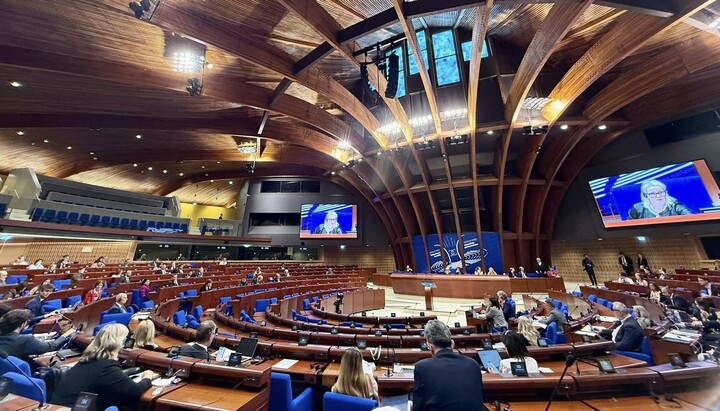
A PACE session. Photo: Facebook page of Servant of the People
On April 21, 2026, at the 13th sitting of its spring session in Strasbourg, the Parliamentary Assembly of the Council of Europe rejected an amendment by the Ukrainian delegation calling for “imposing targeted sanctions and restrictive measures against Patriarch Kirill and the hierarchy of the Russian Orthodox Church.” This follows from the official compendium of written amendments (Doc. 16373) published on PACE’s website.
Amendment No. 2 to the draft resolution “Countering discrimination based on religion and protecting freedom of religion or belief in Europe” was submitted by a group of deputies led by Oleksiy Honcharenko, a member of parliament from European Solidarity. The co-authors were members of the Ukrainian delegation Larysa Bilozir, Olena Khomenko, Yuliia Ovchynnykova, Iryna Konstankevych, Tamila Tasheva, Mariia Mezentseva-Fedorenko, and Rostyslav Tistyk.
The authors proposed adding to the operative part of the resolution a clause calling for sanctions against Patriarch Kirill and the hierarchy of the Russian Orthodox Church "who promote, justify, or provide ideological support for the Russian Federation's war of aggression against Ukraine and other hybrid operations aimed at undermining democratic stability in Europe.”
The explanatory note to the amendment was extremely brief: “Self-explanatory.”
The amendment failed in the vote: 36 deputies supported it, 51 voted against, and 9 abstained. Thus, a majority of the Assembly declined to include in the resolution a direct call for sanctions against the head of the Russian Orthodox Church and its hierarchy.
At the same time, PACE adopted Amendment No. 1 to paragraph 11, which stated in particular that “the Assembly reiterates its recognition that the Russian Orthodox Church is being used as an instrument of Russian influence and propaganda by the Kremlin regime. It stresses that the hierarchy of the Russian Orthodox Church, led by Patriarch Kirill, functions as an ideological extension of the Kremlin regime and is complicit in war crimes and crimes against humanity committed in the name of the Russian Federation and in the pursuit of the Russkiy Mir ('the Russian World') ideology."
That wording, however, was not included in the final document. Only a more general phrase remained, with the Assembly saying it is “deeply concerned that religion is increasingly being weaponised and used as a tool of propaganda and hybrid warfare.” The name of Patriarch Kirill, direct mention of the ROC, and the “Russian world” ideology are absent from the operative part of the final text.
Earlier, the UOJ reported that Hungary had succeeded in blocking EU sanctions against Patriarch Kirill.
Read also
Khust Eparchy honors memory of St. Job of Uholka
A Liturgy is served in Mala Uholka, a birthplace of St. Job of Uholka, on the saint's feast day.
UOC parish in Cologne donates ultrasound machine to Kharkiv region hospital
In Cologne, UOC believers raised funds for an ultrasound machine for the Kehychivka district hospital in the Kharkiv region.
Shevchuk tells Pope Leo of Ukraine's preparations for "another harsh winter"
The head of the UGCC expressed "special gratitude" to the Pope for his phone calls with Putin and Zelensky.
Berlin hierarch comments on Phanar document published by UOJ-USA
Metropolitan Mark called the information about the 2018 "Unification Council" alarming if confirmed, and expressed hope that Patriarch Bartholomew will reconsider his position.
UOC marks Synaxis of All Saints of Volyn Land at Lutsk cathedral
Metropolitan Serhiy of Ternopil and Kremenets led the Liturgy on the feast day of the Lutsk cathedral of All Saints of the Volyn Land.
SBU detains OCU cleric who organized draft evader's escape for money
In Transcarpathia, law enforcement officers detained a clergyman of the OCU who arranged for a draft evader to be smuggled into Slovakia for $15,000.