U.S. growing brainless and limbless embryos for organ harvesting
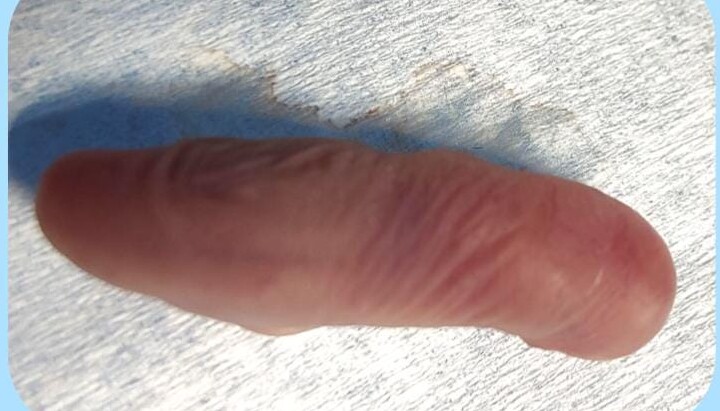
A mouse body without limbs or a head. Photo: Core Memory
Kind Biotechnology, a biotech company based in New Hampshire, has revealed details of a technology that makes it possible to grow embryos inside animals in which organs develop, but the central nervous system, brain, and limbs do not. The details were reported by journalist Ashlee Vance – author of the 2015 Elon Musk biography – in a piece for his publication Core Memory.
Kind Biotechnology founder and CEO Justin Rebo explained that the technology is based on a series of genetic edits introduced into the embryo using CRISPR. According to him, the company has already carried out such experiments “hundreds of times” on mice, and more recently on rats.
Rebo stresses that this is not about organoids grown in a Petri dish, nor about chimeras, but about a full embryo in which the development of the parts responsible for the body and brain has been switched off. The result is, in his words, “a group of organs growing in the womb.”
In the coming months, Kind Biotechnology plans to scale the technology to larger mammals – pigs and possibly sheep – with the aim of obtaining organs suitable for transplantation into humans. In the future, once the technology has been refined, the company intends to use an artificial womb for this purpose.
“We’re working on a platform to build abundant organ medicine, which we believe is a path not only to treating organ failure, but eventually to being more broadly medically useful and even impacting human lifespan,” Rebo said.
Rebo is critical of alternative approaches – growing individual organs in a lab and using genetically modified pig organs, which companies such as United Therapeutics and eGenesis are pursuing. In his view, individual organs cannot develop optimally in isolation – they must form in relation to one another.
“The heart relies on the kidney to modulate the system environment in the right way to allow it to live and grow,” he says. “And both rely on the lungs and the liver and so forth, and both need access to nutrients, which is provided by the intestines.”
As MIT Technology Review previously reported, Kind Biotechnology’s patent applications refer to the goal of creating animals with a complete lack of ability to feel, think, or perceive the environment. Images from the patents depict mice without fully developed brains, without faces, and without limbs. The term “bodyoids” entered the scientific discussion through two Stanford University professors who published an editorial in MIT Technology Review in 2025 in support of growing “spare human bodies.”
According to Justin Rebo, organs obtained in this way could eventually be used for emergency transplantation and to extend human life. Each year, Ashlee Vance notes, tens of thousands of people around the world die while waiting for a transplant.
Earlier, the UOJ reported that Elon Musk’s Neuralink had spoken about plans to merge the brain with AI.
Read also
SBU told Phanar many UOC bishops would join OCU in 2018, report says
According to a Phanar representative’s account, Ukrainian security services told the Constantinople delegation that many UOC representatives were prepared to attend the OCU’s “Unification Council.” In the end, only two did.
Catholic cardinal visits Ukrainian POWs during trip to Russia
During three days of consultations in Moscow, Cardinal Matteo Zuppi discussed prospects for ending the war in Ukraine.
Ukrainians help restore Serbian Orthodox church in Paris
Orthodox Ukrainians have become regular parishioners of St. Sava Church in Paris and have taken part in its restoration.
Bulgarian Church clergy and laity oppose Phanar head’s visit
More than 2,000 clergy and laity have called for the Ecumenical Patriarch’s visit to be canceled, citing disagreement with his actions and concerns that the visit could legitimize schism.
Unknown intruders break down doors at two UOC churches in Sloviansk
Archbishop Paisiy said OCU activists are suspected of breaking into the churches in Sloviansk, and police have launched an investigation.
Sviatohirsk Lavra prays for murdered monk on 40th day after death
The brethren of the Sviatohirsk Lavra held a memorial service for murdered Monk Varsonofiy, calling on the faithful to pray for the newly departed monk.