The immortal hospital on the Kyiv hills
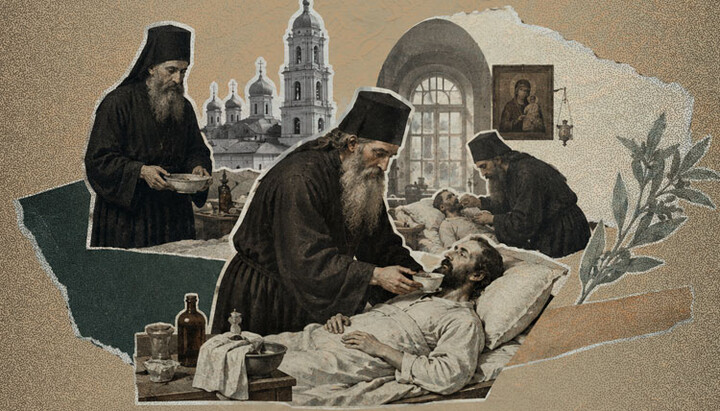
The Lavra infirmary. Photo: UOJ
At the end of the 11th century, a medical drama unfolded in Kyiv. On one side was an Armenian physician practicing in the city. He represented the advanced medicine of his day, diagnosing illnesses accurately from a patient’s appearance and predicting the exact day of death. On the other was a monk of the Lavra and disciple of St. Anthony of the Caves – St. Agapitus, who treated people free of charge.
St. Agapitus’ approach to healing differed sharply from the medical practices of his time.
He personally prepared an herbal decoction, modestly referred to as “boiled herbs,” and gave it to everyone admitted to the monastery infirmary. The simple remedy was accompanied by the monk’s prayer for the sick – a prayer he offered in secret, unwilling to draw attention to himself.
The clash between the two approaches to medicine came to a head during the severe illness of Prince Vladimir Monomakh of Chernihiv. The physician was powerless against the heir’s illness. Then a preparation of boiled herbs made by St. Agapitus was sent to the prince from the Monastery of the Caves. The prince recovered.
The Armenian physician, driven by envy, attempted to poison his rival and gave the monk a deadly potion. St. Agapitus drank the poison but remained unharmed.
After examining the gravely ill monk, the Armenian declared that he would not live another three days, boldly promising to become a monk himself if Agapitus recovered. St. Agapitus ultimately lived for another three months. Astonished, the physician acknowledged the limitations of scientific knowledge before the greatness of Divine Providence, embraced Orthodoxy, and became a monk of the Monastery of the Caves.
The first hospital in Rus’
From the first decades of its existence, the Monastery of the Caves maintained a unique combination of prayer and professional care for the sick. Historical documents mention St. Damian the Healer, who ministered to those who were suffering. The princely physician John Smera, meanwhile, studied medicine in Egypt – the first documented instance of overseas education undertaken for the needs of Rus’.
On February 17, 1107, Prince Sviatoslav of Chernihiv renounced his princely position and was tonsured at the Kyiv-Pechersk Monastery with the name Nikola Sviatosha. At his own expense, he founded a hospital for monks and pilgrims. Thus arose the St. Nicholas Hospital Monastery – the first specialized medical institution in Rus’.
It is known that a lay physician, Peter the Syrian, was invited to work at the St. Nicholas Monastery. This confirms an important point: the Lavra hospital never rejected medical science, but integrated it naturally with spiritual ministry.
At the same time, St. Pimen the Much-Ailing lived in asceticism at the monastery. Frail from birth, the monk demonstrated through his own life that God grants an equal reward both to those who endure serious illness and to those who serve them without complaint. From then on, illness was no longer regarded in theological thought as a curse, but as a form of profound spiritual struggle.
The Lavra hospital survived the catastrophic devastation of Kyiv by Batu Khan’s forces in 1240. By 1462, the St. Nicholas Church on the grounds of the Hospital Monastery once again appears in historical sources as an active center of charitable assistance. And in 1631, Metropolitan Peter (Mohyla) established a school at the Hospital Monastery where geometry and arithmetic were taught alongside theology.
Thousands of pilgrims supported by the monastery
In September 1770, a devastating plague epidemic broke out in Podil, brought from the battlefields of the Russo-Turkish War. City authorities imposed belated quarantines, while residents tried to protect themselves by drinking water mixed with vinegar. Throughout this period, the monastery hospital continued its work around the clock.
By the 18th century, the Kyiv-Pechersk Lavra’s network of guesthouses and medical facilities had reached an enormous scale. Each year, the monastery provided full support for as many as 80,000 pilgrims. Visitors not only stayed at the Lavra’s guesthouse free of charge but also received free meals every day for three, four, or even more consecutive days.
The monastery treasury covered the full cost of medical treatment and fed the poor free of charge, even under the most difficult circumstances.
In 1780, a gilded iconostasis was installed in the stone St. Nicholas Church, along with Royal Doors made of pure silver. The splendor of the church stood alongside the monks’ arduous work in the hospital wards. Even after Catherine II’s reforms stripped the Lavra of most of its landholdings, the monastery hospital continued to operate.
The liquidation decree and the immortal infirmary
The decisive blow to this centuries-old system of charitable service came from the Soviet authorities. On November 18, 1929, the Kyiv District Executive Committee, with the approval of the Politburo of the Central Committee of the Communist Party (Bolsheviks) of Ukraine, finally shut down the Monastery of the Caves. A total of 138 monks were expelled, while more than 130 members of the monastery community were subjected to repression over the course of the Soviet period. The Hospital Monastery was turned into part of a museum complex.
On November 3, 1941, during the German occupation, the ancient Dormition Cathedral was blown up, while the monastery’s architectural monuments were looted.
But even during the darkest years, the Lavra’s tradition of medicine did not disappear without a trace.
In June 1988, the year marking the 1,000th anniversary of the Baptism of Rus’, the territory of the Far Caves was returned to the Church, followed by the Near Caves in 1990. Monastic life and charitable ministry returned to the hills of Kyiv. Despite the monastery’s difficult situation today, members of the brotherhood with medical training continue to treat those in need without charge.
The history of the Kyiv-Pechersk Lavra hospital shows that true healing is impossible without a willingness on the part of those who serve the Church to devote themselves wholeheartedly to the sick. The selfless ministry of the Lavra’s healers became part of the history of the Church’s service to others and embodied the Savior’s words: “I was sick, and ye visited me” (Matt. 25:36).
Read also
Trial of a dead pope
Once in Rome, the body of a deceased pope was seated on the throne and put on trial. The accusation relied on a church canon that had once saved his see.
Monastery built in defiance of king
When Orthodox believers in Minsk were left with just one church, townspeople decided to build another – and even a royal decree did not stop them.
Young Mother and Sleeping Christ
Michelangelo carved a Virgin Mary who looks younger than her Son – and signed his name in marble for the only time in his life. Neither of these peculiarities was accidental.
Orthodox books from a Uniate printing press
In the 18th century, Uniate monks at Pochaiv printed books used in prayer by Orthodox Christians and Old Believers alike.
The story of the honey brotherhood
The Mogilev Brotherhood began with members pooling money to brew honey drinks for feast days – and eventually grew to have its own printing press.
Golgotha in the midst of a pogrom
In the autumn of 1938, the Jewish artist Marc Chagall painted the crucified Christ. Synagogues burn and refugees flee around the cross, while the Crucified One Himself is wrapped in a prayer shawl.