Trial of a dead pope
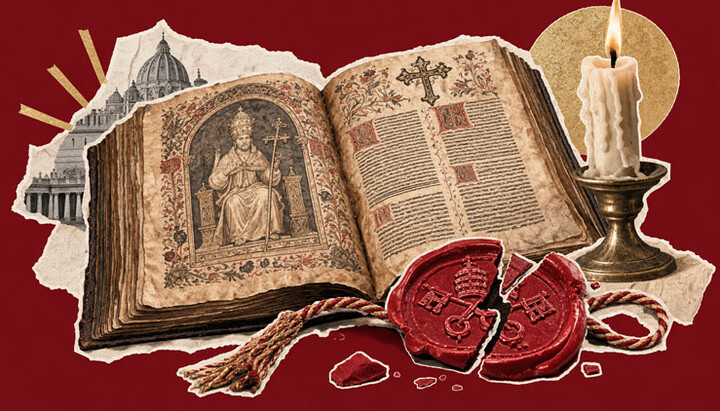
Condemnation of the pontiff. Photo: UOJ
January 897, the Lateran Basilica in Rome. The body of Pope Formosus, who died nine months earlier, is taken out of its tomb. It is vested in papal garments and seated on the throne. A deacon is placed beside it: he will answer for the defendant, who can no longer speak for himself.
Opposite sits the new pope, Stephen VI. The trial begins. The dead man is asked: "When you were Bishop of Porto, why did you, out of ambition, usurp the universal Roman See?"
There is, of course, no answer. But in order to understand where the question itself came from, we must go back thirty years, to far-off Bulgaria.
The bishop whom they would not release to the Bulgarians
In 864, Formosus became Bishop of Porto, a small town at the mouth of the Tiber, near Rome. Two years later, Pope Nicholas I sent him to Bulgaria. Prince Boris had just baptized his people and was looking for someone from whom to receive recognition: Rome or Constantinople.
Formosus distinguished himself so well that Boris asked that he be appointed Archbishop of Bulgaria. It would seem that a better candidate could not be found: the Bulgarians knew and respected him. But Pope Nicholas refused.
The reason for the refusal was canonical.
The ancient Church canons forbade a bishop to move from one see to another. A bishop was considered betrothed to his Church: if he was ordained for Porto, he was to serve only in Porto.
Formosus returned home, and around 870 Bulgaria passed under the jurisdiction of Constantinople.
The very rule that held Formosus back then would, thirty years later, turn against him.
From Porto to the throne of Peter
After that, the life of Formosus resembled a swing. In 876, Pope John VIII condemned him. Among the accusations was the claim that, out of ambition, he had sought the Bulgarian archbishopric and even the Roman throne. In 883, the next pope, Marinus I, restored to him the see of Porto.
And in the autumn of 891, Formosus himself became pope. He was already over seventy. The times were hard: Italy was being torn apart by noble houses, each of which dreamed of the imperial crown. In 892, Formosus crowned Lambert of Spoleto. And four years later, he placed the crown on Lambert's rival, Arnulf of Carinthia.
In April 896, Formosus died, having lived about eighty years. His successor, Boniface VI, remained on the throne for about two weeks. In May, Stephen VI was elected.
An interesting detail: Stephen had once been ordained Bishop of the city of Anagni by none other than Formosus. Now the pupil was preparing to judge his patron.
The sentence on a dead man
Historians still dispute who stood behind this trial. Most often, suspicion falls on the rulers of Spoleto, who had not forgiven Formosus for crowning their rival. But formally everything looked like a purely ecclesiastical proceeding.
The charge was that Formosus had violated the Church canon on the transfer of bishops to another see. He had been Bishop of Porto, and therefore had no right to become Bishop of Rome. Hence the conclusion: his election was invalid. And if so, all the ordinations he had performed during his five years as pontiff were invalid as well.
The sentence was carried out on the spot. The vestments were torn from the body. The fingers of the right hand, with which the pope had once given blessings, were cut off. The body was dragged through the basilica. The chronicle mentions that blood flowed from the mouth of the tormented pontiff.
Formosus was buried in the cemetery for foreigners. But even this proved to be not enough. Soon the body was dug up and thrown into the river.
Retribution for the judge
From here the story acquires various versions. According to one of them, a monk pulled the body out of the river. According to another, it was found by fishermen.
According to a Roman tradition, when the body was brought to the Cathedral of St. Peter, the icons of the saints supposedly "reverently greeted" it. There is no direct evidence for this, but the story itself shows how the people regarded Formosus.
Meanwhile, Rome was seething. In the summer of that same year, 897, an uprising broke out, during which Stephen VI was deposed, thrown into prison, and strangled there. The unrighteous judge, too, received a death sentence.
A parade of popes
Events then rushed forward at breakneck speed. In December 897, Pope Theodore II acquitted Formosus and reburied him in St. Peter's Basilica. Theodore himself reigned for a record-short time - about twenty days.
In 898, Pope John IX convened synods in Rome and Ravenna. They confirmed the acquittal of Formosus, ordered the records of the "cadaver synod" destroyed, and forbade the trial of the dead in the future.
But the matter was not laid to rest. A few years later, under Pope Sergius III, the condemnation of Formosus was reinstated. The priests he had ordained were regarded as laymen if they did not agree to be ordained anew.
In the less than eight years after the death of Formosus, seven popes succeeded one another on the Roman throne.
Some reigned for a few weeks, others – for a couple of years. The trial of a dead man resolved nothing, but it opened one of the darkest pages in the history of the papacy.
A rule that became vengeance
The canonical norm on the procedure for the transfer of bishops was in itself reasonable. It protected the flock from ambitious men who sought a wealthier see. It reminded that a bishop serves a particular church, and not for the sake of his own career. It was precisely this norm that had once kept Formosus in Porto, although the Bulgarians had very much wanted him.
But in 897, the same rule turned into a deadly weapon. It was invoked for the sake of revenge on a dead man who had crossed the powerful of this world.
The story of Pope Formosus shows that church rules work only as long as concern for people stands behind them. When they are used for the sake of reprisal, they wound first of all those who criminally use them. The trial of the dead pope ultimately became a disgrace not for Formosus himself, but for his judges. And Rome understood this faster than the ink could dry on the verdict of condemnation.
Read also
Monastery built in defiance of king
When Orthodox believers in Minsk were left with just one church, townspeople decided to build another – and even a royal decree did not stop them.
Young Mother and Sleeping Christ
Michelangelo carved a Virgin Mary who looks younger than her Son – and signed his name in marble for the only time in his life. Neither of these peculiarities was accidental.
Orthodox books from a Uniate printing press
In the 18th century, Uniate monks at Pochaiv printed books used in prayer by Orthodox Christians and Old Believers alike.
The story of the honey brotherhood
The Mogilev Brotherhood began with members pooling money to brew honey drinks for feast days – and eventually grew to have its own printing press.
Golgotha in the midst of a pogrom
In the autumn of 1938, the Jewish artist Marc Chagall painted the crucified Christ. Synagogues burn and refugees flee around the cross, while the Crucified One Himself is wrapped in a prayer shawl.
Stories of the Early Church. Level of governance: patriarch
How did several episcopal sees rise above the rest, why did the Church’s administrative map come to mirror that of the empire, and is the patriarchate a sacred form of Church governance?