
Orthodox books from a Uniate printing press
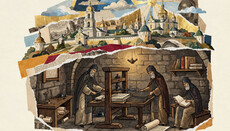
In the 18th century, Uniate monks at Pochaiv printed books used in prayer by Orthodox Christians and Old Believers alike.
In 1790, a new edition of The Mirror of Theology was published in Pochaiv. On the title page, the printing house proudly announced that the book had first been printed at the Pochaiv Monastery in 1618 and was now being reissued at the request of numerous readers.
The Pochaiv printers clearly wanted to establish that their enterprise had a long and distinguished history. But a closer look at 1618 reveals a much more complicated story.
A wandering printing press
In 1618, there was no permanent printing house in Pochaiv. A traveling printer, Hieromonk Kyrylo Tranquillion-Stavrovetsky, had temporarily settled there with his portable press. He made no secret of his activities. The publication details of The Mirror of Theology state that the work was printed "at the Pochaiv Monastery, on the estate of His Grace Lord Andriy Firley, on March 12, 1618."
The irony was that Firley was a Calvinist, and the abbot of Pochaiv was then embroiled in a legal dispute with him over monastery lands. Tranquillion sided with the nobleman.
The printer did not remain at the monastery for long. By November 1619, his press was operating in Rokhmaniv. He described his temporary home as "the humble shelter of my wanderings." His books met with a troubled fate: around 1625, they were condemned by a council in Kyiv, and in 1627, his works were burned in Moscow. A year earlier, Tranquillion himself had joined the Uniate Church.
Thus, the "first Pochaiv edition" was merely an episode in the life of an itinerant scholar and printer.
Monks at the typesetting cases
A permanent printing house did not appear in Pochaiv until more than a century later. By then, the monastery belonged to the Greek Catholic Basilian Order. Sources give different dates for the monastery's transition to the Uniate Church – 1712, 1713, or 1720. Orthodox Christians maintain that the monastery was taken from them, while Greek Catholics argue that the brethren themselves decided to change ecclesiastical jurisdiction.
Around 1730, Greek Catholic Bishop Theodosiy Rudnytsky-Liubenetsky of Lutsk and the local abbot set about establishing a printing operation. In 1731, the monks signed two contracts with craftsmen from Sokal to produce type.
The first products were not even books but individual sheets: tables for the Proskomedia, pastoral letters, and engravings of the Pochaiv Icon of the Mother of God. The first substantial publication was a Sluzhebnik (Liturgikon), issued in 1734–1735. Its title page featured the Pochaiv Icon, and more than a thousand copies were printed.
The monks themselves worked in the printing house. Up to seven monks served there in obedience, all very young, around twenty years old.
They remained within the monastic enclosure, under the supervision of a hieromonk known as the "prefect." The texts were edited and proofread by brethren who had studied philosophy and theology, some of them even in Rome.
The enterprise proved not only pious but profitable. At various times, the printing house generated as much as 40% of the monastery's income.
An order from the old believers
Perhaps the most unexpected chapter in Pochaiv's printing history concerns the Old Believers. In February 1781, the printing house's prefect, Spiridon Kobersky, received permission from Bishop Cyprian (Stetsky) of Lutsk to print books for Old Believers.
Beginning in November 1782, the work proceeded under the supervision of Theophylact Terentyev from Klintsy. Pochaiv engravers carved five woodblocks for the Pandects and four for the Taktikon. Between 1782 and 1795, at least thirty Old Believer editions were produced there.
Uniate monks printing books for Old Believers with the permission of a Uniate bishop. It sounds like a joke, but that is exactly what happened. For the printing house, fulfilling the order was what mattered most.
The Pochaiv imprint, however, became so highly regarded that others began counterfeiting it. Some books bearing "Pochaiv" on their title pages were actually produced by other printing houses.
Chants for everyone
In 1790, the printing house published the Bohohlasnyk, a collection of 247 religious songs. These were sung not during church services but at home, on the road, and during pilgrimages. The book became popular among Uniates and Orthodox Christians alike and continued to be reprinted into the 20th century.
One of its songs, "When the Soul Departs from the Body," was an adaptation of a Polish lament. Different traditions thus came together in a single collection, and no one seemed troubled by it.
The Pochaiv printing house also ventured where others would not. By the late 18th century, it was the only printing house publishing books in the Ukrainian vernacular.
Two hundred printing blocks and one icon
Pochaiv books were recognizable by their distinctive design. The printing house possessed more than two hundred printing blocks for decorative headpieces and around 150 blocks for ornamental tailpieces. The Crucifixion appeared on more than ten blocks, while the Pochaiv Icon was depicted on six.
Engraver Yosyp Hochemsky produced approximately 130 engravings, including The Siege of Pochaiv in 1675. Not everything, however, was original. For the title page of the 1798 Bible, engraver Fedir Strelbytsky copied a design from a Kyiv edition published in 1758.
How many books came off the Pochaiv presses? Estimates vary. Some researchers count approximately 300 Cyrillic and 260 Latin-script editions over the printing house's entire history, while others identify more than 355 books published between 1731 and 1800 alone.
A printing house that outlived its owners
In 1831, the monastery was transferred to the Orthodox Church, and in 1833, it was granted the status of a Lavra. The Basilians demanded 12,000 rubles in compensation for the printing house and its books. The press continued operating for almost another century before closing in the early 20th century.
The Uniate monks of 18th-century Pochaiv could hardly have imagined that their books would outlast their order's presence at the monastery. They set Church Slavonic liturgical texts in type, carved printing blocks depicting the Crucifixion and the Pochaiv Icon, and printed hymns for pilgrims. Their liturgical books and the Bohohlasnyk were read and sung by people of different confessions.
Once a book leaves the printing press, it takes on a life of its own. The Pochaiv press did not choose whose hands its books would eventually reach. And so, to this day, those volumes preserve the memory of the twists and turns in the centuries-old history of this holy place.