Cosmic dream and geometric testament of Spanish genius
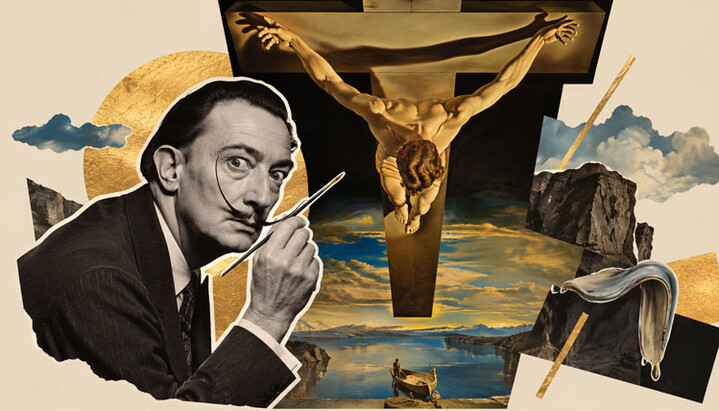
Salvador Dalí and his masterpiece. Photo: UJO
The museum of the Monastery of the Incarnation in Ávila, Spain, holds a simple reliquary of gilded wood. Inside rests a translucent sheet of laid paper the size of a human palm. A few centimeters of delicate ink drawing reveal the bowed figure of the Crucified One. We look at this image from a rare angle – from above and slightly to the right, as if through the eyes of the One who looks down upon the Earth from the heights of heaven.
This drawing was made between 1574 and 1577 by Saint John of the Cross, who was then serving as confessor of the Carmelite convent. Monastery tradition holds that the Ávila elder took up the pen after deep prayerful contemplation. He left not a single line of explanation for his work.
Art historians still debate whether St. John recorded a mystical revelation or sketched a small tabletop crucifix from an unusual angle. But the drawing has survived.
The ink strokes convey the heavy sagging of the flesh, the hands straining at the nails, and the bent knees. The head of the One hanging upon the tree is bowed so low that the Face can scarcely be made out.
The Geometry of a Cosmic Dream
Centuries passed before this tiny drawing became a two-meter oil painting. In the mid-twentieth century, the Spanish Carmelite Father Bruno de Jésus-Marie showed a photographic reproduction of the Ávila drawing to Salvador Dalí.
The artist was then going through a period he himself called "nuclear mysticism" – an attempt to unite scientific discoveries with the metaphysical mystery of faith. Dalí described his unusual inner experience as follows:
«In 1950 I had a "cosmic dream": I saw in color an image that in the dream signified THE NUCLEUS OF THE ATOM. Later this nucleus acquired a metaphysical meaning, and I considered it "the very unity of the Universe" – CHRIST!»
Studying the reproduction shown by Father Bruno, the painter perceived in it a strict mathematical design. He later wrote on a preparatory sketch:
«When, thanks to the guidance of Father Bruno (a Carmelite), I saw CHRIST drawn by Saint John of the Cross, I geometrically solved the triangle and the circle that "aesthetically" sum up all my previous experience».
The triangle traced a line from the top of the cross to the torn hands, and the circle encompassed the lowered shoulders of the Savior, becoming a symbol of the universal covering.
A Beautiful Face Without Blood or Thorns
In 1951 Dalí completed the canvas, measuring 204 by 115 centimeters. Anyone standing before this painting immediately notices the difference between the stark Ávila sketch and the solemn austerity of the oil painting.
The canvas shows no nails, no wounded side, no crown of thorns. In his early conceptions the painter planned to depict drops of blood as white jasmine flowers and scarlet carnations, but then abandoned all traces of earthly suffering entirely. He sought to convey victory over death through transfigured beauty. In a letter to a Scottish art historian, the master confessed:
«My main concern was that my Christ should be beautiful, as beautiful as the God He is».
To render more precisely the plasticity of a body suspended in the air, the painter took an unusual step. In a Beverly Hills studio, the stuntman Russell Saunders, a double from Hollywood films, was hung from straps right under the ceiling. The professional athlete hung beneath the rafters for 35 dollars a day, helping the artist capture the natural tension of the muscles. The contours of the figure were transferred onto the canvas through a stencil grid with charcoal.
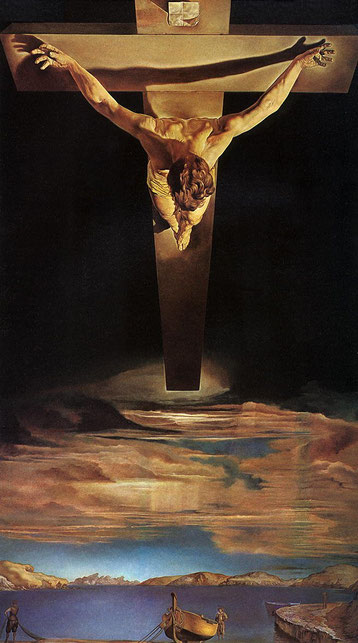
If you look closely at the lower part of the figure, an important detail becomes noticeable. The feet of the One crucified on the tree are painted slightly smaller than natural proportions. Dalí deliberately distorted the perspective so that the upward sweep would create a sense of infinity rising into the heights.
Below the tree of the Cross stretches the quiet Catalan bay of Port Lligat, where the master's home stood. Below, by the golden water, one can see the figures of fishermen, copied from the paintings of the Le Nain brothers, and a boat painted in the transparent manner of Velázquez. The head of the Saviour is inclined precisely toward the shore where the painter spent his days.
A Blow with Sandstone in Glasgow
The painting's museum fate proved dramatic. In 1952, Tom Honeyman, the director of the Glasgow museums, acquired the painting from the author together with the copyright. Scottish newspapers argued for a long time over whether such a purchase was advisable, but decades later this very canvas was named the favorite work of art among the country's residents.
However, in the spring of 1961 trouble struck in the exhibition hall. A 22-year-old visitor climbed over the wooden barrier and hurled a heavy piece of sandstone at the canvas. The stone pierced the canvas, after which the attacker tore the paint with his hands, leaving a ragged hole almost two and a half meters long.
Restorers carried out extremely complex work. They managed to restore the damaged layer so carefully that the traces of the tear are visible only in side light. After that, the painting was covered with acrylic glass.
A Meeting After Four Centuries
History made a remarkable full circle in the summer of 2024. In the Roman church of San Marcello al Corso, as part of preparations for the Vatican's Jubilee Year, both relics were exhibited together for the first time in history. A tiny paper slip from Ávila and a two-meter canvas from Scotland found themselves side by side.
Pilgrims lined up in long queues to see this silent dialogue.
At one pole is the solitary prayerful contemplation of a monk in his cell, sketched with a pen on a meager scrap of paper. At the other is the painter's attempt to comprehend the sacrifice of the Cross through the laws of absolute harmony and cosmic peace.
Since 2026, the Kelvingrove Museum in Glasgow has set aside a renewed space for the painting. There, four minutes of documentary footage alternate with four minutes of complete silence. Everyone who enters this hall is left alone with the Cross suspended in an unearthly blue, uniting a monk's revelation and an artist's quest.
Read also
Why were holy monasteries turned into state prisons?
The history of Christian Europe preserves the memory of times when monasteries served as places of exile imposed by the state. Within their walls, the fates of monarchs and righteous men were decided.
A shepherd boy with a letter from Christ to French king
In the summer of 1212, thousands of pilgrims carrying staffs waited for the sea to part before them. Later chroniclers added ships, slave traders, and a pope's lament to their story.
Facade of bones and facade of light
Antoni Gaudí spent forty-three years building a church in Barcelona, knowing that this construction was for the ages.
Trial of a dead pope
Once in Rome, the body of a deceased pope was seated on the throne and put on trial. The accusation relied on a church canon that had once saved his see.
Monastery built in defiance of king
When Orthodox believers in Minsk were left with just one church, townspeople decided to build another – and even a royal decree did not stop them.
Young Mother and Sleeping Christ
Michelangelo carved a Virgin Mary who looks younger than her Son – and signed his name in marble for the only time in his life. Neither of these peculiarities was accidental.