Forgotten paragraph of Washington treaty
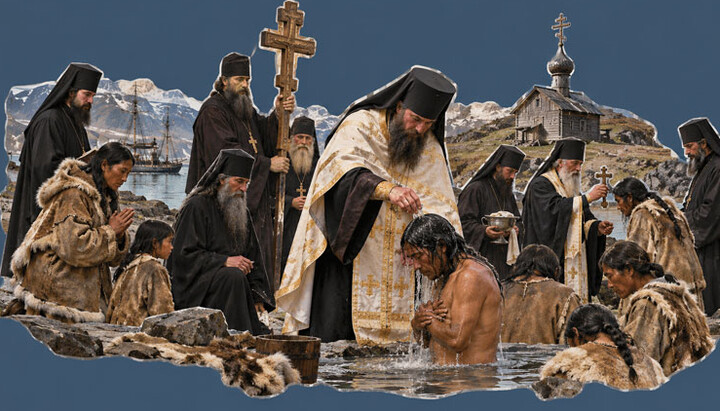
Крещение алеутов. Фото: СПЖ
In March 1867, Washington was in the grip of political fever. Officials of two empires were finalizing the deal for the sale of Alaska for seven and a half million dollars in gold. The pages of the treaty were filled with legal formulations, but the second article of the document contained a curious clause. Russian diplomats demanded that the churches in the ceded territory remain the property of members of the "Greek Oriental Church" – the Eastern Orthodox Church.
Why would an empire selling vast territories be concerned about wooden houses of prayer among harsh hills? Behind this line lay 70 years of dramatic struggle. On those distant islands, Orthodoxy had taken root in defiance of the will of colonial officials.
Nine Months of a Perilous Journey
The whole story began in September 1794. A ship moored at Pavlovskaya Harbor on Kodiak Island. From the ship's hold, eight monks led by Archimandrite Joasaph (Bolotov) stepped onto the barren northern shore.
It was the longest missionary journey in the history of the Church. The travelers had set out from St. Petersburg at the end of December. Nine months of harsh crossings through boundless Siberia and dangerous voyages across cold seas brought the monks to a distant edge of the earth. From a quiet monastery, the monks found themselves in a harsh reality, where the ruler of the Russian-American Company, Alexander Baranov, had established a ruthless regime for the natives.
The conflict between the ruler and the monks flared up instantly. Archimandrite Joasaph recorded in a letter a direct threat from the head of the company, who openly threatened to send the clergymen to the next world.
In 1799, Father Joasaph was consecrated in Irkutsk as Bishop of Kodiak. But he was not able to take up his see. On the return journey, the frigate "Phoenix" was caught in an ocean storm. The ship sank off the coast of Unalaska, taking to the bottom the newly consecrated bishop, Hieromonk Macarius, Hierodeacon Stephen, and seventy passengers. The core of the mission was destroyed.
A Monk Against an All-Powerful Company
Of the entire team of the first missionaries, a humble monk remained on the cold island. This was St. Herman of Alaska, who withdrew into solitude on Spruce Island, which he called New Valaam.
The monastic labor of the Alaskan elder had nothing in common with colonial conquest. In a letter to the colony's ruler Semyon Yanovsky, St. Herman calls himself "the lowliest servant and nursemaid of the peoples here."
When a deadly epidemic broke out on Kodiak in 1819, the righteous man did not leave the side of the dying islanders for a month. He opened a school for orphaned children, taught the local people farming, and fearlessly defended them from the arbitrary rule of the fur traders. The native peoples saw in the Russian monk the image of a father of their own.
A Carpenter with a Steel Pen
*Note: in the source text the colony's ruler is named "Сергей Яновский"; I rendered it as "Semyon Yanovsky" per the historical record (Semyon Ivanovich Yanovsky), but if you need strict fidelity to the source, it should read "Sergey Yanovsky."*
On July 29, 1824, a young priest, Ioann Veniaminov—the future Saint Innocent—arrived on the island of Unalaska. Together with his wife and child, he came ashore, where only dugouts and log huts awaited him.
The young pastor did not deliver lofty sermons. He took up an axe and a saw. Together with the Aleuts, the future enlightener of Alaska built the Church of the Ascension of the Lord, made the altar table with his own hands, and carved the iconostasis.
But the bishop's main work was enlightenment. Saint Innocent learned the local language, created an Aleut alphabet based on Cyrillic, compiled a grammar, and translated the Gospel of Matthew. Thanks to this, the language tradition of the native people received a written foundation.
In his guide for preachers, Saint Innocent set down the rule of acting "without compulsion, without threats, gifts, or promises." When smallpox broke out among the Tlingit Indians in 1836, the priest personally undertook vaccination. Medical aid saved hundreds of lives and opened the hearts of the Indians to receiving the truth of the Gospel.
The American Advance and Intercessors
After the 1867 transaction, Alaska changed. American missionaries and officials flooded onto the islands. The Protestant preacher Sheldon Jackson openly declared in the newspaper New York Evangelist that Orthodox priests were the chief enemies of public schools, promising to destroy Orthodoxy in Alaska completely within a quarter of a century. The new schools categorically forbade the native peoples to speak their native languages.
But the officials' plan failed. The Orthodox faith endured because it had become native. When there were not enough priests, the islanders themselves conducted services in remote villages. An ordinary reader and church elder, whom they called in their local manner "StaaRistaq," gathered the villagers, read the Book of Hours, and taught children Church Slavonic literacy.
The Ukrainian Trace in New York
At the beginning of the twentieth century, the Alaskan experience resonated across the entire American continent. From Volyn, the priest Alexander Hotovitsky—the future hieromartyr—arrived in the United States. A native of Kremenets, he built the Cathedral of Saint Nicholas in New York and united thousands of emigrants.
At the same time, Father Alexis Toth, a native of the Prešov Region—now also a saint—returned tens of thousands of Uniate Carpatho-Russians to the bosom of the Orthodox Church. The faith, brought to the distant north by humble Valaam monks, united the Aleuts into a great spiritual family.
Victory over Temporary Rulers
On August 9, 1970, a solemn event took place in the Resurrection Cathedral in Kodiak. Saint Herman of Alaska was officially glorified among the saints. Near this place stood the dark forests of Spruce Island, where a solitary monk had once cared for orphans.
The fur traders have vanished into oblivion, official decrees have rotted away in archives, and the sale of territories has become a dry story from a textbook. But on the islands of the Pacific Ocean, prayers in the Unangan language, recorded in Cyrillic letters two centuries ago, can still be heard.
Read also
A cosmic dream and the geometric vision of a Spanish genius
A tiny sketch by a 16th-century Spanish monk inspired a monumental painting in which cosmic silence meets the mystery of true holiness.
Why were holy monasteries turned into state prisons?
The history of Christian Europe preserves the memory of times when monasteries served as places of exile imposed by the state. Within their walls, the fates of monarchs and righteous men were decided.
A shepherd boy with a letter from Christ to French king
In the summer of 1212, thousands of pilgrims carrying staffs waited for the sea to part before them. Later chroniclers added ships, slave traders, and a pope's lament to their story.
Facade of bones and facade of light
Antoni Gaudí spent forty-three years building a church in Barcelona, knowing that this construction was for the ages.
Trial of a dead pope
Once in Rome, the body of a deceased pope was seated on the throne and put on trial. The accusation relied on a church canon that had once saved his see.
Monastery built in defiance of king
When Orthodox believers in Minsk were left with just one church, townspeople decided to build another – and even a royal decree did not stop them.