
Why conscience сannot be healed by therapy

We have learned to understand the causes of our wounds – and yet, at three in the morning, the old guilt returns. A reflection on where psychology ends and repentance begins.
Three a.m. The room is dark; only a faint tremor of light from a streetlamp flickers on the wall. You lie awake, staring at the ceiling. The house is silent, but inside, your thoughts churn. A moment from five years ago surfaces. The face of someone you hurt. Words that cannot be taken back. The sting of cowardice refuses to let you rest.
During the day, it was different. You had just left the office of a good psychotherapist – intelligent, attentive, professional. You talked it through, broke it down into atoms. You were told that you were exhausted at the time, that childhood defense patterns had been triggered, that your reaction was shaped by circumstances. You were given a clear, logical alibi. The therapist helped you accept yourself, to acknowledge your right to make mistakes. You went home feeling that the heavy burden had finally been lifted.
But at night, the alibi no longer works. In the silence, the arguments of reason fall apart. You understand the causes of your action, yet that knowledge does not remove the weight in your soul. You see the mechanisms of your psyche, but your conscience demands something more than explanation. It does not want analysis. It wants cleansing.
The boundary between the therapist’s office and the analoy
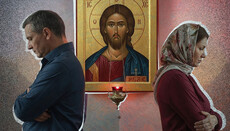
Psychology and the sacrament of confession operate on different planes, and to confuse them is to deprive yourself of help on both levels. Psychotherapy deals with the mechanics of our inner life. It repairs what has been damaged – self-esteem, boundaries, ways of relating to the world. It is an honest, difficult, necessary labor. Without it, a person may not even make it to the church, because their will is paralyzed by neuroses or childhood fears.
But a therapist has no authority to forgive. He can validate your pain, empathize, help you integrate a difficult experience into your biography. But he cannot say: “This sin no longer exists; your soul is clean again.” That lies beyond the competence of science.
Understanding the causes of an action brings temporary relief, but it does not erase the fact of the evil committed.
That residue remains – the one that wakes us in the night.
Few images express this better than the very structure of confession in the Church. Everything there is arranged to lead a person out of the closed circle of self-analysis into the realm of real action.
The spiritual father: a witness, not an expert
In a psychologist’s office, you sit facing one another. It is a horizontal plane. The focus is on your feelings, your personality, the search for a comfortable equilibrium. In church, everything is different. The priest at confession does not stand opposite you. He stands beside the analoy, on which lie the Cross and the Gospel. You both look in the same direction – toward God.
The priest immediately relinquishes the role of an expert on your life. Before confession, he reads a prayer that precisely defines his place: “Behold, my child, Christ stands here invisibly, receiving your confession… I am but a witness, to bear witness before Him to all that you say to me.”
He is only a witness. He does not pass judgment, does not pronounce sentences, does not search with you for “hidden motives” in your behavior. His task is to confirm your conversation with the One who alone has the power to forgive.
This is the vertical that breaks through the ceiling of the self. Here, you do not “accept yourself” – you stand before the Living God, who knows you more deeply than any diagnostic test.
Metanoia: stepping out into the light
The Greek word *metanoia*, which we translate as “repentance,” has nothing to do with mere regret. It literally means a “change of mind” – a radical turning of one’s life.
Psychology often teaches us to adapt to life in a dark room: to learn not to stumble over the furniture, to soften the sharp edges, to grow accustomed to the half-light. Repentance offers something else entirely: to open the door and step outside.
This requires great courage – to stop explaining oneself by causes and circumstances. As long as we justify our sin by a difficult childhood or fatigue, we remain captive to those circumstances. We accept ourselves as victims of our biography. Repentance restores agency. To say “I have sinned” is to acknowledge that I was free to act otherwise. And this recognition of responsibility becomes the first step toward real freedom.
A place of healing, not judgment
There is a persistent myth that the Church exists to frighten people and reduce them to nothing. But the patristic tradition tells a different story. St. John Chrysostom wrote as early as the fourth century: “I beseech you, brethren… do not cease to come to the Church; for here is a hospital, not a courtroom; here one is not tortured for sins, but receives forgiveness.”
The Church sees sin not as a crime to be punished, but as a wound to be healed.
God does not avenge Himself on man for his mistakes. Sin itself is already the wound. When we lie, betray, or hate, we first of all injure our own soul. Confession is not an interrogation but a surgical act. God removes from the soul the shard that causes pain.
The climax of the sacrament comes when the priest covers your head with the epitrachelion and reads the prayer of absolution. Physically, it is a gesture of shelter. You are hidden – from accusation, from your own shame, from the nocturnal ghosts of the past. In that moment, something occurs that human logic cannot explain: the erasure of sin.
When reflection is powerless
The result of good therapy is equilibrium. You understand your past; it no longer terrifies you; you learn to live with it. This is a meaningful outcome, one that makes life bearable and coherent.
The result of true repentance is cleansing. God does not say, “I understand why you did this.” He says, “Your sins are forgiven; go, and sin no more.” The past is not merely analyzed – it loses its power over you. It is washed away.
For the modern person, accustomed to controlling everything with the mind, confession is a leap into trust.
Here one must admit that our intellect and our capacity for reflection are not enough to heal the conscience. Repentance demands vulnerability. And yet it is precisely in this vulnerability that a paradoxical strength is found – the strength to stand up and go on.
At the same time, repentance does not replace the work of self-transformation. You still have to deal with your habits, learn patience, and labor over your relationships. But now you do so not under the weight of guilt, but from a place of freedom. And that freedom is not the result of analysis, but a gift granted to the one who finds the courage simply to come to the analoy and call things by their true names.
From that moment, night ceases to be a courtroom. Silence no longer presses in. For the conscience that has once been washed by God knows: the dark past is no more. There is only today – and the boundless mercy of the One who always awaits our return home.