
Faith is not a checker piece in a spectator sport

Arguments about faith on social media increasingly resemble no-holds-barred fights. We turn to a saint who, sixteen centuries ago, knew how to speak to those interested only in turning theology into a combat arena.
Within an hour, a news story about yet another UOC church being seized draws several hundred comments of every kind. Under other posts, someone from another faith demands that you “prove” the Trinity in three sentences. Someone openly mocks priests. Someone else quotes the Holy Fathers with a barrage of exclamation marks, sometimes without ever consulting the original source.
At a family gathering, an uncle who has not set foot in church since the day of his Baptism suddenly decides, somewhere between the salad and another shot of vodka, to start a conversation about “all that stuff you people have made up in the Church.” Meanwhile, bloggers rack up views with videos carrying sensational titles such as “Priest Couldn’t Answer.”

We find ourselves facing an unpleasant choice. We can jump into the argument and discover an hour later that we are angry, trading barbs and no longer even remember why we started the conversation. Or we can remain silent and spend the rest of the evening reproaching ourselves for cowardice. Both options feel like defeat.
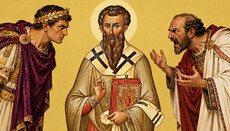
To find the “golden mean” in theological debate, let us travel in our minds to Constantinople in the year 380. In the capital, where nearly all the churches are already in Arian hands, a small Orthodox community gathers around its pastor – St. Gregory, whom the Church will later call the Theologian.
By lamplight in the evening, he prepares an oration against the Eunomians – people who have turned discourse about God into a public contest. We come to him with questions familiar to anyone who has ever opened the comments beneath a church-related post.
Bloggers as spectator fighters
“Vladyka, why does every conversation about faith nowadays end in conflict? It feels as though people come not to hear the other person but to win a verbal fight.”
St. Gregory sets aside his manuscript, smiles bitterly and replies as though he himself had just been scrolling through a news feed:
“For there are, indeed there are, people whose ears and tongues itch when we speak – and, as I see, even their hands. They resemble performers in the arena, displaying not the kind of contest that leads to victory according to the rules of combat, but one designed to catch the eye of those who know nothing of the matter and win their applause.”
He pauses, then adds ironically:
“And they love to play with words as with checkers.”
It would be hard to put it more precisely. The person arguing in the comments needs an audience for self-affirmation. Often he does not even expect to persuade his opponent. What he does expect is the approval of followers who understand theology no better than he does.
For him, faith is a checkerboard, and sacred things are simply pieces to be spectacularly “captured” after a clever move.
When, before whom, and how much to preach
“So what are we supposed to do? Keep silent? Wouldn’t that mean we are ashamed of our faith?”
The bishop shakes his head and raises a finger, as though warning us against our mistake:
“To theologize incessantly is harmful to the soul. The problem is not theology itself but doing it at the wrong time and without measure. Even honey, when consumed to excess and beyond satiety, causes vomiting.”
And he adds:
“One may philosophize about God not at all times, not before everyone, and not about everything. One must know when, before whom, and how much.”
The saint encourages conversation about God. He simply tells us not to feed honey to someone who has already had too much of it – and not to offer it at the wrong moment.
A discussion of the Trinity amid idle toasts at the dinner table is precisely that kind of honey. A sermon about God’s Judgment to someone who has just lost a son, however sinful that son may have been, can likewise become poison. Even the truest words, spoken at the wrong moment, can provoke rejection in the listener.
“But before whom, then, may we preach, Vladyka?”
“Before those who approach these matters seriously, rather than among those who speak about God as just one more subject after horse races, spectacles and songs, after satisfying the belly and what is worse than the belly; for such people, arguing about these matters and displaying subtlety in their objections is merely another amusement.”
Horse races have given way to TV shows and football, but human beings have remained much the same. For one person, a conversation about God is a matter of life and destiny; for another, it is entertainment sandwiched between two other forms of entertainment.
Knowing how to tell the difference is a valuable skill.
Brothers who do not behave like brothers
“Vladyka, what if the other person has come only to argue and will not leave until he hears the answer he wants?”
The archpastor answers sternly:
“Let us not rush beyond the goal like hot and ungovernable horses that have thrown off their rider – reason – and cast away the good bridle of reverence.”
The saint’s opponents were highly sophisticated in theology. Eunomius taught that the essence of God could be exhausted by a single definition. He claimed to know the Divine essence as well as he knew himself. If a mystery can be reduced to a formula, it can be shouted in the public square.
The saint reminds us that God is greater than any definition and that He can be spoken of only with reverence.
Yet Gregory does not disown his opponents. We can remain firm in our convictions without turning the person across from us into an enemy. Even the most aggressive debater can be answered without malice – or we can quietly walk away from the conversation without slamming the door behind us.
We leave the saint with an unexpected sense of relief.
It turns out that we do not have to win every argument on the internet. Nor do we need to be ashamed of remaining silent when a discussion has turned into a spectacle.
What matters is remembering Whom we are speaking about – and why we are speaking at all.
At the threshold of his cell, Bishop Gregory sends us on our way with one final piece of counsel:
“If it is impossible to put an end to hostility, then at least let us speak of mysteries mysteriously, and of holy things in a holy manner.”
He places a hand on our shoulder, pauses, and adds:
“To remember God is more necessary for us than to breathe.”