
Drinking priest, or the flip side of parish life
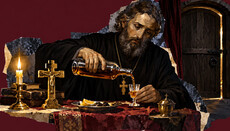
In his epistle, the Apostle Jude describes a scene familiar to anyone who has seen a church meal turn into a drinking party.
On a parish feast day, tables are always laid in the church refectory after the Liturgy. There are pies, salads, fish or meat dishes. And off to one side, as tradition has it, stand a couple of bottles – for toasts to the health of the rector, the choir, and the benefactors. It all seems ordinary and harmless enough. An hour later, the conversations grow louder, the toasts longer, and someone is already unsteady on his feet.

The elderly women of the parish avert their eyes. A young man who only recently crossed the threshold of the altar and still sees the Church through rose-colored glasses watches all this and leaves in embarrassment. For now, only until the next service. But perhaps one day he will leave for good.
Many have witnessed such scenes. They are rarely discussed; doing so is often considered improper. It is a painful subject, and one that sometimes concerns not only the laity. Yet Holy Scripture does not shy away from it, even if it addresses the issue indirectly.
What did the apostle see at the love feast?
The Epistle of Jude is directed against false teachers – people who had infiltrated the Christian community and turned grace into an excuse for licentiousness. Jude writes that “these are spots in your feasts of charity, when they feast with you, feeding themselves without fear” (Jude 12).
The love feasts, or agapae, were communal meals of the early Christians. Rich and poor, masters and slaves sat at the same table. People brought food to share, ate together, and prayed together. The agape was a continuation of the Liturgy. Yet suddenly, people appeared at these tables who cared only about satisfying themselves.
In the Greek text, they are described as “feeding themselves.” A true shepherd feeds the flock; these people feed themselves.
The Apostle Paul witnessed something similar in Corinth. At the Lord’s Supper, one person went hungry while another “was drunken” (1 Cor. 11:21). A meal meant to unite the faithful was instead dividing them and becoming a source of scandal.
Jude does not prohibit drinking wine. What troubles him is the person who calls himself a Christian but, at the common table, ceases to notice the needs of others. That is where it begins: first pride quietly creeps in, and then the hand reaches for the glass almost by itself.
A priest staggering from wine
In the Old Testament, the Prophet Isaiah paints a disturbing picture: “the priest and the prophet have erred through strong drink; they are swallowed up of wine, they are out of the way through strong drink; they err in vision, they stumble in judgment” (Isa. 28:7). It is difficult to imagine, yet those who are supposed to lead the people can barely stay on their own feet.
In Leviticus, after the death of Aaron’s sons, God gives the priests a commandment: “Do not drink wine nor strong drink, thou, nor thy sons with thee, when ye go into the tabernacle of the congregation, lest ye die” (Lev. 10:9). Even then, the clergy were to understand that service before the holy things required a clear mind and a free will.
And the Prophet Ezekiel speaks words that echo the image in Jude’s epistle: “Woe be to the shepherds of Israel that do feed themselves! should not the shepherds feed the flocks?” (Ezek. 34:2). A shepherd who values his own pleasure more than the spiritual care of his people immediately ceases to be a shepherd.
"Let it cease"
From its earliest centuries, the Church knew that this affliction could find its way even into the holiest places on earth. The ancient ecclesiastical rules traditionally known as the Apostolic Canons contain this provision: “A bishop, presbyter, or deacon who is addicted to gambling and drunkenness must either cease or be deposed” (Canon 42). The following canon says the same of lower clergy and adds: “Likewise a layman” (Canon 43).
As we can see, there is no “clerical” drunkenness and “lay” drunkenness. The passion is the same, and so is the sickness, whoever may suffer from it.
Church rules call the person who has stumbled to repentance: “let him cease” – in other words, let him stop his disorderly behavior. Punishment comes only after that. The canon gives a person the opportunity to stop, while deposition from holy orders or excommunication is reserved for those who refuse to take that opportunity.
The canons even contain a telling detail from everyday life. Apostolic Canon 54 forbids a cleric from entering a tavern, but makes an exception for someone traveling who must stay at an inn out of necessity. Those who composed the rules understood that circumstances vary. But the principle remains the same: servants of God should be above reproach, so that the name of God is not blasphemed because of them.
A hangover in solitude
There is another problem that parishes speak about even less often. A priest may drink not only at celebrations but also away from church – at home in the evenings, alone. Parishioners may think everything is more or less fine: services begin on time, and there is at least some kind of sermon. Meanwhile, at home, the unfortunate pastor has a bottle waiting for him – one he hides from his wife, from his children, and sometimes even from himself, afraid to admit that he has become a slave to this passion.
Where does it come from? There must be some reason. It is no secret that a priest hears dozens of other people’s troubles and problems in confession, while there may be very few people to whom he can confide his own – especially if he has no personal spiritual father.
His daily life consists of funerals, occasional services, endless requests, and parish debts. Now there is also the war, with all its horrors. Add to this the tradition of “treating Father” to a drink after a baptism or a house blessing – an offer that can feel awkward to refuse. Exhaustion accumulates in a cleric’s soul, and a drink begins to seem like the only way to unwind.
Hidden alcoholism is dangerous precisely because it is hidden.
Parishioners suspect something but remain silent – out of respect for the priesthood, fear of judging someone, or reluctance to “air the parish’s dirty laundry.” Fellow clergy also see the priest’s problem but hesitate to address the painful subject. And so the person is left alone with his illness until it finally erupts into some public scandal.
At such moments, the canonical words “let him cease” look like an outstretched hand. It is possible to stop before it is too late, but doing so alone is almost impossible. A priest needs a spiritual father to whom he can tell the unvarnished truth. He needs a bishop capable of seeing a sick brother in a drinking priest, not merely a disciplinary offender. Often, he also needs a doctor, because addiction is an illness and cannot always be overcome by willpower alone. Prayer and medical treatment do not contradict one another.
And what should parishioners do? Gossiping is a sin. Pretending nothing is happening is no better. But they can at least stop pouring Father another drink. They can refrain from insisting that he accept one. They can pray for their pastor. And if the problem has already become visible, they can discreetly tell someone capable of helping the fallen cleric with paternal care.
Is wine always to blame?
At the same time, it is easy to go to the opposite extreme and declare wine itself the enemy. St. John Chrysostom, who denounced drunkenness without compromise, warned: “Drunkenness does not come from wine; wine is God’s creation, and God’s creation causes nothing evil. It is a corrupt will that produces drunkenness.”
Wine has its place at a festive table. It is brought for the Eucharist. Christ Himself turned water into wine at the wedding in Cana. The danger begins when the will gives way to passion and a person starts routinely using alcohol to numb emptiness, fear, or exhaustion.
Chrysostom also observed that a person can become intoxicated with anger or lust. A shepherd who feeds himself rather than his flock may be completely sober and yet drunk on vanity. These ailments share the same root – a person forgets those around him and the One above him.
Mercy with discernment
What should be done when all of this touches the life of a particular parish or family? The Apostle Jude gives a precise answer: “And of some have compassion, making a difference: and others save with fear, pulling them out of the fire” (Jude 22–23).
For one person, a gentle word may be enough. He needs support. Another will hear nothing without a stern admonition. Knowing the difference is what “discernment” means. Gossip in the refectory and whispers behind a drunkard’s back have no place here – but neither does silently covering up the sin.
According to the Apostle Jude, we are to correct ourselves by “building up yourselves on your most holy faith, praying in the Holy Ghost, keep yourselves in the love of God” (Jude 20–21). To support another person, we ourselves must first stand on firm spiritual ground.
And only then might it be time to take another look at what is served at the parish feast – so that no one leaves it with eyes lowered in shame.