
“Picassó”: A Temptation Capable of Shaking Faith
Excerpts from Andrei Vlasov’s book “Picassó. Part One: The Slave.” Episode 19.
Time: 1992
Place: Kyiv
Characters: Misha Kaminsky, seminarians, teachers
Misha Kaminsky had been accepted into the seminary choir. To say that he was happy would be to say nothing at all. Could it really be that he, too, would stand in the vast Refectory Church of the Lavra, joining the angelic voices of the seminarians in singing praise to God? He already imagined the words of glorification pouring from his lips in a mighty doxology – at the top of his lungs, no less.
When he shared his joy with his dormitory neighbors, someone tried to bring him back down to earth.
“So, you made it into the choir? Well, congratulations. You’re done for now. You won’t be going home on weekends or holidays anymore. You’ll be stuck at services all the time. Just imagine – everyone else goes to the seaside in summer, and you’re here, in the Lavra. And the choirmaster, I’ve heard, is a tough guy. Sing one wrong note and you get it straight in the chest.”
But Misha was very far from such mercenary reasoning. What holidays? What seaside? When there is a church, and you are singing in that church!
The choirmaster did, indeed, turn out to be rather original. He was a fourth-year seminary student named Stanislav – or simply Stas. Perhaps because his name contained so many “s” sounds, he could not pronounce “ch” or “sh,” replacing them with “s.” He did not hit anyone in the chest, but if someone made a mistake in singing, he might shove them quite forcefully and hiss:
“Are you singing at all? If you can’t sing – don’t sing!”
Another of his trademark phrases was:
“If you don’t know it – you rest!”
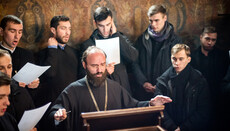
That was what the newcomers to the choir heard for about two months, until they got used to things and began to sing more or less decently. No special classes were held for them. They were simply placed next to more experienced singers during rehearsals and services and told to hum along quietly while watching the notes. But humming quietly did not work at all. How could it be quietly? My voice must be heard under the very dome of the church! And besides, at the beginning one always tries to compensate for lack of skill with volume. That is why the new recruits received a shove in the chest and a sharp “Are you singing?” from the choirmaster. And if it happened during a service, the choirmaster would pluck the tuning fork, bring it to his ear, and say in a subdued voice:
“Pull yourselves together, brethren. We’re coming in. If you don’t know it – you rest.”
Soon, a seminary instructor of church singing returned from some foreign trip. His name was Nikolai Borisovich. He was a “civilian” – and another very unconventional figure at the seminary. He was a man passionately in love with church singing. The moment you asked him a question related to it, he could speak endlessly, forgetting everything else in the world.
Misha could never understand why the seminary choir had not been entrusted to him, but to Stas, who could not even pronounce all the letters properly. But this was one of those mysteries of seminary life, and seminary life was generous with such mysteries.
With Nikolai Borisovich’s arrival, compulsory singing classes for all first-year seminarians began. They were held not in the seminary building itself, but in a classroom in the library, located in a neighboring building – probably so as not to disturb the other students. At the very first lesson, after a prayer and a brief introduction, Nikolai Borisovich said:
“Now, brethren, we are going to shout properly.”
Everyone thought it was a figure of speech. It turned out not to be. It was meant quite literally.
He himself set the example, shouting at the top of his lungs:
“A-a-a-a-a-a-a!”
Others began to join in. At first timidly, then louder and louder:
“A-a-a-a-a-a-a! A-a-a-a-a-a-a!”
When everyone had had enough shouting, Nikolai Borisovich said:
“Now, brethren, remember this: we will never shout like that again. Singing is not shouting, and shouting is not singing. One must sing to God – precisely sing. Of course, there can be a cry of the soul, a cry of repentance. But that is not what I am speaking about now. The angels in heaven sing to God; they do not shout. Everything there is harmonious and orderly. And we must strive for the same. To sing to God means to sing with one’s whole being – with the soul, with the heart. Not with the lips alone. First of all, one must understand what it is that we are singing or saying in prayer. Mindless singing is just shaking the air. If you sing beautifully but understand nothing with your mind and feel nothing with your heart, it will bring you no benefit. Scripture says: ‘Cursed is he who does the work of the Lord negligently.’ Remember these fearful words, brethren. I repeat: singing and prayer must proceed from the mind and the heart.”
“Singing is, above all, prayer. And everything the holy fathers have taught about prayer applies fully to singing. I strongly recommend that you read the works of St. Ignatius Brianchaninov – they are available in our library. He writes very wisely about prayer. The main rule of prayer, expressed long ago by St. John of the Ladder, is this: to enclose the mind within the words of the prayer. Do you hear? The mind within the words of the prayer. And in order to enclose the mind within the words of prayer during the service, one must enclose the mind within the notes during rehearsals. That is, learn to sing beautifully and reverently, to work on vocal technique.”
“You have probably all noticed that when shouting, the sound is formed somewhere here, in the throat, in the vocal cords, and bursts out from there. That must not happen in singing. It is written that ‘your body is a temple of the Holy Spirit who dwells in you.’ Imagine that your body is a church. Just as in a church sound is formed below and rises up under the very dome, so we must form it in the diaphragm” – he placed his right hand on his stomach – “and then raise it upward” – he moved his hand across his chest. “And in the mouth we must shape something like a dome, as though it were the dome of a church, feel the sound there, and then let that sound come out through the lips.”
Nikolai Borisovich spoke in detail about vocal technique, taught different types of breathing, showed how one should and should not sing.
But above all, he devoted his attention to explaining the meaning of various church hymns, teaching the students to marvel at and rejoice in the beauty of the thoughts expressed in them.
At almost every lesson he repeated that God looks upon the human heart, and that one cannot be bodily present in church, singing with the lips, while the mind wanders God knows where. His classes were interesting, and sometimes even fun. Often they lasted through the entire break and even spilled over a little into the next lesson.
But no sooner had Misha recovered from the joy of being accepted into the choir than a severe trial fell upon him, like a thunderbolt from a clear sky.
At that moment, he was sitting on his bed in the dormitory, cross-legged like a Turk, trying to immerse himself in a textbook on liturgics. Suddenly someone touched him on the shoulder. Misha flinched and looked up. Standing before him was his best friend, Georgy. His face bore such grief as if all his close and distant relatives had died at once.
Misha was so stunned that he could not even ask what had happened.
“Here. Read this,” Georgy said, throwing several glossy secular magazines – something like Ogonyok – onto the bed. He sat down and covered his face with his hands.
“Georgy, what is it?” Misha finally managed to say.
“Just read,” Georgy stood up. “Read it, and then we’ll talk,” and he left the room as abruptly as he had entered.
Misha began to read. The magazines contained a series of articles under the general title “The True Face of the Moscow Patriarchate.” In them, a certain priest, Gleb Yakunin, claimed that the present-day Moscow Patriarchate was not at all the grace-filled Church of Christ planted in Rus’ by the holy Prince Vladimir. Instead, it was an organization created by Stalin during the years of the Great Patriotic War. Along the way, the entire church structure was subjected to devastating criticism – the activity of the hierarchs, their way of life, their alleged striving for luxury and power, and so on.
Yes… there was reason to be horrified. Because if… if this were true, then his entire spiritual life, all the church services he had attended over his seventeen years, all the sacraments – Communion, confession… the seminary, the choir, his father… all of it turned out to be a lie.
“My God!” Misha thought, devouring the magazines Georgy had brought. “My God!”
Everything – absolutely everything – collapsed in an instant. He sat there, still cross-legged, running his hands through his hair, reading: “In 1927, the lawful central administration of the Orthodox Russian Church was interrupted by Bolshevik violence… In place of the true Church, from representatives of a ‘temporary synod’ recruited by the Cheka under Metropolitan Sergius (Stragorodsky), the Moscow Patriarchate was formed in 1943 by Stalin and Beria… In violation of all canonical norms, an entirely new religious organization of a totalitarian type was created, having nothing in common with the universal canonical rules of Orthodoxy…”
Again, someone touched him on the shoulder.
“Misha! Evening prayers. We’ll be late.”
He gathered himself mechanically, trudged with the others to the church, stood through the prayers… His thoughts were far away. His feelings even farther. He felt like a small, helpless boy again – the same boy to whom, long ago in church, an unbelieving peer had once come up and asked one simple question: “Why are you in the Church?” His faith had wavered then, ready to fall. But God had strengthened him. God exists! Not for a single minute since then had he doubted it. God exists – and therefore I am in the Church.
But now everything was far more complicated. God exists – but the Church does not? Where is it? Where should it be sought? Does it mean that everything that was before was untrue? He felt the ground slipping away beneath his feet. There is no Church – only the KGB everywhere. That was what Gleb Yakunin claimed.
Now even the assistant inspector, who checked attendance at prayers and vigilantly watched over order in the church, looked completely different. There it was: the KGB, a totalitarian organization!
To be continued…
The previous episode of the book is available here.