
Byzantium: Game of Thrones with a censer in hand and 1000 years of grandeur
Imagine a state where the throne rose to the ceiling, and forks were used at the table when Europe still ate with hands. This is a story of faith, power, and gold.
On December 27, 537, the Hagia Sophia in Constantinople was consecrated. We dedicate this publication to the complicated church-state relations in the Byzantine Empire.
Imagine a state that lasted 1123 years. Longer than any modern empire. A state where golden mechanical birds sang in the throne room, and the emperor's throne rose to the ceiling to impress the imagination of barbarians.
A lot of splendor, charm, gold, pompous grandeur – all this is Byzantium.
But as a preface, it must be said that a state called "Byzantium" never existed. No one in the world used this word to denote their homeland.
The term "Byzantium" was introduced by Western scholars only in the 16th century – a hundred years after the empire fell under the blows of the Turks. It was politically disadvantageous for Western Europeans to recognize the Greek East as the "true Rome".
By coining the term “Byzantium,” they emphasized that this was a “different” history – Greek rather than Roman. The inhabitants of this country, however, called themselves Rhomaioi (Romans) until the very last day, and referred to their state as the Empire of the Romans.
Smelly Paris and golden forks
Most often, textbooks give the year 330 as the starting date of Byzantium, when Emperor Constantine the Great moved the capital to the city of Byzantium and renamed it New Rome (later Constantinople).
However, it would probably be more accurate to consider the 7th century – the reign of Emperor Heraclius (610–641) – as the true birth date of Byzantium. Under him, Latin was abolished, Greek became the official language, and the ruler replaced the Roman title “emperor” with the Greek one, basileus.
Byzantines always considered themselves Romans and despised Europeans, considering them barbarians and savages.
And objectively, there were reasons for this. Byzantines, like the ancient Romans, loved baths, often washed, and used perfumes, which could not be said about Western Europeans of that time.
In Constantinople, a well-thought-out system of underground closed sewers operated. At the same time, in London or Paris, the cry «Garde à l'eau!» (French for «Watch out for the water!») meant that a pot of waste was about to be poured on your head.
In the heat, the stench in European capitals was unbearable. The Thames in London or the Seine in Paris served simultaneously as a source of drinking water and a sewer, which constantly led to epidemics.
Byzantines already knew how to eat with forks (they were two-pronged), while in Europe people ate with their hands. When in the 11th century the Byzantine princess Maria married the Doge of Venice and took out a golden fork at the table, the local clergy were horrified.
This instrument was called "devilish", and the princess herself – a depraved sinner, for "God gave us fingers". In Byzantium, literacy was widespread even among commoners, and universities operated. In the West, even kings (like Charlemagne) often struggled to write their names.
To humiliate the Romans, Western rulers called them "Greeks", which was considered a terrible insult. And the Byzantines called Europeans "Latins" or "Franks", which in their understanding meant "dull boors".
Symphony: a marriage of convenience
Christianity gave people what the fallen empire could not. When the state abandoned the poor, Christians created a system of mutual aid, saving widows and orphans. In a rigid hierarchical society, Christianity declared: «There is neither Greek nor Jew, neither slave nor free».
For the humiliated, this was a shock and a consolation. In an era of plague and death, Christianity said that death is not the end. The empire tried to destroy Christianity, but in the end, it surrendered.
Emperor Constantine the Great realized: paganism is dead, a new "operating system" is needed. The state adopted Christianity as an update.
This saved the statehood but dealt a blow to Christianity itself. Now the state became the virus that began to destroy the faith from within, turning it into part of the imperial apparatus.
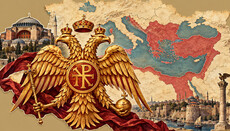
The betrothal of the Church and the state took place with Eastern splendor. A beautiful name was coined for this union: Symphonia. The word carries both musical and philosophical meaning at once. The Emperor and the Patriarch were like body and soul, like two heads of a single eagle.
The Emperor protects the bodies of the subjects, builds roads, fights, and guards the faith with a sword. The Patriarch heals souls, prays for the king, and ensures he does not lose his conscience. On paper, it looked amazing. But in life, it was a "game of thrones" with a censer in hand.
When the Emperor sat on a bench
The honeymoon period of church-state relations began with a touching plot. Emperor Constantine the Great, a former pagan, convenes the First Ecumenical Council in Nicaea.
Imagine this scene: 318 bishops enter the hall. Many of them are disabled: some have a burned-out eye, others have torn tendons, and some have had their ears cut off. These are confessors who survived terrible persecutions. They were used to the Roman power being a beast that kills.
And suddenly the Emperor enters in purple and gold. He does not order them to be executed. He respectfully treats their wounds. He sits not on a throne but on a bench below them. It seemed that at this moment a Christian state dream was born: the Empire ceased to be an enemy, it became the "restrainer" of evil.
The climax of this golden period was the reign of Justinian the Great (6th century). This man slept 3–4 hours a day. Imagine a president for whom the question "how to properly glorify God" is more important than the exchange rate. Justinian believed: if we believe incorrectly, God will turn away, and the empire will fall.
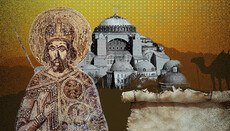
He built the Hagia Sophia. When the Emperor entered the finished temple and saw how the huge dome seemed to float in the air, he exclaimed: "Solomon, I have surpassed you!"
At the Hagia Sophia, the Emperor's place was almost at the altar. The state and the Church merged even in architecture.
This grandeur became a state necessity. People need a spectacle. Previously, these were gladiatorial fights, but the Christian conscience could not tolerate them. The final ban was achieved only in the 5th century, after the monk Telemachus ran into the Colosseum arena, trying to separate the fighters, and the enraged crowd stoned him to death.
"My will is the canon"
Now a majestic chucrh service became the main spectacle, and instead of theatrical performances, people listened to sermons. Undoubtedly, the Church also had a colossal influence on the state.
Christianity also humanized Roman law. Laws forbade killing slaves, improved the situation of women, led to the construction of hospitals (Byzantium was the first to invent the hospital as an institution), and much more.
But the main change that occurred in the Christian Church compared to the pre-Nicene period is that it adopted many functions previously performed by the pagan religion of Rome.
The Church became an instrument of sacralization of state power.
Anointing for kingship (coronation) made the ruler sacred and untouchable, even if that person had come to power through murder, intrigue, or villainy. After the anointing, a rebellion against the basileus was equated with a rebellion against God.
In reality, emperors and patriarchs did not observe much ceremony. They appointed their own candidates and shamelessly used the Church treasury to fund wars. In essence, the Church in Byzantium was governed not by the patriarch and clergy, but by the emperor and his team.
Only the emperor had the right to convene Ecumenical Councils – the patriarch could not do this either legally or practically. If the clergy acted against the will of the basileus, they faced exile or execution. The emperor also issued laws regulating the internal life of the Church, from rules of conduct for monks to the order of worship services.
Pious Justinian believed in his mission so strongly that he began dictating theology to the Church: “My will is the canon." Bishops who disagreed were removed from office. From the very beginning, the symphony leaned toward state dictatorship.
As a result, church leaders became fully involved in political struggles. After all, the state’s religious policy depended directly on who sat on the throne. Moreover, the Church began to play an ideological role, conveying narratives to the people that served the authorities, urging obedience, fostering patriotic spirit during wars, and defending the political system regardless of the moral character of those in power.
The price of the golden collar
What did the Church gain in return? First, the Church took on a vast social mission. Hospitals, homes for the elderly, orphanages, and the distribution of bread to the poor – all of this was under the Church’s care, and the state relied on it to maintain social stability.
Second, this status gave the Church immense resources. Thanks to state funding of schools, the Byzantine clergy became the most educated in the world. They preserved ancient philosophy, synthesizing it with Christianity.
As a result, in the era of the Ecumenical Councils, the "faith of the fishermen" gained the language of high philosophy, transforming into a coherent, logical system with a solid intellectual foundation. But the greatest and most tragic price for the protection of the state was the secularization of the clergy.
Since episcopal sees offered real power and access to resources, people driven by ambition rather than faith immediately flocked to the Church.
Simony (the sale of church offices) became a chronic disease of the Byzantine Church, one it could not rid itself of even after the empire’s collapse.
Fear of the emperor generally supplanted fear of God. Of course, church history has known heroic exceptions to this rule, but this was how the system functioned. The only stronghold and guardian of the pre-Nicene Church’s spirit remained monasticism.
It was the least dependent on money and power. In fact, monasticism arose as a response to the secularization of the Church. Monks were often in firm opposition to the emperor and the patriarch.
When the state imposed heresy (for example, iconoclasm), it was the monasteries and monks who bore the brunt, facing exile and imprisonment, while preserving the purity of the faith.
Soldier theology and blood on icons
The 7th–8th centuries saw dramatic times arrived for church–state relations. Soldier-emperors came to power, and Arab Muslims appeared on the borders. The emperors of the Isaurian dynasty reasoned simply, in a soldierly way: "If God is with us, we win."
"If we lose, it means we ‘messed up’ somewhere. The Arabs do not venerate icons and win. We venerate icons – and lose. Conclusion: we must remove the icons, and then God will turn toward us."
Thus began iconoclasm. Soldiers stormed into churches, smeared frescoes, and chipped sacred images.
Monks who defended the icons were drowned in the Bosporus, sewn into sacks, and icon painters had their fingers broken. By the same principle arose the heresy of Monothelitism – the state’s attempt to invent a "political theology" to reconcile with the Monophysites.
But when faith is traded for politics, the result is disastrous. In the 7th century, Egyptian Christians welcomed the Arab Muslims as liberators: "Better a caliph who simply collects a tax than an emperor who meddles in the soul." This is how Byzantium lost its wealthiest provinces.
Better a Turkish turban than a papal tiara
But the most terrible wound to Byzantium was inflicted not by Muslims but by fellow Christians. In 1204, the Crusaders, who were supposed to liberate the Holy Sepulchre, decided to take a “detour” and seize Constantinople. Knights with crosses on their cloaks looted altars and turned churches into stables.
A prostitute was placed on the patriarchal throne at the Hagia Sophia, where she, according to historian Niketas Choniates, sang obscene songs and performed lewd dances. For the Byzantines, this was, one might say, the end of the world. The 15th century arrives. Only one city remains of the Great Empire.
Its walls are old, the garrison is just 5,000 soldiers against the 100,000-strong army of Sultan Mehmed. In despair, the Palaiologos emperors sign a union with Rome in Florence, recognizing the pope’s authority in exchange for help. But the help never comes.
The people of Constantinople met the returning unionist bishops with sullen silence. Admiral Loukas Notaras said a famous phrase: "Better to see a Turkish turban in the city than a Latin tiara."
People understood: the Turks could kill the body, but the West would demand their soul.
May 29, 1453, is the final night of the empire. A service is being held at the Hagia Sophia. Orthodox Christians and the few Catholic Genoese who came to defend the city pray and receive Communion together.
The last emperor, Constantine XI Palaiologos, removes his insignia and says, "Let whoever wishes save himself, but I will die with my city," and throws himself into the thick of battle, dying as a common soldier.
An ark for the nation
His body was never found. The state perished. The symphony was broken. But because the Church did not dissolve into the union, it preserved the people. Sultan Mehmed, having captured the city, realized that the Greeks could only be governed through their faith.
He handed the new patriarch, Gennadius Scholarius, a staff and granted him the rights of an "ethnarch" (a nation ruler).
For the next 400 years, before the Greek state existed, the nation lived within the Church.
And the Church became an ark, carrying the people through the flood of the Ottoman yoke. The main drama of church–state relations in Byzantium was the internal struggle between the "Church of power" and the "Church of the spirit". It was this struggle that created the unique portrait of Byzantine Orthodoxy.