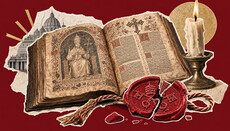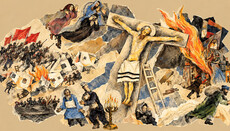

Archangel Gabriel's feather. Two dinars. No bargaining
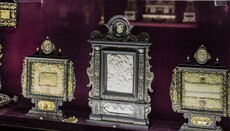
Relics, indulgences and trade in miracles: how faith was turned into a commercial transaction, and why we keep looking for shortcuts to God.
If one were to compile a registry of objects that at various times have been passed off as sacred relics, the resulting document would balance on the edge between religious ecstasy and outright fraud. Historical distance allows us to view this phenomenon as a large-scale economic and psychological system that has undergone no significant changes over the centuries. The essence remains the same: an attempt to give spirituality a material form that can be bought, transferred, or pawned.
The starting point for the large-scale "market of holiness" in Europe was 1204 – the date of the capture of Constantinople by participants in the Fourth Crusade. The city, which for centuries had been the main repository of Eastern Christian artifacts, was subjected to total plunder.
For knights whose debts to Venetian bankers exceeded all conceivable limits, the export of church treasures became the only way to justify the campaign.
A flood of objects poured into European capitals, whose value was determined by their supposed connection to Gospel history.
It was then that artifacts began appearing in European markets, descriptions of which today seem like an ironic reconstruction. Professional relic traders who followed the crusaders offered goods for every taste: from fragments of the Virgin Mary's clothing to exotic "feathers of the Archangel Gabriel." The latter example frequently appears in satirical literature of the time, particularly in Giovanni Boccaccio and Geoffrey Chaucer's works, indicating the widespread nature of the phenomenon. When fraud becomes a theme for popular stories, it means the scale of falsifications has reached a critical point.
John Calvin's audit
The monetization of miracles was extremely pragmatic. A city or monastery possessing a significant relic automatically became a pilgrimage center. This meant a constant influx of funds: road tolls, inns, trade in related goods, etc. The shrine became an asset yielding stable dividends.
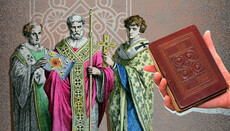
In the mid-sixteenth century, one of the leaders of the Reformation, John Calvin, attempted a rational audit of this market. In his "Treatise on Relics," he compared data on Europe's most venerated artifacts. The most famous result of this research was his calculation of particles of the Life-Giving Cross. Calvin concluded that if all the wooden fragments stored in cathedrals under the guise of this shrine were gathered together, their volume would suffice to build a large cargo ship. Such a revision exposed a simple truth: the relic market was regulated by laws of supply and demand, not historical authenticity.
A similar situation was observed with other "unique" objects. The number of nails with which, according to tradition, Christ was nailed to the cross numbered in the dozens, and relics of popular saints could simultaneously be found in five or six different cities.
But for the medieval consciousness, legal authenticity often gave way to symbolic significance. A person paid not for a verifiable fact but for tangible hope of solving their problems.
Simony: the price of grace
Church tradition records attempts to commercialize spiritual experience as early as the first century. The episode with Simon the Sorcerer, described in the Book of Acts, became a precedent that gave its name to an entire phenomenon – simony. Simon, seeing the external manifestations of the Holy Spirit's action through the apostles' hands, offered them money for the transfer of this ability. The apostle Peter's response was brief: "Your money perish with you, because you thought that the gift of God could be purchased with money" (Acts 8:20).
The term "simony" was subsequently applied to the sale of church positions, ranks, and any forms of spiritual mediation. However, the disease proved chronic. By the sixteenth century, it had evolved into the practice of selling indulgences. Johann Tetzel, who entered history as one of the most effective sellers of such documents, claimed: "As soon as the coin clinks in the box, the soul is freed from purgatory."
This was an attempt to turn repentance – a complex and internal process – into a transaction.
People were offered the chance to buy peace of conscience without changing their way of life. The indulgence became the final point in a chain of commodity-money relations with God, where instead of personal transformation, the client was offered a payment receipt.
Magic vs faith
The reasons for this phenomenon's persistence lie not in the cunning of merchants, but in consumer psychology. The Gospel program is inconvenient by definition. It requires internal work: forgiving enemies, fighting selfishness, patience, etc. This is a long path without guarantee of instant relief.
Magic, on the contrary, is technological. It offers an understandable algorithm: buy an object, perform a ritual, and get results. There is no place for the freedom of grace here. In magical consciousness, God or higher powers become performers obligated to fulfill their part of the deal if "payment" in the form of an object or ritual is made correctly.
Today's "blessed bracelets," "prayer-infused earth," or oil from Jerusalem advertised as a panacea are merely new forms of the old request to simplify faith.
This is an attempt to guarantee safety and success without resorting to a revision of one's own life. The mechanics remain the same as those of the medieval merchant: endowing a material object with autonomous power capable of "solving the problem" without human will.
Revision of values
Saint John Chrysostom in his teachings repeatedly emphasized that the pursuit of external miracles and objects often becomes a sign of spiritual immaturity. For him, the greatest miracle was character change – when the greedy becomes generous, and the angry becomes meek. This process requires efforts that cannot be delegated to an object in one's pocket.
The text from the Gospel of Matthew contains a stern warning for those who build their lives on external effects: "Many will say to Me in that day, 'Lord, Lord, have we not prophesied in Your name, cast out demons in Your name, and done many wonders in Your name?' And then I will declare to them, 'I never knew you'" (Matt. 7:22-23). One can be at the center of "miracles" and manage "shrines," yet have no personal connection with the Creator.
The paradox is that God sometimes answers the requests of people praying even before questionable objects.
The theological explanation here is simple: the answer is given to a sincere and contrite human heart, not to the "charge" of this or that object. God shows mercy to a person regardless of their delusions, but this does not legitimize the counterfeit industry.
True holiness is not subject to inventory and has no retail price. It is not fixed in objects as some static force. The attempt to buy a spiritual result is always a sign that a person perceives relations with God as a commercial transaction. However, in this system there is no "discount" for purchasing the right pendant or oil. The real value of spiritual life is measured not by artifacts in one's pocket, but by a person's readiness for honesty before themselves, which cannot be sold or bought.
The concept of "holiness to go" remains a convenient illusion, allowing one to avoid the main thing – a personal encounter with God, in which one cannot hide behind another's merit or a paid check.