
From virtual lies to real blood
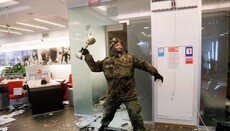
In recent days, Ukraine has witnessed a series of incidents that give rise to deeply troubling thoughts. UOC churches have been set on fire, vehicles belonging to UOC priests engaged in volunteer relief work have been destroyed, and banks, investment company offices, and television channels deemed undesirable have been vandalized. And, tellingly, it is unlikely that anyone will be held accountable for these acts.
An organization calling itself the OUN has claimed responsibility for the attacks. Its chairman, Mykola Kokhanivskyi, noted that the activists could even have stormed the building of Ukraine’s Presidential Administration. The only reason they did not, he explained, was that too few people had joined the protest – only about 300. “We are brave, but we are not stupid,” Kokhanivskyi said.
Well, both bravery and stupidity are subjective qualities that defy precise measurement. Nor has anyone yet invented an instrument capable of measuring malice and hatred. Yet it takes no supernatural powers to see that aggression and xenophobia in Ukraine have reached a critical level.
Not so long ago, Ukraine was a country firmly associated around the world with warmth and hospitality. Its calling cards were golden fields of ripening wheat, beautiful women, and wonderfully melodic folk songs. Any act of aggression, let alone murder, drew unequivocal condemnation from society. One need only recall the powerful and lasting public outcry over the murder of journalist Georgiy Gongadze.
Over the past two years, Ukraine has become a very different country. Today, it is a nation painted in dark colors.
On February 23, Ukrainian MP Vadym Rabinovych, chairman of the parliamentary subcommittee on human rights, stated on NewsOne: “The government has set the machinery of hatred in motion in society, and now it is powerless to bring the situation under control.”
But is the government alone responsible for the wave of aggression sweeping across Ukraine? Is this wave not also born on the screens of political talk shows, in television reports, and in social media posts? And do certain representatives of the world's second-oldest profession feel no responsibility for what is now happening in Ukraine?
In March 2015, Kyiv hosted a ceremony for the presentation of the “Joseph Goebbels Award.” According to the organizers themselves, the award was intended exclusively for propagandists and employees of Ukrainian media outlets responsible for:
- Systematic violations of journalistic standards;
- Inciting hatred and hostility among Ukrainians;
- Fueling ethnic discord within Ukraine;
- Participating in the creation and dissemination of propaganda.
The ceremony honored quite a few “worthy” journalists, but some nominees managed to stand out even against this distinguished company. One was Bohdan Butkevych, a journalist with Ukrainskyi Tyzhden, who had called for the killing of 1.5 million of his fellow citizens live on Hromadske.TV.
It is difficult to say what prevented Butkevych from personally taking up arms and acting on his own appeal. Perhaps health problems, dissatisfaction with the meager army rations, or simply the inability to find military gear in his size.
At any rate, there have been no reports suggesting that the reason he did not volunteer for the anti-terrorist operation (ATO) was that he was serving a prison sentence for publicly calling for murder under Article 129 of Ukraine’s Criminal Code.
Television reports, publications, and talk shows targeting the Ukrainian Orthodox Church do not contain calls for murder.
Not yet.
But that hardly makes them any more objective, truthful, or benevolent.
“The Moscow Patriarchate as a Distorted Mirror of Bolshevism,” “Militants in Cassocks,” “Squeezing Moscow Out, Drop by Drop,” “The Moscow Patriarchate Is a Criminal Sect,” and so on. The list could go on indefinitely.
A particular message is being systematically and deliberately planted in the minds – and even the subconscious – of Ukrainians: that the Ukrainian Orthodox Church, through its unity with worldwide Orthodoxy and its ties to the Moscow Patriarchate, is an agent of the Kremlin’s intelligence services; that it bears responsibility for the war in Donbas; and that it is practically the root cause of all Ukraine’s present misfortunes.
The scope of this article is nowhere near sufficient to accommodate even a small fraction of such examples. Let us therefore turn to the work of one of the most “progressive” representatives of the Ukrainian media – Espreso, which made its name covering the Euromaidan events.
In yet another Espreso talk show, this time devoted to sectarianism, its creators went beyond their usual formulaic attacks on the UOC and actually accused the Church of organizing the activities of destructive sects in Ukraine. Carefully selected “political analysts,” “historians,” and “experts” helped create precisely the picture the program’s producers wanted.
But the centerpiece of this supposed “journalistic investigation” was the triumphant arrival in the studio of the leading nominee for the Joseph Goebbels Award – Bohdan Butkevych.
A journalist who, just a year and a half earlier, had declared that Ukraine had “a category of people who simply need to be killed” was invited into the studio as an expert on Church affairs!
Did the talk show's producers know what kind of reputation their guest had? Of course they did. But in post-Maidan Ukraine, a Ukrainian citizen's patriotic orientation serves as a blanket indulgence for every conceivable transgression, including blatant violations of the law.
During his brief appearance, Butkevych managed to cause a scandal, mislead viewers by claiming that “the number of UOC eparchies is declining year after year,” and express his hope that the UOC would cease to exist in Ukraine within his lifetime.
It is hardly surprising, then, that the activities of Espreso and numerous other media outlets, which use lies and manipulation to portray the Ukrainian Orthodox Church as an enemy in the eyes of Ukrainians, are bearing their predictable fruit.
One of the most widely circulated quotations attributed to fascist propagandist Joseph Goebbels concerns precisely the power of the media and their influence over people: “If you tell a lie big enough and keep repeating it, people will eventually come to believe it.”
Lies and slander inevitably breed aggression and hatred
On January 30, Archimandrite Job, the steward of the Pochaiv Lavra, died tragically. According to novices and monks who knew him during his lifetime, he was one of the finest monastics in Ukraine, a man whom many regarded as a model of spiritual life.
One of Ukraine's most popular news websites, Censor.NET, published a report about the tragedy. At the time of writing, the article had received 197 comments.
Our people have a tradition of speaking either well of the dead or not at all, regardless of who they were. Yet you will find no kind words in these comments. There is neither grief nor sympathy. Almost every comment is steeped in gloating, malice, and hatred.
Hatred directed at a man these people had never even known.
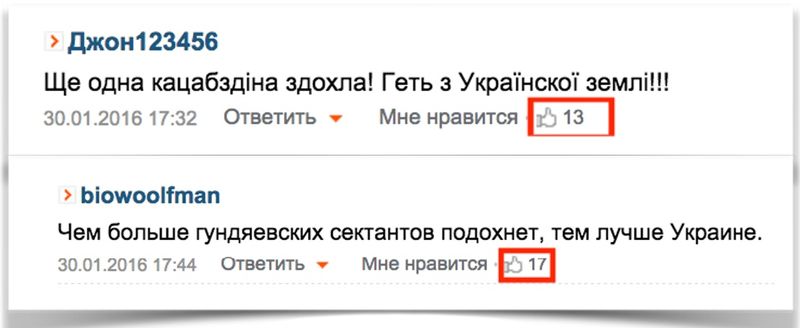
Such “well-wishers” are not difficult to find on social media either.
For example, Yaroslava Mishchenko, also known as Lana Samokhvalova, who runs the Facebook group “For a United Local Church,” apparently has no objection to allowing comments such as calls for violence against UOC clergy and faithful on her page devoted to the presentation of a book about the persecution of the UOC.

And this is only the first stage – the virtual one.
Sooner or later, aggression expressed through a computer screen is no longer satisfied with the tapping of keyboard keys. It demands an outlet in real life.
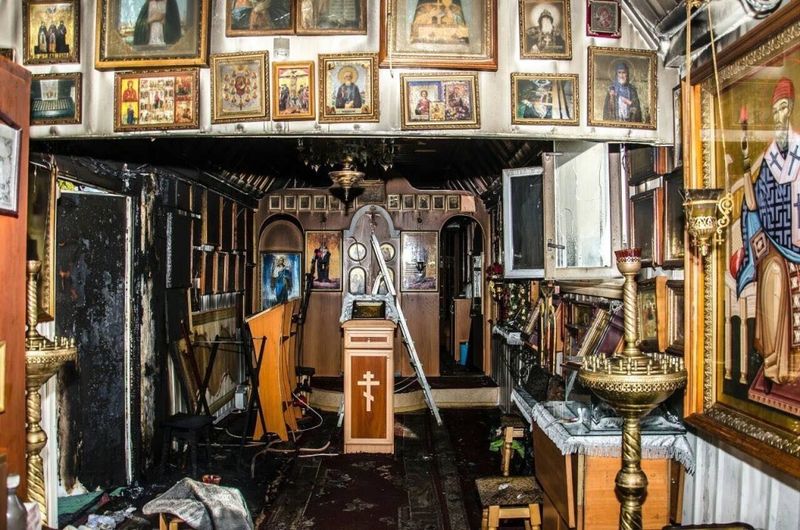
In the town of Mykolaiv in Lviv Region, unidentified individuals set fire to a UOC church dedicated to the Mother of God’s “Assuage My Sorrows” Icon.
As the photograph shows, the church is exceedingly modest, both in size and in its interior furnishings. Whom could it possibly have threatened, and how, in a region where the Kyiv Patriarchate and Greek Catholics have virtually all the religious buildings at their disposal, the support of the patriotically minded population, and the open sympathy of the local authorities?
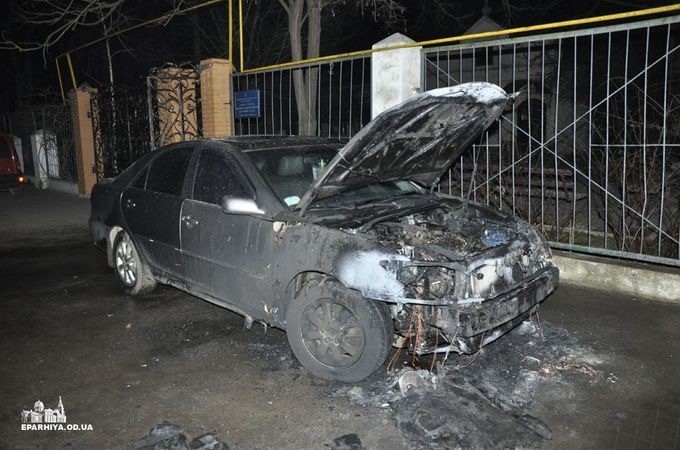
On February 23, in Odesa, another group of unidentified individuals set fire to the car belonging to Archpriest Pavlo Poleshchuk, head of the Odesa Eparchy's Social Department and the Coordination Center for Humanitarian Assistance to Displaced Persons and Those in Need.
The priest used this vehicle to deliver food packages to more than 200 internally displaced persons from Donetsk and Luhansk Regions.
Perhaps these were some of the very “superfluous people” of Donbas whom “Church expert” Butkevych, in his incendiary speech, had denied the right to live.
The examples cited above concern only damage to Church property.
This is the second stage of the consequences of anti-Church propaganda.
But Ukraine's media professionals continue their work.
In the theory of the “Overton window,” no subject is off-limits. Even the most implausible and repugnant ideas can progress from being “unthinkable” and “radical” to “acceptable” and “reasonable.”
Journalists at Depo Lviv found a particularly extravagant way to report on UOC priests donating blood: “UOC Priests Have Their Blood Let in Rivne.”
Apparently, the outlet's staff thought this was a joke. But surely you will agree that this particular joke comes perilously close to crossing the line.
Our country is now facing an extremely difficult situation. More and more Ukrainians are losing their jobs and being left without means of support. Many soldiers returning from the ATO, some with weapons, are struggling with psychological problems and finding it difficult to reintegrate into society.
All these people will be looking for someone to blame for their troubles.
Will they find those who are truly responsible? Or will the puppet masters, through their media mouthpieces, direct their anger toward those who have the least to do with their suffering?
On August 24, 1572, during the St. Bartholomew's Day Massacre in France, Catholics killed approximately 30,000 Huguenots.
According to estimates by leading contemporary specialists in twentieth-century Church history, Soviet authorities killed approximately 130,000 members of the clergy between 1917 and 1941. Of these, around 1,700 had, at the time of writing, been canonized by the Church.
And although a scenario involving the physical extermination of Orthodox clergy and believers may seem unimaginable even in present-day Ukraine, the historical examples cited above, the divisions and hatred within Ukrainian society, and the colossal efforts of the domestic media to discredit the Church leave us unable to be entirely certain that such a tragedy could never happen.