
From Mother of God’s abode to 'temple of all gods': Lavra's new mission?
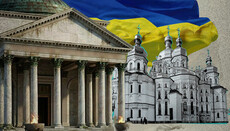
The monks have been driven out of the Lavra. Concerts and culinary shows have been staged there. The relics have been subjected to sacrilegious examinations. And now a neo-pagan pantheon is set to rise within its walls.
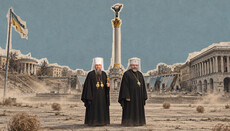
On June 28, 2026, Constitution Day, President Volodymyr Zelenskyy spoke at the Kyiv-Pechersk Lavra and announced that he was submitting a bill to the Verkhovna Rada establishing a Ukrainian National Pantheon, intended, in his words, to honor Ukrainians who “fought for Ukraine” and “inspired Ukraine.” By July 1, parliament had swiftly approved the initiative, and the Cabinet of Ministers just as swiftly adopted a mechanism for its implementation. The proposed location: the territory of the Kyiv-Pechersk Lavra.
Why the Lavra? Who will populate this National Pantheon? Which names will it immortalize? Whom will it hold up as an example?
From monastery to a startup for a new state ideology
The decision to create the Pantheon cannot be viewed in isolation from what has already been happening in the Lavra.
For three years, the authorities have been trying to expel the monks of the UOC from the monastery. Churches and monastic buildings have been seized, and believers have been denied access to the shrine. The idea of turning it into an “OCU monastery” has struggled to take shape – there are barely any monks there, and those who are present are simultaneously listed as employees of the Ministry of Culture.
For some time, the authorities seemed unsure what to do with the shrine they had acquired. One day it hosted a cooking show, another day a prayer breakfast, another a song-and-dance ensemble. But now the state appears to have made up its mind. The Lavra is being transformed into a platform for promoting a new state ideology – a kind of startup project that officials hope to market to Ukrainian society.
It is telling that Zelensky chose the Lavra as the venue for celebrating Constitution Day, an entirely secular holiday. The event was attended by senior government officials, representatives of religious organizations, and other dignitaries. Just yesterday, the authorities were presenting the Lavra to the world as a sacred site allegedly damaged by Russian attacks. Today, the same shrine serves as a backdrop for state ceremonies: the president speaks against the picturesque setting of the Dormition Cathedral while officials sit beneath the Lavra’s bell tower.
Now this practice is being enshrined in law. The text of the Pantheon legislation explicitly states that it is to become a venue for state ceremonies, the presentation of the country’s highest honors, and mandatory visits by foreign leaders and delegations as part of official protocol.
In other words, there is no mention of sacredness. The authorities intend to use the Kyiv-Pechersk Lavra as a state ceremonial complex.
You can’t build anything in the Lavra? The state couldn't care less about it
When the government terminated the UOC’s lease of the Lower Lavra, it accused the Church of improperly managing monastery property.
The Ministry of Culture compiled an extensive list of alleged violations, including “unauthorized reconstruction, additions, redevelopment of cultural heritage sites, and the construction of new buildings within the reserve,” “improper use of a 1914 basement,” and “inadequate maintenance” of Building No. 113, a historic book storage facility. Apart from the last example, officials never specified which structures were supposedly involved.
When the UOC demanded a detailed list of the alleged violations, the state refused to provide it and classified the document.
At the time, officials repeatedly accused the Church of damaging the Lavra’s “historic appearance.” This raises an obvious question: would constructing a “temple of all gods” – which is what the word pantheon literally means – not alter that historic appearance?
The answer is surprising. Formally, the construction will violate neither the Lavra’s appearance nor Ukrainian law. But not because the Pantheon fits naturally into an ancient Orthodox monastery. Rather, because the authorities have removed every legal obstacle that might stand in the way.
Member of Parliament Maksym Buzhanskyi drew attention to this while commenting on Law No. 15360 “On the Ukrainian National Pantheon.”
“The law literally says that other laws can be ignored,” he noted.
Indeed, the transitional provisions of the legislation effectively suspend the application of six separate laws.
The Land Code requires land to be used for its designated purpose? Not in the case of the Pantheon.
Environmental legislation prohibits major construction within protected reserves? A new provision specifically authorizes the Pantheon’s construction there. Moreover, the protected status of the land “cannot serve as grounds for refusing approval” of the project. In other words, officials responsible for safeguarding the reserve have been legally deprived of the right to say no.
The law protecting cultural heritage preserves buffer zones around UNESCO sites? Two key provisions of that law simply do not apply to the Pantheon. Another amendment expressly permits construction within a UNESCO buffer zone – precisely where such projects are ordinarily forbidden.
There is also legislation governing burial sites and imposing sanitary and environmental requirements. None of those standards will apply either.
Finally, urban-planning permits for the Pantheon will be issued “without regard to local planning documentation.” Put plainly, Kyiv’s master plan can be ignored.
The contrast is striking. The Church was accused of unauthorized alterations and harming the Lavra’s historic character, and those accusations were used to justify expelling monks from the monastery they had spent decades restoring after the Soviet era. Yet when the state decided to build its own “temple of all gods” within the shrine, it did not trouble itself with complying with existing laws – it simply rewrote them.
Only one law remains beyond the reach of the Verkhovna Rada: the international Convention Concerning the Protection of the World Cultural and Natural Heritage. Under that convention, any major construction project within a UNESCO site or its buffer zone requires prior notification of the World Heritage Committee and an assessment of its impact.
Ukraine’s parliament can suspend domestic legislation. It cannot suspend the country’s international obligations.
That is why the question of the Lavra’s future as a World Heritage site is no longer merely rhetorical.
A “temple of all gods”
The word pantheon comes from Greek and literally means “temple of all gods” – in other words, a universal pagan sanctuary.
That symbolism is troubling because it is so powerful. The state is placing an originally pagan monument in the very heart of Orthodoxy in Ukraine.
The symbolism becomes even more striking when one considers the history of the original Roman Pantheon. Built between AD 118 and 128 on Rome’s Piazza della Rotonda, it was converted into the Christian church of Santa Maria ad Martyres in 609. The transformation symbolized Christianity’s triumph over paganism.
Now, some argue, the word has long since lost its pagan meaning and simply denotes a place honoring distinguished individuals. Let us then examine whom the Ukrainian authorities intend to honor in this new “temple of all gods.”
Replacing the worship of God with the cult of national idols
The law contains no definitive list of individuals to be commemorated in the Pantheon. It does, however, identify categories: leaders of Ukrainian states, hetmans, presidents, commanders of the Ukrainian People’s Army, the Ukrainian Galician Army, the Carpathian Sich, the Ukrainian Insurgent Army, and the Armed Forces of Ukraine.
Undoubtedly, many worthy people belong to these categories – scholars, writers, philanthropists, statesmen, and soldiers who gave their lives for Ukraine.
Yet the authorities have begun this project by repatriating and reburying the remains of deeply controversial historical figures associated with the OUN, the UPA, nationalist underground movements, and the civil war period.
Several examples are frequently cited.
Andriy Melnyk has been accused of collaboration with Nazi Germany and involvement in repressive actions against civilians in occupied Ukraine.
Stepan Bandera has been accused of collaboration with the Nazis and, indirectly, of involvement in the Volhynia massacres.
Symon Petliura has been linked by critics to anti-Jewish pogroms between 1918 and 1921, during which hundreds of thousands of Jews were killed, injured, or robbed according to various historical estimates.

Some regard these figures as heroes. Others see them as fighters for Ukrainian independence.
But all of them, directly or indirectly, are associated with bloodshed. How, the author asks, can such figures be buried alongside the Venerable Fathers of the Kyiv Caves, saints who dedicated their lives to God?
There is another important consideration. The Lavra is an Orthodox shrine. Yet the Pantheon is intended to honor Greek Catholics, non-believers, and individuals who were openly hostile to the Orthodox Church.
Perhaps the Ukrainian Pantheon will not resemble its pagan Roman predecessor. No sacrifices will be offered there, and no pagan festivals will be celebrated.
Yet the project strongly recalls the Soviet cult of the “heroes” of the 1917 Revolution. The Soviet regime built its own pantheon: Lenin, Stalin, Kirov, Shchors, and others. Their biographies were rewritten as the “lives of saints” of a new atheistic religion. Communism had its saints, relics, mausoleums, rituals, and obligatory holidays.
The National Pantheon project appears to follow a similar path. Only now the communist heroes are replaced with national heroes, Lenin with Bandera, Soviet mausoleums with Ukrainian pantheons.
Whether Soviet or Ukrainian, the author argues, both represent the same spiritual substitution: the place of God, the Most Holy Mother of God, and the saints is occupied by a state cult. The highest value becomes the state, the nation, independence, revolution, or the Maidan. Those honored are people who sacrificed their own lives – or, more often, the lives of others – upon that altar.
God is replaced by an idol: the idol of statehood or nationhood.
And who, the author asks, specializes in such substitutions?
One is reminded of a saying attributed to the early Christian writer Tertullian: “The devil is God’s ape.”
A pantheon in the Lavra: concern for the state or a blow against Orthodoxy?
Experts across the political spectrum agree on one point: there was no practical necessity to build the Pantheon in the Lavra. Kyiv offers dozens of alternative locations.
Why choose an Orthodox shrine? And whose idea was it?
Former MP Ihor Mosiychuk has claimed that the decision to place the Pantheon in the monastery was made personally by President Zelensky. Political analyst Kostiantyn Bondarenko argues that it is an attempt to spite the Church.
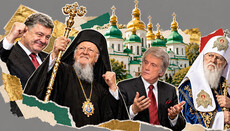
Whether that assessment is correct or not, a clear pattern emerges in the relationship between Zelensky and the UOC. Before taking office, he promised not to interfere in matters of faith. In late 2022, his administration launched large-scale measures against UOC clergy. In 2023, the Church was expelled from the Lavra. In 2024, he signed legislation effectively banning the UOC. Now comes the decision to build a pantheon in one of the most revered Orthodox shrines in the world.
If the previous steps could be presented as a struggle against alleged “Moscow-linked clergy,” the construction of a “temple of all gods” in the Lavra represents something broader – a blow against Orthodoxy itself.
Why this is happening remains unclear. Perhaps the president sincerely believes that Orthodoxy has no place in Ukraine. Perhaps he feels closer to other religious traditions. Perhaps he is influenced by advisers whose views differ from those of the Church.
Whatever the explanation, history suggests that campaigns against the Church rarely achieve their intended goals.
The Lavra survived the Mongol invasion, the bureaucratic constraints of the Synodal era, and the Soviet museum of atheism. Each time, prayer returned to its caves.
It will likely survive the “temple of all gods” as well.
The real question is what price those who initiated this latest transformation of the shrine will ultimately pay for it.