
How OCU and UGCC turn Volhynia perpetrators into heroes
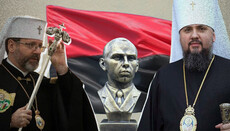
Two religious bodies that claim a special role in the life of the Ukrainian state are actively glorifying figures associated with the deaths of thousands of civilians. How did this happen, and why are they doing it?
On May 26, 2026, Ukrainian President Volodymyr Zelensky awarded the Separate Special Operations Center “North” of Ukraine’s Special Operations Forces the honorary title “Named After the UPA Heroes.” The presidential decree described the move as part of the effort to “restore the historical traditions of the national military.”
The decision provoked a sharp reaction in Poland, where many were quick to remind that OUN-UPA units were involved in the killing of tens of thousands of Polish civilians.
The backlash was swift. Poland’s president stripped Zelensky of a state decoration over the glorification of the UPA, the defense minister declared that Ukraine would not join the EU “with Bandera,” and members of the European Parliament linked the issue of the Volhynian massacres to Ukraine’s European integration.
None of this came as a surprise. For many years, the Ukrainian authorities have promoted a narrative portraying as heroes people associated with genocide and ethnic cleansing, building a cult around historical figures who shed blood. When politicians do this, one can at least understand the logic. Political power often seeks symbols, myths, and emotionally charged historical narratives.
What is far harder to explain is the active role played in this process by two religious organizations – the Ukrainian Greek Catholic Church (UGCC) and the Orthodox Church of Ukraine (OCU). Far from distancing themselves from the cult, they have helped legitimize it. More than that, they have endowed it with a religious aura and, at times, something approaching a sacred status.
OCU: “We are proud to be called Banderites”
As early as 2016, “Metropolitan” Mykhailo Zinkevych of the UOC-KP declared in a sermon following the consecration of a church in the Vovchak tract that UPA insurgents were “people of holy lives,” adding that “today we have shown our love for the UPA warriors by laying a church in their honor, naming it after them, and including them among the saints – among All Saints of the Ukrainian Land.”
In April 2019, the official OCU website published remarks delivered by Serhii (Epifaniy) Dumenko at Lviv National Agrarian University. The head of the OCU described Stepan Bandera as “a genius of the Ukrainian national and nation-building spirit” and stated: “When people call us Banderites, we are proud of it. <…> For some, the term is an insult, but for us it is an honor.”
This was not the private opinion of an ordinary “priest.” It was a statement made by the head of a religious organization that calls itself the Local Church of Ukraine and claims to serve as a spiritual pillar of Ukrainian statehood. Its leader not only refuses to distance himself from the Banderite identity but openly embraces it and presents it as a badge of honor.
The rhetoric soon moved from speeches into liturgical and memorial practice.
That same year, during a visit to the Ternopil region, Serhii Dumenko “consecrated” a memorial cross dedicated to UPA fighters.
In 2021, OCU “priests” in Ivano-Frankivsk recorded a video performing the song Batko Nash Bandera (“Our Father Bandera”) for the first time.
In organizations that call themselves Christian, the words “Our Father...” are addressed to God. “Father Bandera” represents a direct challenge to the Christian worldview. For a flash mob bordering on blasphemy, the “priests” should have received at least a reprimand. Instead, OCU head Serhii Dumenko personally endorsed it, saying the song had become a kind of anthem for Ukrainians defending “their God-given Ukrainian land.”
That same year, Epifaniy signed a memorandum of cooperation with a group of young Banderites.
Also in 2021, “Archbishop” Nestor Pysyk of Ternopil and Kremenets served a memorial service for UPA fighters whose remains had been discovered near the village of Velyki Zahaitsi and reburied “according to the Christian rite.” This was not simply a prayer service. It was a full-scale commemorative event involving members of the Ukrainian Armed Forces, government officials, and participants in military-historical reenactments. The focus was less on praying for the forgiveness of sins than on celebrating “heroes.” Nor was this an isolated episode in Pysyk’s career.
Even before the creation of the OCU, in September 2018, he “consecrated” a chapel and a restored symbolic grave dedicated to “48 heroes” of the UPA in the village of Zymne, describing it as a place of prayer for “fighters for the freedom of Ukraine.” His eparchy includes the Antonivtsi tract – formerly the headquarters of the UPA military district “Volyn-South,” now converted into a UPA museum camp. Anniversaries of the UPA’s founding are regularly commemorated there with the participation of Pysyk himself, OCU “clergy,” local officials, and members of the Plast youth organization.
In 2022, near Pochaiv, he presided over the ceremonial reburial of the remains of ten UPA fighters who, as the Ternopil Eparchy’s own report stated, were buried as “true Heroes ... with all honors and Christian customs.”
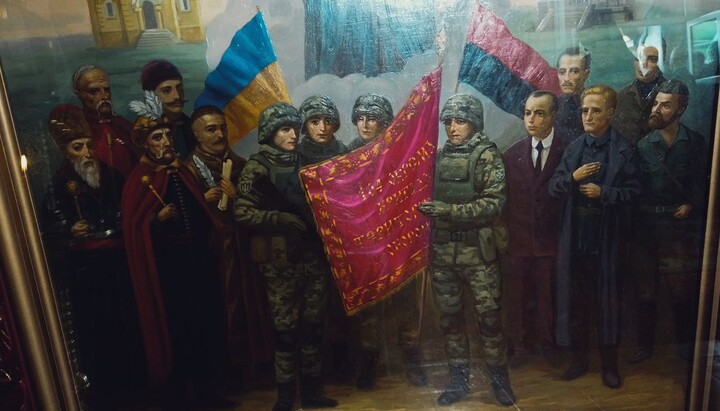
On June 18, 2023, the cult of the “heroes of the UPA” reached a new level. During a visit to an OCU monastery at the Cossack Graves memorial complex, Serhii Dumenko “consecrated” an icon depicting Stepan Bandera, Roman Shukhevych, and Yevhen Konovalets. The icon bears the title With Weapons in Their Hands and God in Their Hearts. The fact that these figures appear alongside Cossacks, UPA fighters, and contemporary Ukrainian servicemen does not change the essence of what is taking place. A nationalist movement associated with the killing of civilians is being transferred into the realm of icon veneration and church symbolism.
There is also a less blatant, yet highly revealing example of how the Bandera cult has seeped into the Church’s public culture.
On October 1, 2024, the Feast of the Protection of the Mother of God according to the new calendar, Serhii Dumenko served in vestments whose ornamentation reproduced an embroidered shirt once worn by Stepan Bandera. The design had been reconstructed from a historical photograph and was subsequently marketed under the name 'Banderivka'.
Further evidence of how deeply the cult of the “heroes of the UPA” has penetrated the mindset of OCU “clergy” can be seen in the case of chaplain Vasyl Fedorenko, whom Zelensky awarded the medal *For Military Service to Ukraine* on Constitution Day, June 28, 2026. In his acceptance speech, Fedorenko described the front line of the current war as “the line of our resurrection” and concluded by quoting Roman Shukhevych: “We must not fear death, because we have already won long ago ... through our willingness to die for Ukraine! Glory to Ukraine, glory to Ukrainian knighthood!”
A Christian does not fear death because Christ has conquered death – not for any other reason. Yet here, a different cult takes center stage.
Significantly, the cult of the UPA has also become a platform for joint activity between the OCU and the UGCC. In 2024, Nestor Pysyk served a memorial service for fallen UPA fighters in Panasivka together with clergy from both confessions. Church canons strictly prohibit such concelebration, yet the OCU and the UGCC set those prohibitions aside for the sake of their shared cult of the “UPA heroes.”
UGCC: Bandera, UPA chaplains, and the church memory of nationalism
Unlike the OCU, which was created just over seven years ago, the UGCC traces its history back to 1596 and was directly involved in many of the events now presented as “heroic.”
The Church played a significant role in the emergence of the UPA itself. Many of the movement’s members, from rank-and-file fighters to its leaders, were Greek Catholics. As a result, the UGCC possesses a much longer tradition of glorifying and sacralizing the UPA.
On October 17, 2009, a solemn memorial service was held at Stepan Bandera’s grave in Munich to mark the fiftieth anniversary of his death. In the official announcement, Bandera was described as the “leader of the Ukrainian nation.” The service was led by Bishop Petro Kryk, Apostolic Exarch for Ukrainian Byzantine Rite Catholics in Germany and Scandinavia, together with clergy of the UGCC and the UOC-KP.
Ten years later, in 2019, Auxiliary Bishop Bohdan Manyshyn of the UGCC’s Stryi Eparchy blessed the renovated Bandera family museum-estate. The event took place as part of the “Year of Stepan Bandera” and Ukraine’s Defender Day celebrations. In his sermon, Manyshyn stated that the estate belonged not only to the Bandera family but to all of Ukraine, because it was there that “the patriotic spirit of the leader of the Ukrainian nation” had been formed.
That same year, a solemn memorial service was held at a monument to Bandera with the participation of UGCC Archbishop Volodymyr Viityshyn, as well as students and faculty of the Ivano-Frankivsk Theological Seminary of the UGCC. In the sermon, Bandera was described as “a hero of Ukraine” and “a figure worthy of emulation.”
Also in 2019, UGCC Bishop Vasyl Ivasiuk of Kolomyia blessed the Shukhevych family museum-estate in Tyshkivtsi. The official announcement referred to Roman Shukhevych as “a legendary figure of the twentieth-century national liberation struggle.”
In 2021, the UGCC Synod published a laudatory article entitled "Confessors of the Faith: Fr. Vasyl Shevchuk – UPA Priest and Ensign ‘Kadilo’", in which Shevchuk was described as one of the “most self-sacrificing chaplains of the UPA.”
In October 2022, a prayer service marking Ukraine’s Defenders Day and the 80th anniversary of the founding of the UPA was held at the UGCC’s Cathedral of Holy Wisdom in Rome. Among those present were Oleksandr Yarema, State Secretary of the Cabinet of Ministers of Ukraine, and Andrii Yurash, Ukraine’s ambassador to the Holy See. The event offered a clear example of the close partnership between the Ukrainian state and the UGCC in honoring the “heroes of the UPA.”
In October 2024, UGCC Bishop Petro Holinei and local clergy blessed a “Monument to Insurgent Glory” in the Kosiv region. The accompanying report described the village of Kosmach as the “capital of Banderism,” while stating that the monument “further underscores the immortal glory of the Ukrainian Insurgent Army.” Following the blessing, Holinei declared: “Today we do not weep. We celebrate the memory of glorious moments of battle...”
In December 2024, the UGCC Department of Military Chaplaincy and its pilgrimage center organized a pilgrimage for the families of fallen Ukrainian soldiers to various shrines across Europe. Among those “shrines” was the grave of Stepan Bandera, where prayers were offered “for all the fallen warriors who gave their lives for the freedom of Ukraine.”
The UGCC also contains iconographic depictions of Bandera. One example is a fresco in the Cathedral of the Immaculate Conception of the Mother of God in Ternopil, the cathedral church of the UGCC.
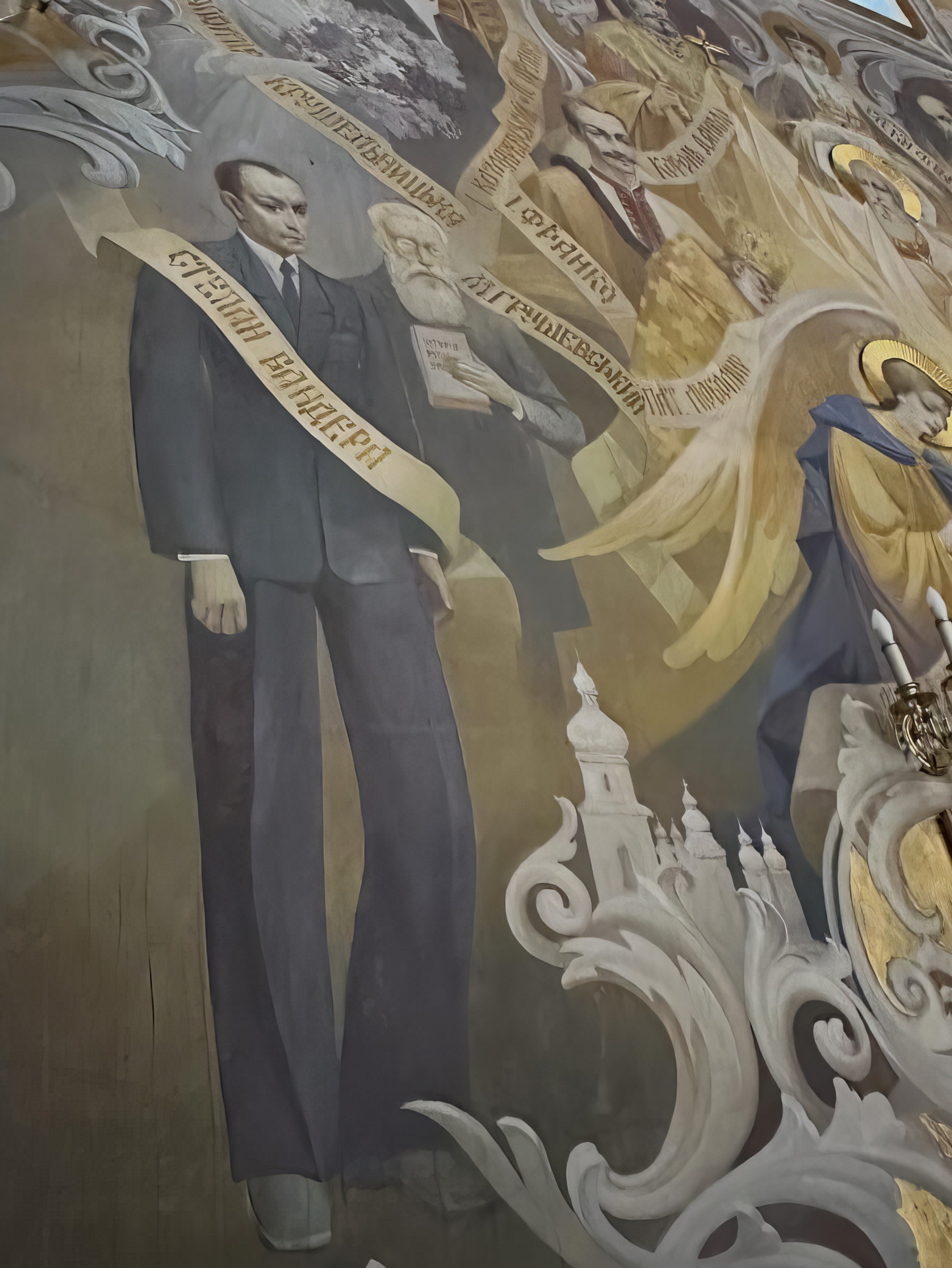
Finally, in May 2026, Ukraine held a state reburial ceremony for Andriy Melnyk, leader of the OUN, and his wife Sofia. For several days, their remains lay in the UGCC Patriarchal Cathedral in Kyiv, where the bishops and clergy of the UGCC conducted funeral rites before the couple was reinterred at the National Military Memorial Cemetery. The ceremony was attended by Ukrainian President Volodymyr Zelensky and other senior government officials. At the cemetery, UGCC Bishop Yosyp Milan and OCU “Archbishop” Yevstratiy Zoria, together with clergy from both churches, conducted a joint prayer service.
Particularly revealing were the words spoken by Yosyp Milan during the burial: “This moment is not merely an act of reburial. It is not only the return of remains; it is the return of meaning. It is a reminder to us, the living, that a state cannot be built without memory, a nation cannot stand without unity, and freedom has no future without a moral foundation.”
In other words, the foundation of Ukraine’s future is being built upon the veneration of individuals associated with the killing of civilians and collaboration with the Nazi regime.
Where prayer ends and cult begins
At this point, an important distinction must be made between praying for the dead and glorifying them, heroizing them, or building a cult around them.
When criticized, representatives of the UGCC and the OCU typically respond that they are merely following the Christian practice of praying for those who have departed this life. And it is true: the Church prays for everyone. But prayer and cult are not the same thing.
Prayer is directed toward God. A cult is directed toward a person and toward society.
In prayer, we ask the Lord to forgive sins. In a cult, we transform a person into a model to be imitated and invest that person with a quasi-sacred status.
Prayer is an act of mercy toward the dead. A cult is an act of violence against the memory of innocent victims.
It is precisely this kind of cult-building that the UGCC and the OCU are engaged in. Figures who are, to put it mildly, highly controversial historically and deeply problematic morally are presented as “heroes,” “freedom fighters,” “leaders of the nation,” “knights,” and “warriors of light.” Their memory is sanctified through solemn services, iconography, and highly publicized commemorative events.
When a church leader publicly calls Bandera “a genius of the national spirit,” when a bishop blesses his family museum and speaks of him as “the leader of the Ukrainian nation,” when seminarians are told after a memorial service that he is a figure worthy of emulation, and when UPA leaders appear on icons alongside the Most Holy Theotokos, this is no longer prayer for the forgiveness of sins. It is the sacralization of a national myth.
Equally telling is what one does not hear in the statements of OCU and UGCC representatives. There are no calls for repentance before the victims. There is no acknowledgment of atrocities committed against civilians. No appeals for forgiveness from Polish families. No attempt to reconcile Ukrainian historical memory with the memory of murdered Poles.
Instead, one hears only about “heroes,” “leaders,” and the “immortal glory of the UPA.”
The victims of “UPA heroes” cannot be silent
The OUN and the UPA can be assessed in different ways as historical phenomena. One may speak of resistance to Soviet rule, of the tragedy of the Ukrainian people, or of the brutal multi-sided conflict that engulfed western Ukrainian lands.
The history of the twentieth century was extraordinarily complex and bloody. But the struggle for independence does not erase historical facts: collaboration with the Nazis, the killing of civilians, the destruction of villages, and anti-Jewish pogroms.
None of this can be sanctified.
None of this can be justified.
Not by anti-Soviet resistance. Not by reasons of state. Not by appeals to historical justice.
Consider just one example.
On July 11, 1943, UPA units launched coordinated attacks on ninety-nine Polish villages in Volhynia and killed approximately 8,000 Poles, most of them women, children, and the elderly. In total, roughly 100,000 Poles were killed by OUN-B and UPA forces between 1943 and 1945. Poland’s Institute of National Remembrance classifies these events as genocide.
In June 2026, Polish President Karol Nawrocki, announcing the revocation of Volodymyr Zelensky’s Order of the White Eagle, stressed that the decision was not directed against the Ukrainian people and did not alter Poland’s strategic support for Ukraine. At the same time, he emphasized that naming a Ukrainian military unit after the “Heroes of the UPA” went far beyond the sphere of Ukraine’s internal affairs.
Israel has also reacted. Back in December 2018, Israel’s ambassador to Ukraine, Joel Lion, sharply criticized the Lviv Regional Council’s decision to declare 2019 the “Year of Stepan Bandera.” He said he was “shocked” and asked how honoring individuals linked to anti-Semitic crimes could possibly help combat anti-Semitism and xenophobia.
In January 2020, the ambassadors of Israel and Poland, Joel Lion and Bartosz Cichocki, issued a joint statement condemning Ukraine’s memory policy. They described the honoring of Stepan Bandera and Andriy Melnyk as an “insult” to the memory of the “innocent brothers and sisters” murdered on territories that now belong to Ukraine.
In 2022, Israel’s embassy condemned a nationalist march honoring Bandera, stating, in a quotation cited by the European Jewish Parliament: “Any attempt to glorify those who supported Nazi ideology desecrates the memory of Holocaust victims in Ukraine.” Nor were diplomats the only ones to respond.
In 2019, after a monument to Roman Shukhevych was erected in Ivano-Frankivsk, the World Jewish Congress called on Ukraine to stop glorifying such figures. The organization said it was deeply troubling that individuals who promoted a Nazi agenda and participated in the murder of Jews were now being celebrated as heroes.
Then, in May 2026, Israel’s Foreign Ministry reacted to the state reburial of Andriy Melnyk, expressing regret over an official ceremony honoring a man who collaborated with the Nazis and emphasizing that there can be no place for ignoring historical truth.
At the same time, the Yad Vashem Holocaust Memorial Center stated that honoring the leader of a movement that supported Nazi Germany and cooperated in the persecution and murder of millions of Jews undermines the moral integrity of Holocaust remembrance.
Polish officials ask a logical question: can a country that seeks a European future build its national and religious identity upon the glorification of a movement associated with the mass killing of civilians?
We would ask a different one:
Can church structures that aspire to a special place within the state engage in the glorification and sacralization of individuals linked to the bloody deaths of thousands of innocent victims?
The question is rhetorical. In practice, they already do. And it is entirely possible that one day we will witness the ecclesiastical canonization of Bandera, Shukhevych, and other similar figures.
The servility of churches seeking a special role in the state
Today, both the OCU and the UGCC aspire to such a role in Ukraine. From its very inception, the OCU has presented itself as a symbol of Ukrainian statehood. The UGCC has long claimed to be the spiritual voice of the Ukrainian national idea. Such ambitions inevitably impose obligations toward the state. They are expected to provide religious support for state projects and to supply ideological and quasi-sacred foundations for national myths.
Yet those projects and myths often come into direct conflict with the Gospel and the teachings of Christ. The glorification of the OUN and UPA is one such case.
The Church should stand with its people. It cannot remain completely detached from history. But that does not mean it must grant ecclesiastical legitimacy to every state initiative or function as an instrument of political propaganda.
The Church may offer a moral evaluation of political actions and historical events based on the Gospel. It may not reshape its message to fit the latest national pantheon. And when a church begins serving state interests and adapting itself to public demand at the expense of Christ’s teaching, one is entitled to ask:
Is this truly Christ’s Church?
Before our eyes, something is happening in Ukraine that should not be happening. The state is constructing a cult around historical figures associated with genocide, mass killings, pogroms, and ethnic cleansing. The OCU and the UGCC, meanwhile, clothe that cult in a pseudo-Christian garment.
They furnish it with ecclesiastical symbolism. They introduce it into liturgical practice. They weave it into iconography.
The Gospel teaches no such thing.
Conclusion
Ukraine is currently enduring a devastating war. Part of its territory remains under occupation. Soldiers and civilians continue to lose their lives. Ukrainians have every right to defend their country against Russian aggression and to uphold their sovereignty.
But war does not grant anyone the right to pretend that the blood of Polish civilians, Jews, Ukrainians, and all other victims of nationalist violence ceases to matter simply because it was shed under the banner of freedom and independence for Ukraine.
The Church may pray for the dead. What it may not do is transform those responsible for the killing of civilians into sacred symbols of national memory. Under all circumstances, it must remain faithful to Christ rather than to the latest state-sponsored myth.
The Apostle Paul wrote to the Galatians: “For if I yet pleased men, I should not be the servant of Christ” (Galatians 1:10).
A Church that seeks political expediency by pleasing those in power and sanctifying their historical myths ultimately loses the very thing for which it exists: its freedom to bear witness to Christ.