
Shameful chronicle of one week: how the OCU was born
Exarchs under escort, a call from the operations room, and 36 votes for Epifaniy: what a member of the Phanar delegation revealed about the 2018 "Council".
The UOJ-USA has published an internal report by a cleric of the Patriarchate of Constantinople who accompanied Metropolitan Emmanuel of France in Kyiv in December 2018. The document is addressed personally to Patriarch Bartholomew and was written about a month after the events, in January 2019. It covers exactly one week: from Monday, December 10, when the author flew to Kyiv, to Sunday the 16th, when the delegation returned to the Phanar. According to the publication's sources, the author of the report is the current Metropolitan Gregorios of Ankara, who in 2018 was a young deacon of the Patriarchate. This is neither journalism nor memoir, but an official report of the kind written for a single reader, and therefore with utmost candor and in every detail.
It is precisely this that makes the document both valuable and dangerous for the Phanar. All public statements by the Ecumenical Patriarchate about the "Unification Council" of December 15, 2018, at which the OCU was actually created, were couched in the most solemn terms: the Patriarchate, "in praise of God and in great joy," announced the successful conclusion of the Council. The report, however, was written by a direct participant in the events and was not intended for public scrutiny. Consequently, the picture it presents is entirely different, and so are the colors in which those events are depicted.
The authenticity of the document is indirectly attested by the author's awareness: he knew the protocol of the Phanar delegation down to the smallest details, including the names of the Presidential Administration staff and the schedule of meetings with UOC bishops and OCU "hierarchs," as well as the exact breakdown of the votes when the list of three candidates for the post of head of the newly created structure was compiled.
It should be noted that the Greek media have already managed to comment on the document, and in their opinion "it is concrete enough not to be left unanswered." "If political pressure was exerted on the patriarchal delegation, this needs to be clarified. If the descriptions are inaccurate, an equally clear denial backed by facts is needed. Silence leaves room for suspicions surrounding the critical days of December 2018," says "Ekklisia Online". Well, let us see what the report of a participant in those very events says.
She teaches, and you learn
The author of the chronicle is convinced that the main task of the Phanar delegation in Kyiv was to protect the interests of the Patriarchate of Constantinople. It was precisely from this that the delegation proceeded in its work in Ukraine.
Here is a conversation in a restroom, where the author went "to splash a little water on his face" and met "Archbishop" Eustratius Zoria, at that time Filaret's right-hand man. Zoria asks how he sees the situation. The answer is worth quoting, because it is, in essence, a manifesto: "We did not come here to negotiate, nor to call into question the rights of the Mother Church. She teaches, and you learn. In this case we are not negotiating as equals with equals."
And further: "Do you want insane demands? You will remain in schism. This is the last chance for the elder Filaret to become a hero. If he misses it, he will end his life a schismatic. We are in the position of benefactors, not the benefited."
And all this is said not by a metropolitan or a patriarch, but by a Phanar deacon – in a restroom, to a Ukrainian "archbishop" who formally stands far above him in the hierarchy. It is telling that Zoria not only was not offended by his interlocutor's brazen tone, but even thanked him.
The same intonation is heard from Metropolitan Amphilochios of Adrianople, when on the day after the Council he serves at St. Michael's Monastery and says that the Mother Church "baptized the Ukrainian people anew."
The author relays this without a shadow of embarrassment, as a very felicitous remark. But let us consider what this phrase meant for those who heard it: a people with a thousand-year Christian history is declared baptized anew because a Constantinople delegation spent a week in Kyiv and organized a "council" at which schismatics received legitimacy. This position strongly resembles colonial rhetoric, and for Ukrainian church self-awareness it is offensive regardless of jurisdiction.
No less expressive is the scene concerning the dissolution of the structures of the Kyiv Patriarchate and the UAOC.
First, the author writes their names only in quotation marks. Second, he explains to Zoria that the document on self-dissolution must be signed before the Unification Council, because dissolving at it an organization that "the Mother Church never recognized" would mean indirectly recognizing it (!). Thus a representative of the Patriarchate of Constantinople effectively confirmed that the Phanar never considered the UOC-KP and the UAOC to be a Church. But the author goes further and adds a threat: if there is no dissolution, Metropolitan Emmanuel will not take part in the forthcoming event, "and you will be disgraced to the ends of the earth." And immediately, in parentheses, he reveals to the reader his "hidden calculation," writing about it bluntly: if something went wrong, the Ukrainians would retain a path back, but with dissolution "this path of retreat would be closed, and they would be bound."
In essence, this is the key phrase of the entire document. It explains very well why the Phanar needed the self-dissolution of the UOC-KP and the UAOC on the eve of the Council rather than after it: not for the sake of ecclesiological purity, but to bind the participants and deprive them of room for maneuver. The author himself calls it a calculation and himself calls it hidden. It turns out that the Patriarchate of Constantinople understood perfectly well that the representatives of the UOC-KP were capable of any "maneuvers" and could simply deceive the Greeks without a twinge of conscience.
Filaret's break with the OCU in 2019, when he tried to revive the Kyiv Patriarchate and discovered that legally it no longer existed, only confirmed the fears of the Phanar delegation.
The guest residence and the operations room
The official version of the events of December 2018 has always insisted that the state merely "assisted" the Church. However, the chronicle shows with utmost candor what this "assistance" looked like from the inside.
The cleric of the Patriarchate who arrived in Kyiv was met by "Presidential Administration staff accompanied by police" and taken to the President's guest residence, where the exarchs were staying. On the evening of December 11, representatives of the special services came to this residence "for briefing" and reported to Metropolitan Emmanuel about "the real intention of many (bishops) from Onuphry's group to come to the Council" and about their "fears of Moscow." In other words, the Ukrainian intelligence services served as a source of information for the Constantinople delegation regarding the sentiments of the episcopate of the canonical UOC. The sessions on drafting the Statute of the future OCU were held "in the presence of Mr. Rostislav Pavlenko on behalf of Mr. President and Andriy Yurash" – the deputy head of the Presidential Administration and the then director of the Department for Religious Affairs of the Ministry of Culture. Filaret's demands concerning the Council were discussed at a meeting with the same Pavlenko and Yurash.
Then begins what in any other country would be called a scandal. To run ahead: after the failed night meeting with Poroshenko, which will be discussed in the next chapter, the exarchs decided to leave. Understanding that any discussion "aimed at working out a radical solution would be disrupted due to the constant surveillance of everything in the building," they switched to communicating "silently, by means of handwritten notes on paper." And the draft communiqué was sent to the Patriarch only in the morning – "solely because we knew that everything said in telephone conversations was being heard." Metropolitan Emmanuel demonstratively bought a plane ticket at his own expense, "so that those in power would see it," packed his luggage, and called cars to take him to the airport.
What happened next, the author recounts almost in a matter-of-fact, report-like manner. The President asked Metropolitan Emmanuel to stop by the palace "for a short while." An hour passed, but there was still no word from him. Then a message arrived "that the police were coming to take all of us together to the Presidential Palace."
The delegation was brought "under escort by a strong police force." On the way, Bishop Daniel of Pamphilon, a US citizen, reported what was happening to the American Embassy, and Metropolitan Amphilochios to the Greek Foreign Ministry. At the Presidential Palace, the Constantinople delegates had their phones taken away and were subjected to personal search. To Metropolitan Amphilochios's question, the head of the delegation, Metropolitan Emmanuel, replied that "we are detained and forbidden to leave the country."
The delegation was released only after a conversation with the Patriarch, and went to a restaurant to discuss matters "in another place." The author notes: "throughout the 'meal,' more than ten secret agents moved around us, making little effort to conceal their secret character."
Here it is worth recalling that all this is not "Moscow propaganda" but a documentary report by a Phanar cleric. It records that the exarchs of the Ecumenical Patriarch were in fact detained by the Ukrainian authorities, deprived of communication, and delivered under escort to the President, so that in their presence he might obtain the desired decision from Patriarch Bartholomew. The presence of the head of the security services at the late-night meeting involving Poroshenko, Filaret, and Emmanuel is mentioned by the author almost in passing, like a detail of the setting but it is a highly telling detail.
Separately, it is worth noting how the chronicle describes the state's participation in the "Council" itself.
Poroshenko personally persuaded Filaret to sign a renunciation of all positions in the new church structure and a document on the dissolution of the UOC-KP. Earlier, parliament speaker Andriy Parubiy had also gone to Filaret with the same purpose.
And when Denysenko from the rostrum of the "Council" demanded the right to run for the post of primate of the OCU, "a man dressed in military uniform approached the President and demanded Filaret’s candidacy, but the President restored order." In other words, the rules at the "Council" were determined by the President and his aides. In fact, it was a state-organized event to which "bishops" had been invited.
You are not ready for autocephaly
The central episode of the chronicle begins at eleven o'clock in the evening of December 13, when Poroshenko summons Metropolitan Emmanuel for a "consultation." The other exarchs wait in the reception room "in a state of unspeakable anxiety and in the cold."
Metropolitan Emmanuel returns at two o'clock in the morning "downcast and deeply saddened" and reports that for the meeting with Poroshenko the special services demanded that he take off even his wristwatch, and that, besides the President, Filaret and the head of the security services were also present in the office.
Filaret was "unyielding and inflexible" and "had the President’s silent support." The outcome: "Unfortunately, we shall fail."
The author describes in the utmost detail everything Filaret demanded. The day before, Zoria had read to the exarchs a draft communiqué according to which the future "Unification Council" elects a primate, but Filaret remains "Chairman of the Holy Synod, Exarch of All Ukraine with the rights of a Primate, that is, convening the Synod, episcopal elections, depositions, etc." Metropolitan Emmanuel explained that this "would be an unprecedented step in the ecclesiology of the Orthodox Church and we would become a laughingstock throughout Orthodoxy." However, Zoria "insisted very stubbornly, threatening that without this there would be no Council."
And here the author drops a phrase that explains well what was going on: "The paradox is that the representatives of the state, who had repeatedly assured us that they would in the end persuade the elder Filaret, at that hour took no more and no less than the position of Mr. Eustratius. His Grace the Exarch was left alone."
That is, at the decisive moment Poroshenko was ready to hand Filaret the actual governance of the new Church under a nominal primate, just so that the "Council" would take place. The Phanar refused this, and this is indeed an important point in the whole story – the one at which the interests of Constantinople and Kyiv genuinely diverged. Representatives of the Patriarchate of Constantinople understood perfectly well who Filaret was and what he represented.
And here a logical question arises: did they understand this in Constantinople when they decided to lift the anathema from Denysenko, recognizing it as imposed for political considerations rather than for schism? The answer, it would seem, is obvious.
The denouement of the "Council" story comes on the afternoon of December 14 in the operations room, to which the exarchs were brought, again, under escort. Poroshenko sets up a speakerphone connection with the Patriarch. According to the report, Patriarch Bartholomew said to the President of Ukraine: "I have learned from His Eminence of France about the difficulties, and I am sorry that the problematic behavior of one person alone proves that you are not ready for autocephaly." And further: "I honor you and respect you, but I am not going to sell the dignity of the Patriarchate to any Filaret. And if you are not in a position to impose order upon him, I am sorry, but my people must depart. At the Phanar we learned to fear no one and nothing where its rights from the ages are concerned."
Poroshenko's answer looks both strange and habitual for Ukrainian politicians, who are used to covering their actions with threats from Russia: "Your Holiness, the situation in Ukraine is such that if we do not hold the Council tomorrow, there is a likelihood of military intervention by Russia, which will see our weakness." The Patriarch replied: "Then correct the situation immediately."
Next, Poroshenko read out a draft of a letter that he himself would give Filaret to sign.
According to the draft, Filaret renounces any position in the new Church except permanent membership in the Synod. In the end, Patriarch Bartholomew agreed to continue, but only if "my Exarchs assure me that none of the privileges of the Mother Church is under threat." Poroshenko "immediately and joyfully said goodbye to everyone and hurried to the elder Filaret to obtain his signature with his own authority." The signature was brought an hour later. What Poroshenko said to Filaret we do not know. We know only that in 2019 Denysenko, reviving the UOC-KP, stated that he had been deceived – by Poroshenko, and by Dumenko and Zoria.
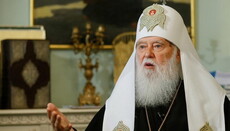
But let us return to the document and try to assess the situation. The Patriarch of Constantinople, in the presence of the President and his special services, states that Ukraine is not ready for autocephaly. The President responds not with a church argument but with a military one: without the "Council" there will be an invasion by the Russian Federation. And the next day the "Council" nevertheless took place. It was held not because "readiness for autocephaly" had suddenly emerged, but because teh President had obtained a signature from the ninety-year-old "hierarch," which the latter would subsequently claim had been received through deception.
The author, of course, reports this with delight, but a reader who does not belong to the Phanar delegation sees something else here. He sees that the Tomos was issued after pressure from Poroshenko, who used the argument of war, and that the Patriarch himself at the decisive moment knew that he was granting autocephaly to a church that he himself had called unready for it.
There is also a human dimension in the situation, which the author was unable to hide.
On the morning of December 15, when Filaret refuses for hours to sign the dissolution of the "Kyiv Patriarchate" and the entire square in front of St. Sophia’s is waiting in the cold, the author writes: "In our hearts, we understood such an act. It was perfectly natural. The 'Kyiv Patriarchate' was a matter of a lifetime and of deeply held convictions for the ninety-year-old hierarch." And at the end, when Zoria, "in tears," hands Emmanuel the signed document and says, "Father, I think you know what this document means to us," the author replies: "The Mother Church is a physician. Every operation causes pain, but it heals.”
Half a year will pass, and the "healed" UOC-KP will rise from the operating table, declaring the entire "operation" unlawful, and the "surgeons" and their "assistants" deceivers. The chronicle, without intending to, explains with utmost clarity why this happened.
The Statute as an instrument
Disputes over who wrote the Statute of the OCU and whom it benefits have been going on since December 2018. Filaret, as we remember, claimed that the Statute was written in the interests of Constantinople. The chronicle of the Phanar delegation member essentially confirms this. The Statute was indeed written by the exarchs, "defending by all means the eternal privileges of the Holy Great Church of Christ," while the Ukrainian representatives merely accepted the text. The final edit the author made himself: "first I corrected it in Greek, and then in their language through English and Ukrainian translations." The Ukrainian text of the OCU Statute is thus a translation from Greek via English.
The most candid part of this section of the report is devoted to the technology of negotiations. The author puts "concessions" in quotation marks and explains that these were merely ruses for advancing the interests of the Phanar. He chooses the example himself.
The draft stated that the guarantor of the Statute is the Ecumenical Patriarch. They worked on this phrase for an hour. Finally Zoria asked what it meant, and then-Deacon Gregorios, by his own account, had been waiting for this question "from the very beginning."
He declares that "today in the new Church there are grateful people, but tomorrow ungrateful ones will come and want to introduce provisions contradicting the Tomos, so the guarantor of the Statute's conformity with the Tomos must be the Patriarch."
Zoria proposed spelling this out in detail. They did. However, at the end of the session Eustratius admitted that the detailed wording "had become more binding than the original," but did not go on to change it. "I should have been content with the original," Zoria said. The author sums up: "By means of such practical and partly illusory 'concessions,' the position of the Holy Great Church of Christ was secured."
In fact, what we see here is not negotiations but behind-the-scenes games in which one side sets the rules and the other merely thinks it is participating in the discussion. This is worth recalling every time OCU representatives say that the Statute reflects the will of the Ukrainian church people.
The second example concerns the name of the new structure. During the final editing, Zoria proposed removing the word "Autocephalous" from the Church's official name, calling it "non-ecclesiological." The author agrees, but explains to the Patriarch the true background: Zoria did not want this word because of its association with Makariy's UAOC. As for the Phanar, Zoria's proposal suited it, "since 'autocephalists' is an odious and unacceptable notion." Thus, the new ecclesiastical structure, for whose autocephaly the whole process had supposedly been undertaken, ended up without the word "autocephalous" in its name: to one side, it was a reminder of the rivals; to the other, of the schismatics. As for the Ukrainian people, supposedly yearning for autocephaly, no one even remembered them in this situation.
The third example, self-dissolution, has already been mentioned. But here one should also say something about the procedural side. On the morning of December 14, even before the call to the Patriarch, the author, with Met. Emmanuel's permission, sets Pavlenko a condition: before the "Council" the legal entities of the Kyiv Patriarchate and the UAOC must be dissolved. Yurash suggests telling the representatives of these structures about it "privately, not in front of everyone." The author replies: "His Grace the Exarch will not come down to the Council if this is not done." Zoria tries to move the dissolution into the framework of the Council or to the time after it, but is refused. Then the Ukrainians ask to have a draft of the dissolution prepared for them, and… it is drafted by a deacon of the Patriarchate.
Thirty-six votes
How exactly Epifaniy was elected had until now been known only from the retellings of participants, which differed in details. The chronicle, however, gives figures from a person who himself affixed the Council's seal to the ballots and was "constantly present" at the vote count, which was led by Bishop Daniel (Zelinsky) of the Patriarchate of Constantinople.
First, Metropolitan Emmanuel announced that all hierarchs could be candidates, "with the exception of two bishops – Filaret and Makariy." Filaret objected from his seat: "Are we deprived of the right of election? Everyone here has a name and a title. I have none. Why?" He was answered first by UOC Metropolitan Symeon (rather sharply), and then by Makariy. After that Metropolitan Emmanuel "with gravity and gratitude read out Metropolitan Filaret's letter to Your Holiness, in which he renounced any position in the new Church." Thus the letter obtained by Poroshenko the day before was presented to Filaret himself as a fact of renunciation, and this was done before two hundred delegates.
Then 121 people voted for a secret ballot and 41 for an open one. After that a list of three candidates was drawn up, in the formation of which "hierarchs," "clerics," and laity took part: Epifaniy – 81 votes, Symeon – 56, Mykhailo Zinkevych – 38.
And here there is an interesting moment: "Metropolitan" Mykhailo Zinkevych refused inclusion in the list. The next in votes, "Metropolitan" Dimitriy, also refused. After that, according to the author, everyone refused, "to the point that the elder Filaret was forced to beg someone who had received one vote each, even without their knowledge, to agree to inclusion among the 'three persons,' which is what ultimately happened."
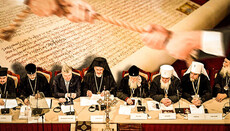
That is, the third candidate in the final list turned out to be a person with a single vote, who was included there without even obtaining his consent! Only after this did Filaret "approach and, having voted, bless the ballot box with an effective and symbolic gesture." In the final vote, in which only "bishops" of the UOC-KP, the UAOC, and two bishops from the UOC took part, Epifaniy received 36 votes and Symeon (Shostatsky) 28.
Of the 64 "bishops" who voted, 36 spoke for Epifaniy, that is, slightly more than half. Symeon, the only one of the two bishops who had come over from the UOC to be nominated, received 28 votes. In all likelihood, besides Drabinko, a significant part of the UAOC "episcopate" voted for him, as well as those "hierarchs" of the Kyiv Patriarchate who did not want to see Filaret's protégé at the head. Had Mykhailo – according to the chronicle, the "opposition candidate" – not withdrawn his candidacy, the outcome could have been different. In the end, the first “Primate” of the OCU won by a margin of eight votes in an election in which the two main figures had been excluded beforehand, while the third candidate was added to the list without his knowledge.
And this is no longer a detail, but a direct question: how legitimate was Dumenko’s election?
The question of legitimacy should also be raised in connection with the author’s assertion that the Phanariots themselves voted at the "Council." According to him, he "insisted that the list be brought to the Exarchs, and that this be done in the middle of the procedure, so that – neither at the beginning nor at the end – it would be possible to see how each person had voted." In other words, the Exarchs of Constantinople voted in the election of the "Primate" of the Ukrainian church.
Two out of the "many"
The entire plan for the "Unification Council" rested on the expectation that the episcopate of the UOC would split and that a significant portion of it would join the new structure. The chronicle shows where this confidence came from and how it ultimately fell apart completely.
On December 11, then-Metropolitan Oleksandr (Drabinko) of the UOC came to see the Exarchs. He is described as a representative of "Onuphry’s group." According to the author, he "warmly expressed his support for the canonical actions of the Mother Church and reported that many secretly wished to join the new body, but feared, on the one hand, that the Phanar would ultimately take no action to protect them, and, on the other, that Moscow’s actions against possible 'defectors' would be merciless."
Metropolitan Emmanuel assured Drabinko that the Patriarch, "exercising his right to provide assistance through appeals beyond his borders, would in no way abandon clergy of any rank who joined," and asked him to "convey this in the strictest confidence to all sides, in order to encourage those who wished to join."
That evening, the Ukrainian security services confirmed the "genuine intention of many from the group of His Beatitude Onuphry to attend the Council." A dinner with Shostatsky and Drabinko then took place, paid for by the latter. Clergy members who were "intending to follow them" were also present at the dinner.
In the end, however, the only representatives of the UOC who came to the "Council" were the same Shostatsky and Drabinko. The chronicle does not even discuss this fact; the author simply moves on to describing the presidium, where Symeon is seated "as the first of Onuphry’s group," which consisted of him and Drabinko.
This point is important for two reasons. First, it documents the mechanism: Constantinople promised UOC bishops protection through the right of appeal, that is, through the very same disputed canonical instrument on which the entire Phanar argument concerning the Ukrainian issue rests, while obtaining information about the sentiments of the episcopate from the Ukrainian security services.
Second, it shows just how far the picture presented to the Exarchs diverged from reality. Both Drabinko and the security services spoke of "many." According to them, public opinion "warmly supported" everything that was happening. Yet only two out of the 98 UOC bishops at the time attended the "Council", which, in practical terms, is little more than a statistical margin of error.
The meeting with the "bishops" of the UOC-KP on the evening of December 13 is also telling. "Metropolitan" Mykhailo arrived with seven "hierarchs," who are described in the document as being "among those who resisted." It turned out that "they had no knowledge or information whatsoever about the course of the discussions," that they "were afraid to express their views in a vote because the gray-haired elder Filaret was imposing an open vote on them," and that they "demonstrated a lack of inner readiness." According to the author, "Metropolitan" Anthony (apparently Makhota) "moved everyone deeply": "We have lived in schism for so many years, in darkness and in the shadows, like prisoners of our own choice… We have become accustomed to living in schism and, as it were, to self-sufficiency. We often fail to realize the pitiful state we are in. Help us at least to understand our problems."
This is said by a serving "hierarch" of the Kyiv Patriarchate. The author presents these words as a touching testimony of repentance. But in reality, they sound quite different: the "episcopate" that Constantinople recognized as canonical by a single synodal decision – without repentance or reordinationm – was itself describing its condition as schism, darkness, and captivity just 48 hours before the Council. This admission has never been made public until now.
It has happened before
Church history knows of many acts adopted under pressure from secular authorities. The chronicle inadvertently places the events in Kyiv in this category, and it is useful to recall how such acts ended.
The closest parallel and the most uncomfortable one for the Phanar is 1589.
Ecumenical Patriarch Jeremiah II came to Moscow seeking financial assistance and spent more than six months there, actually in the position of an honored prisoner. Tsar Feodor I and Boris Godunov secured his agreement to the establishment of the Moscow Patriarchate, and according to the sources, Jeremiah agreed reluctantly and under pressure. Constantinople later spent centuries reminding Moscow that the patriarchate had been granted to it "under constrained circumstances."
The December 2018 chronicle describes essentially the same pattern with striking precision: the Exarchs at the residence of the head of state, their phones confiscated, a ban on leaving, and a president who, in the presence of the head of the security services, obtains the desired decision. The only difference is that Jeremiah needed six months, while Emmanuel needed just one night and a phone call.
If the Phanar considers the act of 1589 to have been coerced and therefore flawed, it will have to explain how the act of 2018 differs from it.
The second parallel is the Council of Florence in 1439. Emperor John VIII Palaiologos brought a Greek delegation to Italy in pursuit of military assistance against the Turks and secured the signing of the union. The argument was the same as Poroshenko’s: if you do not sign, the enemy will come. All the Greeks signed, with the exception of St. Mark of Ephesus. After returning home, those who had signed withdrew their signatures one after another, while the people never accepted the union with the Catholics.
Just fourteen years later, Constantinople fell. The military argument in an ecclesiastical matter proved futile, and the signatures placed under pressure were not worth the paper on which they were written.
There is a third parallel, closer in time. In 1870, a sultan’s firman established the Bulgarian Exarchate, and in 1872 the Council of Constantinople declared the Bulgarians schismatics, condemning "ethnophyletism," that is, the subordination of ecclesiastical organization to the national principle. The schism lasted 73 years. For the Phanar, it became enduring evidence that the Church cannot be created by the state along national lines. In Kyiv in 2018, the country’s president pushed through the creation of a new Church with the participation of the parliamentary speaker and other officials and did so on a purely national basis. The word "autocephalous," as we have seen, was removed from the name for tactical reasons. But removing a word is easier than removing a precedent: the Bulgarian history has not gone anywhere.
The fourth parallel is Estonia in 1996. It shows how such situations usually end. Constantinople revived its 1923 Tomos and established a parallel structure in the canonical territory of the Moscow Patriarchate. Moscow broke communion with Constantinople, and several months later the parties reached an agreement on two parallel jurisdictions. This was possible in Estonia because the matter involved dozens of parishes. But in Ukraine, the issue concerns thousands of parishes and dozens of monasteries! This is precisely why an "Estonian compromise" proved impossible on the Ukrainian scale. A member of the Phanar delegation to Kyiv explains why: Constantinople’s entire calculation was based on a mass defection of the UOC episcopate, which ultimately did not happen.
Finally, it is worth recalling how Constantinople itself experienced pressure from secular authorities. Patriarch Constantine VI was expelled from Turkey in 1925 as part of a population exchange. Patriarch Maximos V was forced to step down in 1948 under the pretext of illness, while his successor, Athenagoras, flew from America aboard a plane provided by President Truman. The Phanar remembers these events as humiliation and violence against the Church. Yet in Kyiv, the guardians of this memory did not voice the slightest protest when the state organized a church council and effectively held them hostage.
Once again: in all the cases listed above, the outcome was the same. An act adopted under pressure did not simply disappear, but neither did it acquire the necessary fullness and authority within the Church. It remained a subject of dispute for subsequent generations until the Church found the strength either to affirm it freely or to revoke it. The 2018 Kyiv act has so far been confirmed by neither of these means, and the report to Patriarch Bartholomew explains very clearly why it is so difficult to regard it as a free act.
Who will read what into this
A document written for a single reader has now become public, and everyone will find something different in it.
Moscow will find confirmation of everything it has been saying since 2018: the "Unification Council" was a state-organized event; autocephaly was granted under pressure and on the basis of political rather than ecclesiastical arguments (that without the "Council", Russia would supposedly attack); the Exarchs acted in contact with the security services; and attempts were made to lure UOC bishops over with promises of protection. For Moscow, this document is more valuable than any statement of its own because it was written by an opponent. The one thing Moscow will have to keep quiet about is the parallel with 1589, which cuts against Moscow no less than it does against the Phanar.
The Churches of Serbia, Antioch, Poland, Bulgaria, Georgia, and others that have not recognized the OCU will gain an argument they have long needed. Their position has always been that the issue is not Moscow, but the manner in which the new structure was created in Ukraine. That very process is what the report to Patriarch Bartholomew describes.
The situation is different for the Churches of Alexandria, Cyprus, and Greece, which have recognized the OCU: for them, the document is extremely inconvenient. Publicly, they will most likely remain silent. But within these Churches there are many bishops who agreed to recognition reluctantly and under pressure, or even refused to support it altogether. For them, the report will become yet another argument against further legitimization of the Ukrainian schismatics.
The situation looks most difficult of all for the OCU. For it, the document is not merely inconvenient but directly destructive. It indicates that the Statute was drafted by the Greeks and translated through English; that the "concessions" were merely nominal; that the name was shortened for tactical reasons; that the "Primate" was elected with 36 votes after the two principal contenders had been excluded; and that the "bishops" of the OCU were describing their own condition as schism just two days before the "Council." Each of these details has long been discussed, but there had been no documentary evidence to substantiate those discussions. Now there is—and it has been provided by the Phanariots themselves.
Instead of an Epilogue
The main question remains: what will the Phanar say in response? Our Greek colleagues are right: silence in a situation like this is also an answer, and far from the best one. The only way to refute the document is to produce facts that contradict it. But the person who would have to be refuted is not some "Moscow propagandist", but their own cleric, now a metropolitan, who wrote not for the public but for his Patriarch.
And if the document is authentic, then the Ecumenical Patriarchate will have to acknowledge the obvious: the OCU was born not out of "great joy" and not from the will of the Ukrainian church people, but out of late-night negotiations under the watch of the security services, a phone call from the operations room, and a signature obtained from a ninety-year-old elder in exchange for promises that he himself would later call deception.
Almost eight years have passed. The chronicle of one week has turned out to be a chronicle of a mistake that the Phanar made deliberately. And the longer it remains silent, the more obvious it will become that it has nothing to say in its own defense.