
How to respond to persecution: Lessons from St. Silouan the Athonite
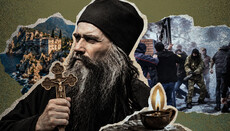
The Church can and should be defended, but without malice. Why love for persecutors is not weakness but the only way to preserve the Spirit of Christ in the midst of the struggle.
The Ukrainian Orthodox Church is going through difficult times today. Forcible seizures of churches, court battles, information harassment, labels of being an "FSB branch" – all this raises a practical question for every believer: how should one respond to persecution?
There is no single opinion on this within the Church. Some believe that the only right path is humble silence and patient acceptance of sorrows. Others engage in legal battles, defend parishes in court, and stand guard outside places of worship to protect them from raiders. The "active" reproach the "passive" for indifference, while the "passive" say that the "active" give in to provocations.

Let us try to find an answer in the spiritual legacy of St. Silouan the Athonite:
“Where there is pride there cannot be grace, and if we lose grace we also lose both love of God and assurance in prayer. The soul is then tormented by evil thoughts and does not understand that she must humble herself and love her enemies, for there is no other way to please God.
‘The enemy persecutes our Holy Church,’ you may say. ‘Am I then to love him?’ But my answer is this: ‘Your poor soul has not come to know God, and how greatly He loves us, and how longingly He looks for all men to repent and be saved. The Lord is love, and He sent the Holy Spirit on earth, Who teaches the soul to love her enemies and pray for them that they too may find salvation. That is true love. But if they are judged according to their deeds, then they merit punishment.’ Glory to the Lord that He loves us so much, forgives us our sins, and reveals His mysteries to us through the Holy Spirit.”
The Church can and should be defended, but only while preserving peace in one’s heart and denying oneself the right to harbor hatred. The logic of the world is the logic of justified retaliation. But Christ overturns this logic with the commandment of the Sermon on the Mount:
"You have heard that it was said, ‘You shall love your neighbor and hate your enemy.’ But I say to you, love your enemies, bless those who curse you, do good to those who hate you, and pray for those who spitefully use you and persecute you, that you may be sons of your Father in heaven; for He makes His sun rise on the evil and on the good, and sends rain on the just and on the unjust" (Matt. 5:43–45).
From a Christian point of view, those who cut off locks on churches with angle grinders, file denunciations, or spread slander are not simply “enemies of the Church.” First of all, they are lost, deeply unhappy people falling into a spiritual abyss.
Elder Silouan writes: "The soul has compassion for enemies and prays for them because they have wandered away from the truth and are going to hell. This is love for enemies."
When we are persecuted, we lose only walls, which sooner or later will turn to dust. But when people persecute the Church, they destroy their own immortal souls. For whom, then, should we weep more?
When the apostles John and James saw that the Samaritans did not receive Christ, righteous zeal flared up in them, and they proposed to resolve the matter radically: "Lord, do You want us to command fire to come down from heaven and consume them, just as Elijah did?"
We need to firmly understand and embrace the Savior’s answer: "You do not know what manner of spirit you are of. For the Son of Man did not come to destroy men’s lives but to save them" (Luke 9:54–56).
Zeal without love turns into ordinary aggression dressed in spiritual clothing.
The Apostle Paul reminds us of the criterion of spirituality:
"But you are not in the flesh but in the Spirit, if indeed the Spirit of God dwells in you. Now if anyone does not have the Spirit of Christ, he is not His" (Rom. 8:9).
If, in the struggle for churches, for the canons, for faithfulness to Christ, we lose the Spirit of Christ – the spirit of meekness, mercy, and prayer – then whom are we ultimately defending? A church without Christ becomes a museum, and a struggle without love becomes just another worldly squabble.
The first Christians conquered the Roman Empire not with swords. They astonished the pagans with something the world did not have and could not have. The Carthaginian apologist Tertullian wrote in his Apology that the pagans exclaimed in amazement: "See how they love one another!" Love for their own and mercy toward enemies melted even the most hardened pagan hearts.
A striking example of this spiritual law is found in the Patericon.
Once Abba Macarius the Great was walking with his disciple to Mount Nitria. The disciple went ahead and encountered a pagan priest carrying a heavy log. "Where are you running, demon?" the monk shouted at him. The priest became angry, beat him cruelly, and ran on. Soon he met Macarius himself, who said gently and respectfully: "Hello, laborer, hello!" Astonished, the priest asked what good the elder had seen in him. "I saw you toiling and hurrying somewhere with great care," Macarius answered. This humble and kind greeting so touched the priest that he fell at the elder’s feet and became a monk, and many other pagans turned to God after him. From this incident the abba drew a great rule: "A proud and evil word turns even good people toward evil, while a humble and kind word turns even evil people toward good."
When we answer malice with malice, we multiply evil and reinforce the persecutors in their “rightness.” But when they see before them people who are calm, prayerful, noble, and who hold no evil in their hearts, their conscience begins to speak louder than any propaganda slogans.
The main tragedy of times of crisis is internal division. Today, the Ukrainian Orthodox Church includes people of different temperaments, spiritual experiences, and abilities.
One man of prayer withdraws into seclusion and weeps silently over the sins of the world, considering prayer the only weapon. Another stays awake at night preparing lawsuits and appeals to international institutions. A third stands guard at the parish, physically protecting the church doors. A fourth works in the information field, while a fifth provides financial support to the community. Trouble begins when we measure everyone by ourselves and condemn those who act differently. The Apostle Paul warns us against this trap:
"There are varieties of gifts, but the same Spirit; And there are varieties of ministries, and the same Lord… But one and the same Spirit works all these things, distributing to each one individually as He wills" (1 Cor. 12:4–5, 11).
"Who are you to judge another’s servant? To his own master he stands or falls. Indeed, he will be made to stand, for God is able to make him stand" (Rom. 14:4).
Defending a church is a God-pleasing work. St. Job of Pochaiv himself took part in legal proceedings in his time, defending the Pochaiv Monastery (now the Lavra). But he did so without malice or hatred toward his offenders, relying on the law and trusting in God.
How can these spiritual truths be put into practice in everyday life?
Let us restrain our tongue
The Apostle James writes: "Wherefore, my beloved brethren, let every man be swift to hear, slow to speak, slow to wrath: for the wrath of man worketh not the righteousness of God." (James 1:19–20). Let us stop inventing insulting nicknames for opponents, mocking their blunders, and reposting venomous memes. Gloating is a poison that kills the one who gloats, not the one gloated over.
Let us not snap back at slander
When we are called "agents" or "traitors," the natural reaction is to respond in kind. But the Gospel path is the path of dignity and calm. Our best defense is a pure life and the truth, not a retaliatory stream of filth.
Let us pray for those who cut off the locks
This seems impossible only until we take the first step, acting against "I don’t want to." Let us name in our personal prayer an activist, an official, or a judge. Let us ask God to enlighten them and grant them repentance. And we will see how the sticky, paralyzing fear begins to leave our own hearts.
Let us remember: judgment belongs to God
We often want immediate retribution, "fire from heaven." But the Apostle Paul reminds us:
"Repay no one evil for evil. Have regard for good things in the sight of all men. If it is possible, as much as depends on you, live peaceably with all men. Beloved, do not avenge yourselves, but rather give place to wrath; for it is written, ‘Vengeance is Mine, I will repay,’ says the Lord… Do not be overcome by evil, but overcome evil with good" (Rom. 12:17–21).
God Himself will stand up for His Church. Not a single tear, not a single unlawfully seized church, not a single undeserved reproach is forgotten by Him.
But He Who holds history in His hands expects us to be not judges but witnesses of His love. Persecution is always pain and the filth of worldly vanity. Yet in the spiritual dimension, it is a time when gold is refined in the furnace.
The Book of Revelation of John the Theologian reveals the eternal meaning of what we are experiencing today:
"And he said to me, ‘These are the ones who come out of the great tribulation, and washed their robes and made them white in the blood of the Lamb. Therefore they are before the throne of God, and serve Him day and night in His temple. And He who sits on the throne will dwell among them’" (Rev. 7:14–15).
Walls can be taken away. Churches can be locked. But the Holy Spirit, Who dwells in a meek and humble heart, cannot be locked up. Buildings and political regimes will collapse, court records will decay, the noise of sorrows will subside, and what remains after it depends on what we come out of this fire with. If we keep the faith, defending the Church with peace, prayer, and love, we will see the fulfillment of the main promise of Scripture:
"And God will wipe away every tear from their eyes; there shall be no more death, nor sorrow, nor crying. There shall be no more pain, for the former things have passed away" (Rev. 21:4).