Yelensky’s plan: Why is DESS demanding what the UOC has already done?
DESS is demanding that the UOC take steps it has already taken, while offering no assurance that further demands will not follow. What is behind Yelensky’s ultimatum?
The head of the State Service of Ukraine on Ethnopolitics and Freedom of Conscience, Viktor Yelensky, gave an interview to Archpriest Roman Makar, a cleric of the Vinnytsia Eparchy of the UOC, on the YouTube channel "DNK" ("DNA").
We examine what the official is actually seeking from the Church.
Demands that have already been met
Asked what the state wants from the UOC, Yelensky gave a brief answer: “The Ukrainian state, represented by DESS, wants the Ukrainian Orthodox Church to leave the Russian Orthodox Church.” He then broke this down into four requirements.
First, the Kyiv Metropolia “must ensure the withdrawal from the ROC of all parishes, eparchies, monasteries, theological educational institutions, missions, brotherhoods, and sisterhoods.”
Second, “The Primate of the Church must withdraw from the Holy Synod of the ROC and inform the faithful. Likewise, the Kyiv Metropolia must inform the faithful of its withdrawal from the ROC.”
Third, the Metropolia must “declare the ROC Charter invalid for itself.”
Fourth, the Metropolia must “adopt a resolution stating that it does not recognize the annexation of eight eparchies in eastern Ukraine and Crimea.”

Fr. Roman and the DESS head spent considerable time discussing these points, along with the agency’s 2023 “expert examination” of the UOC Charter and its 2025 “study.” Yet anyone who has followed the issue even casually would struggle to understand what there is left to discuss. After all, the UOC has already fulfilled three of the four demands, fully and unequivocally, through the decisions of its Council in Feofaniya.
One of the Council’s resolutions states: “The Council adopted the relevant amendments and additions to the Statute on the Administration of the Ukrainian Orthodox Church, affirming the complete autonomy and independence of the Ukrainian Orthodox Church.”
Just days after the Council, on June 1, 2022, His Beatitude Metropolitan Onuphry sent Letter No. 0464 to the then-head of DESS, Olena Bohdan. The letter was published on the agency’s website.
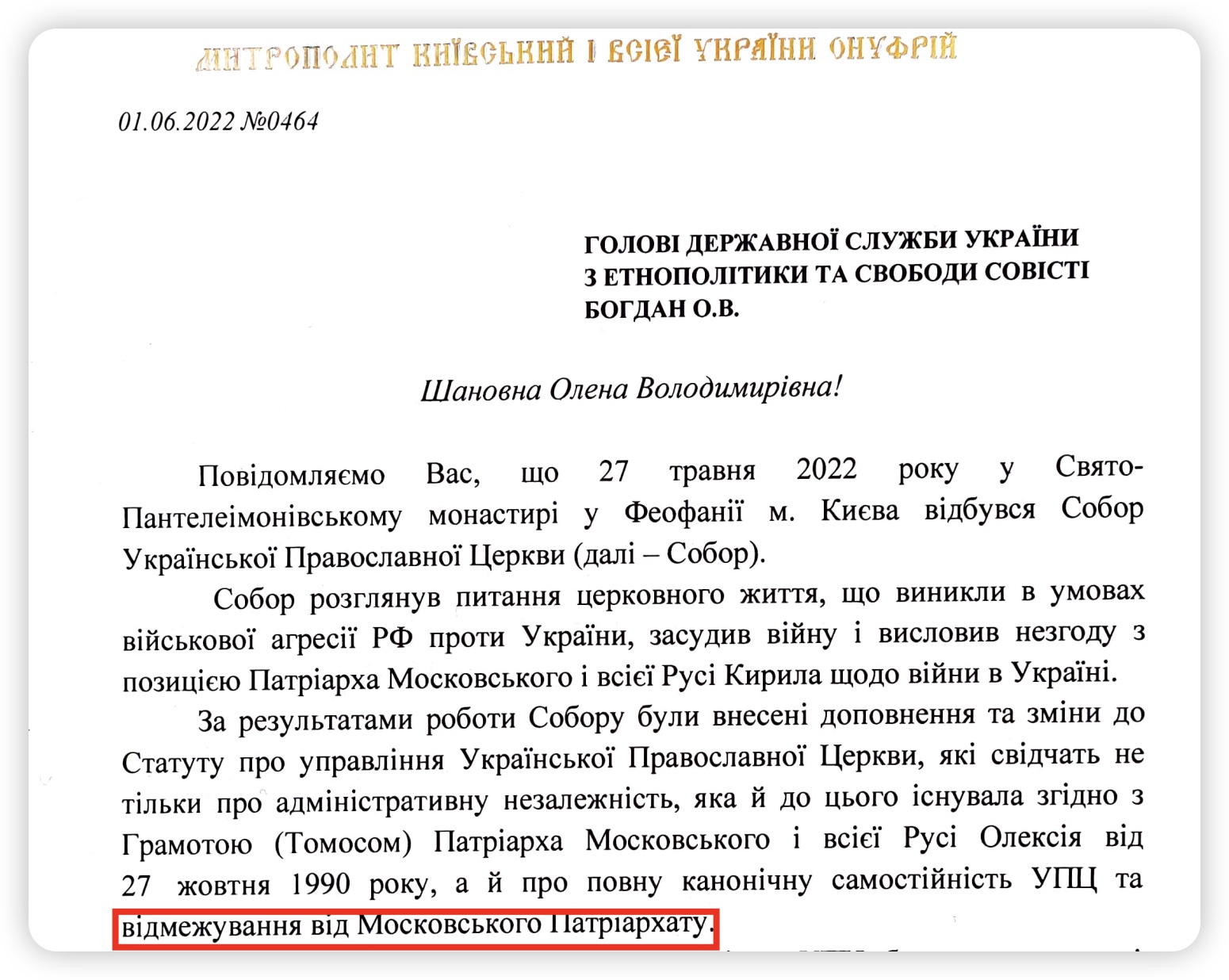
The letter states that:
- The UOC has disassociated itself from the Moscow Patriarchate.
- The Primate of the UOC is no longer a member of the Holy Synod of the ROC.
- Resolutions of ROC Councils no longer serve as the basis for the activities of the UOC Council of Bishops.
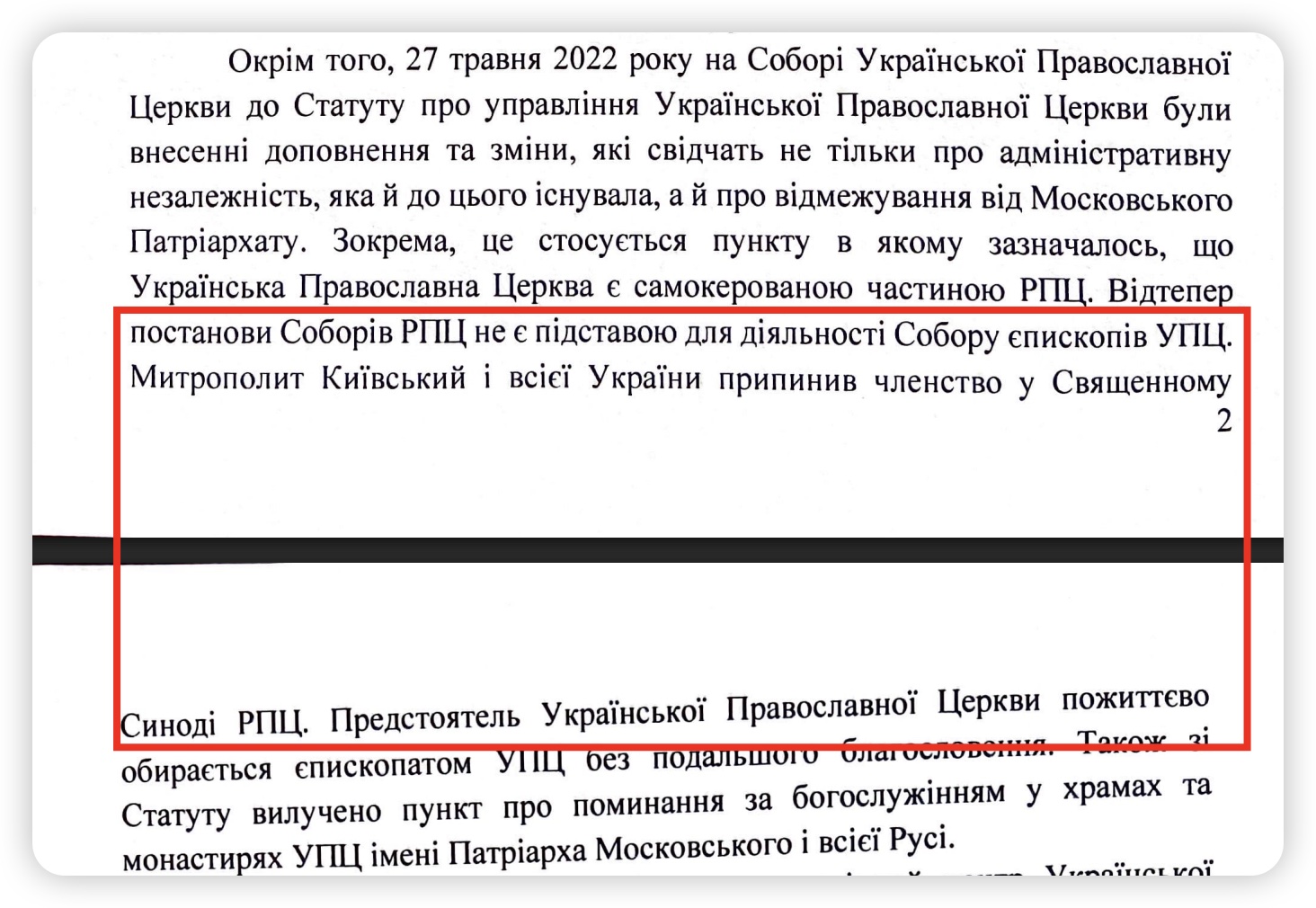
In other words, there is nothing more to be done on these points. Convening the bishops merely to repeat decisions already made, at Yelensky’s whim, would be pointless. Besides, there is no guarantee that DESS would not find “deficiencies” in a new statement as well.
As for the demand to reject the Russian Church’s annexation of UOC eparchies, the situation is more complicated. The UOC has expressed its disagreement with the Russian Church’s actions in occupied territories, including those involving the Berdiansk, Kherson, and Crimean eparchies.

In October 2024, a “Statement by UOC Bishops on the Actions of the Holy Synod of the Russian Orthodox Church Regarding UOC Eparchies Located in the Temporarily Occupied Territories of Ukraine” was published. It was signed by several dozen bishops.
Admittedly, this was not an official document of the Kyiv Metropolia of the kind Yelensky demands. But the authorities should value it precisely because it was issued without their prompting. The statement calls for “respect for the boundaries of the canonical Ukrainian Orthodox Church and for Ukraine’s sovereignty and territorial integrity” – exactly what Yelensky says his agency is seeking.
Indeed, the program’s host, Fr. Roman Makar, pointed out that the DESS demands had already been met: “But we’ve already left. You simply need a document, and that’s the whole sticking point.”
Yelensky, however, maintains that the Church provided no “substantive response,” claiming that its reply “did not say a single word about the directive itself.”
Some context is needed here. The DESS head was referring to the Kyiv Metropolia’s response of August 16, 2025, to the agency’s demand that it sever its alleged affiliation with the ROC, which DESS officials had “identified” in their study.
That document, signed by Metropolitan Onuphry, directly addressed the DESS directive. It described the agency’s demands as “not so much a legal act of a government agency as a public ultimatum addressed to the highest governing bodies of the Ukrainian Orthodox Church, based not on official documents and objective facts but on the director’s own subjective opinions.”
The reason is straightforward: the UOC does not recognize the legitimacy of the “study” in which DESS purported to establish the Kyiv Metropolia’s dependence on Moscow. The letter clearly explains why the Church does not consider it possible to comply with an ultimatum that DESS has labeled a “directive.”
In essence, the conflict between the UOC and Yelensky comes down to the official’s refusal to recognize the validity of the Council’s decisions and the official letters signed by the Primate.
He keeps repeating the same demand: “Let them provide us with a resolution stating that the UOC has left the ROC. That’s all.”
When told that the UOC Charter itself constitutes such a resolution, Yelensky objects: “The study examined that Charter and concluded that it does not provide such grounds.”
In other words, the decision of the Council – the Church’s highest governing authority – means nothing to Yelensky, while a document containing the right wording means everything. The question remains: exactly what wording would satisfy him? More on that below.
Rules that keep changing
During the interview, Yelensky revealed that the demands previously presented to the UOC had been different and included additional requirements.
“For example, representatives of the Orthodox Church in America, which is friendly toward the ROC, came to see me. I showed them – there was no directive yet – what the Ukrainian state wanted from the UOC. They said, ‘This particular point is obviously excessive.’ It required sending out letters of peace, which would amount to a claim to autocephaly. Fine, that point is no longer there.”
Several things follow from this admission. The state showed its proposed demands for the UOC to a foreign Church before presenting them to the UOC itself. There were originally five demands, and the fifth – sending out “letters of peace,” effectively a declaration of autocephaly – was dropped only because the Americans called it “obviously excessive.”
Earlier still, Yelensky had proposed something else. For example, he advised parishes to write to Moscow announcing their withdrawal from the ROC.
Here is what he said: “The head of a religious organization that officially belongs to the Moscow Patriarchate but does not want to remain there simply makes a statement, sends a letter there, sends us a copy, and that’s it. That is sufficient for us. The directive has been fulfilled.”

Yet Yelensky now denies ever making such a demand, saying that he “does not require priests and bishops to address Patriarch Kirill, as some media outlets have reported.”
It is worth recalling that those media reports did not come out of nowhere. The official’s position kept changing, with each new version presented as the only definitive one.
More importantly, neither the law nor the directive specifies what will happen if the Church fulfills all four requirements. In June 2026, Yelensky told Interfax that in such a case, the “affiliation” designation would be lifted and the lawsuit withdrawn. But that was merely a verbal promise from an official, not a procedure established by law.
During the interview, he himself demonstrated how much such promises are worth.
When a court ruled that the approval of the 2023 expert examination was unlawful because the proper procedure had not been followed, DESS simply “issued the order again,” according to Yelensky.
“With the same wording?” the host asked.
“Of course,” Yelensky replied.
In other words, the court overturned the order, and DESS simply reissued it. Yelensky did not explain what would prevent the agency from doing the same with the directive – issuing it again with an additional requirement after the Church had complied with all the existing ones.
It is also worth recalling that this official has repeatedly reversed his positions over the course of his life.
As the UOJ previously reported, in a 1988 work he wrote that “one cannot help but marvel at the scope and depth of Lenin’s thought,” while describing the Ukrainian Autocephalous Orthodox Church as “created by die-hard bourgeois nationalists, Petliura’s lackeys.”
Someone capable of such dramatic reversals could just as easily change his position on how many requirements the UOC must meet.
Let us recall that the Kyiv Metropolia described the directive in its response as a “public ultimatum” based on the director’s “own subjective opinions.” After this interview, it is difficult to call that characterization unfair.
A threat that no one has demonstrated
Throughout the conversation, Yelensky frames the issue in terms of national security.
The Moscow Patriarchate is a “terrorist organization,” it “is a party to this war,” and “the legitimate aim of the law is to leave this terrorist organization.”
He claims that Patriarch Kirill “openly says that we want to destroy you, kill you, rape you.”
Yelensky did not specify where Patriarch Kirill had said any of this.
But the real problem lies elsewhere. Let us ask a question the host did not get around to asking and that the official has failed to address in three years: how exactly does the UOC’s connection to the ROC manifest itself today, and what threat does it pose to national security?
Can Patriarch Kirill issue orders to even a single UOC bishop? He cannot, and Yelensky knows this perfectly well. Can Moscow force a UOC priest to say even a word in support of the “special military operation” during a sermon? It cannot. Otherwise, at least one such case would have emerged over the past four years, and DESS would be showcasing it at every opportunity.
The only thing the “study” clings to is the 1990 Gramota, which states that the UOC is united with universal Orthodoxy through the Russian Church.
But this concerns exclusively internal Church matters that have nothing to do with national security.
The OCU Charter says essentially the same thing about Constantinople: its connection to Orthodoxy runs through the Patriarchate of Constantinople.
If being “united through” another Church constitutes a threat to national security, then the OCU is just as “affiliated” with Turkey as the UOC is with Russia.
The priest who was barred from chaplaincy
Perhaps the most powerful part of the conversation was not an argument but a personal story.
Fr. Roman Makar told it in his own words:
“When the war began, we were in shock during those first days. We prayed every day and gathered together. Then some of our young parishioners volunteered for the military. I stayed in touch with them, and very soon – I don’t think even a month had passed – through talking with them and sensing their need for support, I felt a desire to become a chaplain… And in the end, I was told, ‘Sorry, but you belong to the wrong denomination. Chaplaincy is closed to you from the outset.’”
The priest then asked Yelensky:
“As the head of DESS, don’t you think this violates my rights and the rights of other young, active priests who are not enemies of their country but, on the contrary, support it?”
In response, the official cited a provision of the law “that prohibits a clergyman from serving as a military chaplain if his religious organization has its center outside Ukraine, in a state that has committed aggression against Ukraine.”
He added: “You simply live and serve in a somewhat different atmosphere.”
It is worth recalling, however, that representatives of denominations serving in the “right” atmosphere have shown little enthusiasm for becoming chaplains.
Even three years ago, when the wave of volunteers heading to the front was at its height, neither OCU clerics nor UGCC priests were rushing to join the military. As of August 2023, only 165 of 738 chaplain positions had been filled.
The situation has not improved today.
OCU “Metropolitan” Klyment Kushch has complained that “there is a problem with chaplains in the military. Unfortunately, the overwhelming majority of clergy do not want to join the armed forces.”
And here, sitting before the official, is a priest whose parishioners volunteered for the front, who has wanted to be at their side for four years, and whom a law developed with DESS involvement bars from chaplaincy “from the outset.”
The soldiers whom this priest ministered to before the war remain at the front without his spiritual support. Not because Fr. Roman has done anything wrong, but because he lives in a “different atmosphere.”
Is there no way for UOC clergy to obtain mobilization exemptions?
The situation surrounding the mobilization of UOC clergy is even more cynical. Reports of TRC personnel seizing priests appear almost daily.
Yelensky explains this by claiming that the UOC has failed to comply with the so-called 2018 renaming law, under which its communities are required to identify themselves as the “ROC in Ukraine.”
Fr. Roman proposes a hypothetical scenario in which someone agrees to comply.
“Suppose I comply with the law, rewrite the charter, and submit it. Would I then, as part of the ROC, qualify for a mobilization exemption?” he asks.
Yelensky replies that even in that case, no exemption would be granted.
“That had to be done in 2018. It is no longer possible now,” the official says, suggesting instead that the charter be amended “so that you are not affiliated or connected with the ROC in any way.”
And this brings us to the most interesting part: what exactly is the DESS head proposing?
According to Yelensky, religious entities that sever their ties with the UOC can become “independent.”
At the same time, he acknowledges that “this does not really correspond to Orthodox ecclesiology.”
“An eparchy leaves – not the ROC, but the Kyiv Metropolia of the UOC – and exists on its own. I cannot propose a model for you. Propose your own,” Yelensky declares.
No need to sign in blood
Now let us consider how Yelensky describes the actual procedure for “withdrawal.”
According to him, “the directive does not require anyone to sign in blood, go out into the square, or shout anything. A procedure has been chosen that genuinely places no burden on the conscience of believers.”
But let us examine what this supposedly conscience-friendly procedure looks like in practice.
A UOC priest cannot become a chaplain, even though many of his parishioners are serving at the front. Yet he himself can be seized by TRC personnel at any moment. And although Church canons prohibit him from taking up arms under penalty of deposition from the priesthood, he can be sent to the front lines.
To avoid all this, the priest must amend his parish charter. But such a charter would not conform to Orthodox ecclesiology.
What a wonderful choice indeed.
And despite all this, Yelensky goes around telling everyone that Ukraine enjoys exceptional religious freedom.
Conclusions
One final question remains: what is all this for?
Yelensky answered that question too, although indirectly. He said that constitutional scholars might “pounce on him and talk at length about the fact that we are a secular state,” but that refusing to recognize the OCU’s independence amounts, if not directly, then nevertheless to a refusal to recognize Ukrainian statehood.
“I often tell this to my colleagues from countries whose Orthodox Churches do not recognize the autocephalous Church of Ukraine,” Yelensky emphasized.
It is hardly a coincidence that the subject of the OCU, which had not come up throughout the interview, suddenly appeared at the very end.
To sum up the conversation, the picture is as follows.
The UOC is being told to meet conditions it has already met long ago. Yet no one guarantees that even after it complies with the ultimatum, the DESS leadership will not come up with new demands.
UOC entities are being encouraged to sever their ties with the Kyiv Metropolia and enter an uncertain canonical status.
Why is this being done? DESS expert Liudmyla Fylypovych previously explained it quite openly: “If they withdraw from the structures of the ROC, they [the UOC – Ed.] will, in Moscow’s understanding, voluntarily place themselves in a state of ‘non-canonicity,’ in the ‘gray zone’ where the Kyiv Patriarchate remained for 30 years.”
It appears, then, that Yelensky is seeking the “right” wording from the UOC so that other Local Orthodox Churches will have grounds to declare it schismatic.
And then Serhiy Dumenko is supposed to ride in on a white horse and welcome everyone into his brotherly embrace.
“And the Church that emerges – a united Ukrainian Orthodox Church – will stand on the Gospel and Christian principles of love, patience, and mutual respect,” Viktor Yelensky said in closing the program.
Such is the strategic plan of the head of DESS. There is plenty of politics in it. Orthodoxy, not so much.