A knife in the back: Who really derailed the Tomos in 2008?
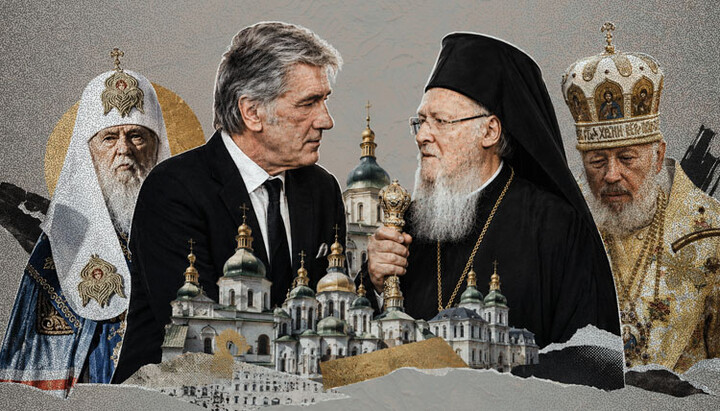
Why did Patriarch Bartholomew strike the table with his staff before Yushchenko? Photo: UOJ
Viktor Baloha, who headed the Presidential Secretariat from 2006 to 2009, told a story that is hard to believe yet impossible to dismiss. According to him, in the summer of 2008, on the eve of the celebrations marking the 1020th anniversary of the Baptism of Rus', Patriarch Bartholomew came to Kyiv with a virtually finalized decision on Ukrainian autocephaly and left empty-handed – after a single conversation in the presidential office on Bankova Street.
Baloha's account is valuable not so much for its sensational nature (rumors about this have circulated for a long time) as for its details. Together they form a picture that explains not only what happened in 2008, but also what unfolded in 2018. But the most interesting part is that this picture contains at least three points that simply cannot be overlooked.
Six months of negotiations and eight-hour dinners
According to the former head of the Secretariat, all the preparatory work fell personally on him. Yushchenko had set the task of securing the visit of Ecumenical Patriarch Bartholomew, but the latter, in Baloha's account, had no intention of coming simply for the occasion: he allegedly said that he wished to establish a patriarchate in Ukraine, but that serious groundwork was needed first, and that he would fly to Kyiv only if everything came together.
All the work took about six months. Baloha brought Filaret Denysenko to Istanbul twice – the first time together with the head of the UAOC, Mefodiy Kudriakov, and the second time alone. Conversations and dinners with Bartholomew lasted seven or eight hours at a stretch. It was there, Baloha says, rather than in Kyiv, that the actual blueprint for the future church structure was discussed. It was to include the UOC, the UAOC, and the UOC-KP. The patriarch of this new Church was supposed to be Metropolitan Volodymyr (Sabodan) of Kyiv.
And here an interesting detail emerges. The former official claims that Mefodiy Kudriakov asked Bartholomew what place would be assigned to him in the new structure. Moreover, he stated that he was prepared to be even a simple monk unlike Filaret, who, in Baloha's words, demanded nothing less than the patriarchate. The Patriarch reportedly replied that this was unrealistic, since no Local Church would recognize such an appointment. He allegedly advised Denysenko to become a deputy, and that later, when new elections were held and Metropolitan Volodymyr stepped down, things would become clearer.
In other words, it turns out that the framework which the Phanar had been coordinating with Kyiv for six months was built neither around Filaret nor around Mefodiy, but around the canonical Kyiv Metropolitan. Both leaders of the schismatic structures were being offered secondary or even tertiary roles with the vague prospect of "we'll see later." Mefodiy, according to Baloha, agreed to yield primacy to Volodymyr, but Filaret did not.
"After that, for the matter to be considered at the Ecumenical Synod, all hierarchs – from bishop to metropolitan – had to sign. All structures had to unanimously sign the documents. Everyone signed," says Baloha. He personally delivered the signed documents to Istanbul.
After that, the Primate of the Church of Constantinople came to Ukraine and met with the Ukrainian President, government officials, and Patriarch Alexy of Moscow. Then, just before his departure, he made another visit to Yushchenko at the presidential offices on Bankova Street.
What happened there is so extraordinary that we cannot but quote Baloha: "I brought Bartholomew to the President for a farewell working evening in his office. Bartholomew expressed gratitude for the warm reception, Yushchenko thanked him for coming. They exchanged pleasantries, and Bartholomew said: 'Mr. President, in two or three months you will receive the patriarchate.' And Yushchenko replied: 'Your All-Holiness, you are so kind, so good, but I have a request – to appoint Filaret as patriarch.' At that, Bartholomew rose, struck the table with his staff – he had spoken in Greek the whole time, but now switched to Russian and said to Yushchenko: 'You attend to your own duties. Spirituality is my my domain. Do not meddle in it.'"
"The whole way to the airport he was weeping. At the airport he fell face-first into a flower bed, ate the earth, and was covered in clay all over. He stood up and said: 'Today the greatest mistake in the history of Ukraine has occurred. Today, because of incomprehensible ambitions, we have lost the chance to create a patriarchate in Ukraine. You are in for, you are in for great troubles. You are in for, I quote, wars.'"
You will agree that the picture described by Baloha is very vivid and even epic. The former official himself, when asked what he would correct if he had a time machine, said briefly: "I would have asked the President to stay silent. Simply to stay silent." We shall return to this phrase.
A night on Pushkinska Street
So, according to Baloha, Yushchenko asked the Patriarch to place Denysenko at the head of the new structure. But why did the President decide to make such an appeal in the first place? After all, he himself had been conducting negotiations for six months and knew perfectly well that the Phanar would not agree to Filaret's candidacy.
According to our information, the decisive conversation took place not on Bankova Street, but earlier and in a different location – on Pushkinska Street, at the residence of the head of the UOC-KP. Viktor Yushchenko came there in person to obtain Denysenko's consent to the framework worked out with Constantinople. The conversation dragged on until nearly morning.
Denysenko's position was simple and absolutely immovable: he agreed to the unification of Ukrainian Orthodoxy on one condition that he be guaranteed the patriarchal see of the new Church. He had no intention of being a deputy, an honorary chairman, or a first among equals with reservations. The arguments that the Ecumenical Patriarch was waiting and that a second such chance might never come had no effect on him.
Leaving Filaret's office toward morning, the President reportedly said in exasperation: "Your Holiness, today you have plunged a knife into the back of Ukraine." And these were not merely words spoken in irritation. Yushchenko understood that without the signature of the head of the Kyiv Patriarchate, the entire framework of a "united Ukrainian church" became meaningless. And it was precisely for this reason that he decided to make one last attempt to "push through" Filaret's candidacy during his meeting with Patriarch Bartholomew.
In other words, on Bankova Street the Ecumenical Patriarch heard not merely a sudden "ambition" of the Ukrainian president, but the condition of Filaret Denysenko, conveyed through the President of the country. And it was for this that he struck the table with his staff.
Did the UOC episcopate sign?
And here we come to the most vulnerable point in Baloha's account. He claims that the document on the creation of the new structure was signed by representatives of all parties, including the UOC.
But if written consents from the hierarchs of the canonical Church were indeed obtained, why have they not been published to this day?
Most likely, for one reason only – no one signed anything.
The fact is that in 2008, Metropolitan Volodymyr sent a letter to Patriarch Bartholomew in which he spoke out directly against the scenario then being discussed – the creation in Ukraine of several parallel Orthodox jurisdictions, as was later confirmed by the UOC itself. The logic is straightforward: if he had actually signed a document on unification with the UOC-KP and the UAOC, no parallel structures would have remained in Ukraine.
That is, the Metropolitan was criticizing plans to create a new "church" out of the UOC-KP and the UAOC that would exist in parallel with the UOC. He warned Patriarch Bartholomew that such a step could intensify ethnophyletic sentiments in church communities, deepen the polarization of society, and return the country to a fierce struggle over churches and church property. And most importantly – the schism would not be healed in any case, because non-canonical groups claiming autocephalous status would remain in the country.
The fact that the UOC had no intention in 2008 of mechanically uniting with the schismatics was acknowledged even in the opposing camp. The resource "Kyivske Pravoslavya" ("Kyiv Orthodox Christianity"), analyzing the events of 2008 from an openly pro-autocephaly standpoint, notes that no progress was observed in negotiations with Metropolitan Volodymyr and that the main obstacles to the project were his position and Denysenko's ambitions. In other words, even those who regard 2008 as a missed opportunity do not claim that the canonical Church signed documents on unification.
But the question arises: is Baloha deliberately telling an untruth, or was he himself misled? The latter seems more plausible. Around Metropolitan Volodymyr in those years worked people deeply involved in the "autocephaly project" – above all his secretary Oleksandr Drabynko, as well as priests from the circle of the UOC's Department of External Church Relations. For someone from Bankova Street who was conducting negotiations through these intermediaries, verbal assurances that "the episcopate is ready" could quite easily have appeared to be the consolidated position of the Church. But the position of the Church is expressed not in the assurances of aides and secretaries, but in the Primate's letters and the Synod's decisions. And those simply did not exist.
Metropolitan Volodymyr's position: not "against autocephaly," but against its fake version
It is important to remember here that Metropolitan Volodymyr never opposed the full independence of the UOC. He was categorically against forcing this path. His logic was simple: autocephaly makes sense only when it grows organically and does not threaten a new schism. Autocephaly obtained by a political decision is not a solution to the problem but an aggravation of it. And virtually the entire episcopate of the UOC held this position at the time.
Nevertheless, Metropolitan Volodymyr did not abandon the task of resolving the schism in Ukrainian Orthodoxy. The following year, at a synaxis (council) in Constantinople, he addressed a letter to all the Primates of the Local Churches, asking that the question of the Ukrainian schism and the status of the UOC be resolved through their joint efforts. This was recounted in 2018 by Oleksandr Drabynko. According to him, the matter was hushed up at the time – by whom and why, he does not specify.
However, we can draw an obvious conclusion. Metropolitan Volodymyr genuinely tried to resolve the Ukrainian problem. But in a manner entirely different from what Patriarch Bartholomew attempted in 2008 and what he "did" in 2018. Metropolitan Volodymyr was not an opponent of the Ukrainian Church’s independence; he was opposed to uniting the Church with those who were not members of it. And his successor as Metropolitan of Kyiv holds exactly the same position.
Read also
A political commissar’s vocabulary: Three interviews with Epifaniy Dumenko
In just six days, the OCU leader managed to call an end to church seizures “capitulation,” describe Lavra monks as “hired hands,” and portray the U.S. vice president as a victim of propaganda.
The Council of Crete: a decade of unity in name only
Constantinople marked the anniversary of the Council of Crete with a theological conference in France. They spoke about the unity of Orthodoxy, although over the past years there has noticeably been less of it.
Yelensky’s plan: Why is DESS demanding what the UOC has already done?
DESS is demanding that the UOC take steps it has already taken, while offering no assurance that further demands will not follow. What is behind Yelensky’s ultimatum?
Why OCU hierarchy lacks canonical ordination: what Local Churches say
The OCU head refuses to address invalidity of his ordinations. But almost all Local Churches speak of it – even those that recognized the OCU.
Why nation-first advocates do not call for peace
Ukraine’s population is declining by nearly one million people a year, and experts are warning of the nation’s demographic extinction. Yet the leaders of the Orthodox Church of Ukraine (OCU) and the Ukrainian Greek Catholic Church (UGCC) continue to call for war and mobilization.
The deception that decided the fate of the Tomos
In 2008, the "Filaret problem" derailed Yushchenko's plan. In 2018, Poroshenko solved it in just one hour – with a police escort for the Greeks and verbal promises to Filaret.