Facade of bones and facade of light
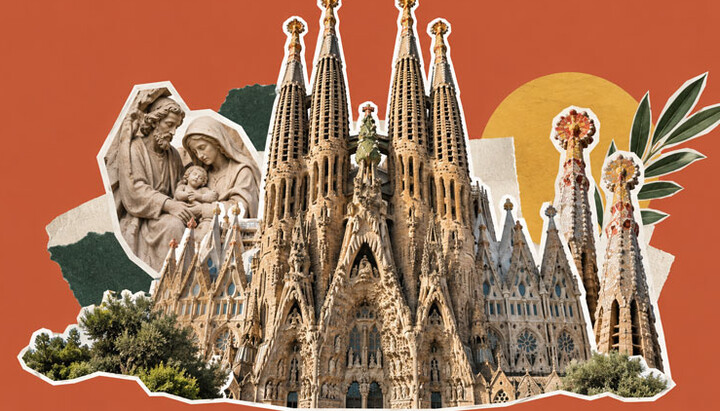
Basilica of the Holy Family. Photo: SPZh
On Monday, June 7, 1926, an elderly man in a worn suit left the workshop at the unfinished church. As he did every day, he set off for the church of Sant Felip Neri. On the street, he was struck by a tram. Three days later he died in the hospital.
On Saturday, the funeral procession passed through the whole city to the very church where he had lived for the last months. The Catalan journalist Lluís Carreras wrote the following day: «He left there on Monday, alone. He returned on Saturday – accompanied by an entire people».
That man was Antoni Gaudí. He was buried in the crypt of the Sagrada Família, the Church of the Holy Family. At that time, only one completed tower rose above it.
A tree instead of a textbook
The first stone in the foundation of the church was laid on March 19, 1882, according to the design of another architect, Francisco de Paula del Villar. A year later, the thirty-year-old Gaudí took over the construction. Of his forty-eight years as an architect, he gave forty-three to this church. In his last years he took no other commissions, and from November 1925 he slept at the construction site.
Gaudí learned not only from the luminaries of architecture. His pupils recalled how he pointed to a tree with his hand and added: «This tree near my workshop – is my teacher!»
Gaudí looked at nature as a book of the Creator. If God made trees such that they hold up heavy crowns, then a column of a church can also branch like a trunk. If a seashell winds in a spiral, then a staircase can also be built in the same way. He also calculated the architecture of the vaults in an unusual way: he hung cords with small weights, and then looked at an inverted photograph of this net.
Many of his creative solutions seem fluid, almost alive. In fact, they are woven from straight lines. Gaudí was one of the first in architecture to use forms that mathematicians call hyperboloids and paraboloids.
A she-donkey under the workshop ceiling
The first facade Gaudí erected was the eastern one, in honor of the Nativity of Christ. Everything in it breathes festive joy.
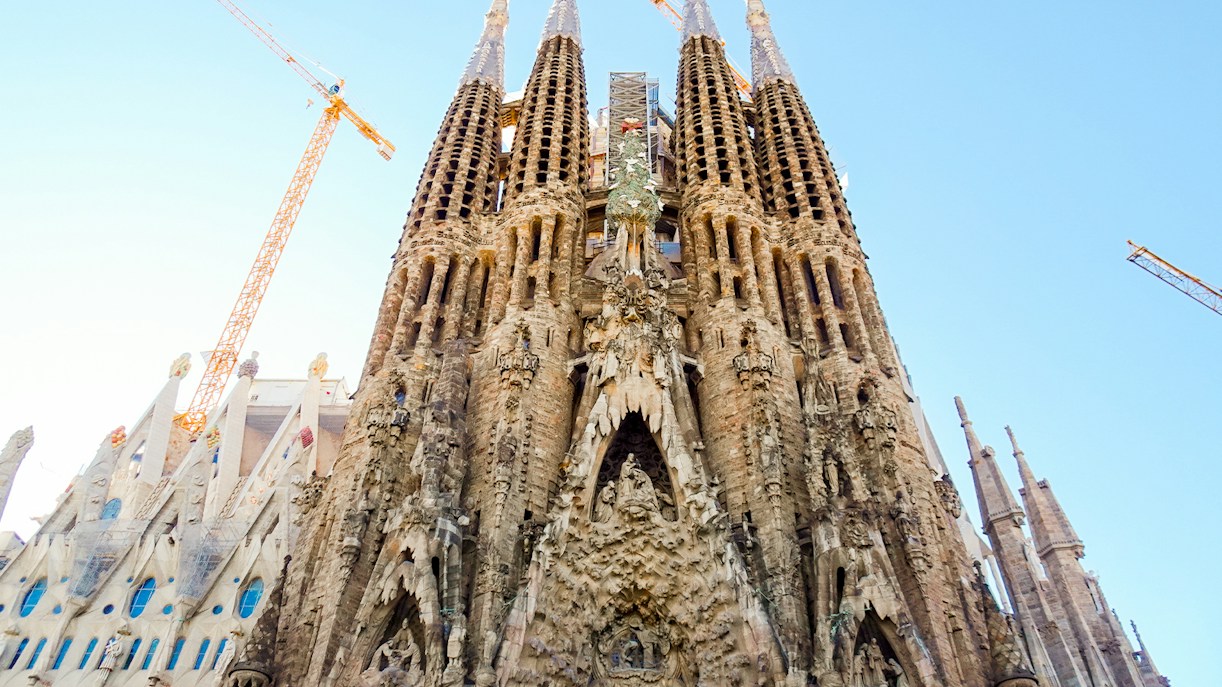
To create the sculptures, he sought out living models, photographed them, and made plaster casts directly from their bodies. For the scene of the Massacre of the Innocents, casts were taken from children who had died at birth and were brought from a hospital. As for the donkey for the Flight into Egypt, it had to be lifted on straps under its belly. The story goes that the animal was stubborn and did not wish to pose to please people.
If you raise your eyes to the base of the columns at the entrance, you can notice tortoises. The column of Joseph is supported by a sea turtle – it looks toward the sea. The column of Mary rests on a land tortoise, facing the mountains. According to the foundation that is leading the construction, the tortoises and chameleons on the facade seem to be creeping downward, fleeing from evil.
During Gaudí's lifetime, only the bell tower of St. Barnabas was completed here, in 1925. Everything else he left to his successors.
The Facade of Bones
The western facade, facing the sunset, is dedicated to the Passion of Christ. According to Gaudí's design, the facade was meant to be fearsome, as though built of bones.
Construction of it began only in 1954, and from 1986 the sculptures were created by Josep Maria Subirachs. His style contrasts sharply with that of the opposite facade.
One sees angular figures and chiseled faces; there is not even a shadow of pomp. The architect did this deliberately, for death is never beautiful.
Let us pause at the sculptural scene with St. Veronica. On the veil she holds is the Face of Christ, carved in concave relief. Wherever you move, it seems that He is looking straight at you. One of the Evangelists on the left was given the face of Gaudí himself. The scene of the kiss of Judas contains a magic square of numbers whose sum in any direction is 33 – the age of Christ's earthly life.
The Unhurried Client
Why was Gaudí in no hurry with the construction of his architectural masterpiece? He uttered a phrase that all the tour guides of Barcelona now repeat: “My Client is not in a hurry.”
Gaudí's actual words, preserved by his students, sound even stronger: “I know that the personal taste of the architects who come after me will influence the building… Great temples were never the work of a single architect.”
He understood that he was working for posterity. The façade of the cathedral he created became a model by which his followers can grasp the genius's design. To this end, Gaudí made many plaster models of sculptures and prepared drawings.
It soon became clear that this had been a wise decision. In 1936 the workshop was ransacked. The drawings and photographs burned, and the plaster models were smashed. It seemed that the author's design was lost forever. But from 1939 the work resumed: architects gathered the fragments of the models, studied the surviving photographs and published plans. And, most importantly, they had before their eyes the completed Nativity façade.
Gaudí was not the first whose church was built by generations of architects. Cologne Cathedral was under construction for more than six centuries, and Milan Cathedral for almost six. But the Sagrada Família is one of the few ancient churches that are still being built to this day.
A cross above the city
On February 20, 2026, a crane lifted an enormous cross with a Lamb at its center to the top of the central tower. The Tower of Jesus Christ reached its peak – 172.5 meters. It is now the tallest church in the world.
On June 10, 2026, exactly one hundred years after Gaudí's death, Pope Leo XIV blessed and opened this tower. He called the basilica a work that is still being built.
A little lower, a star above the Tower of the Mother of God has been shining for several years now. The twelve-pointed glass star was first lit on December 8, 2021.
Construction of the church is still not complete. The main, southern Glory façade is only just beginning to be built. The shape of the staircase in front of it is still being discussed by the clergy of the church, the city authorities and local residents. Of the eighteen planned towers, four have not yet been built. Completion of the work is not expected until the mid-2030s.
The church is being built, as Gaudí intended, on donations. It is called an expiatory church – that is, one created as a fruit of repentance.
Today, the donations of parishioners have been joined by money from ticket sales to millions of tourists.
Generations of builders
Gaudí died when only one tower was visible above Barcelona. Now there are already fourteen. Dozens of architects, sculptors, and masters of glass and stone have put their lives into the cathedral, knowing that the work they began would be passed on to the next generations of builders.
Perhaps this is the hidden philosophical meaning of the Sagrada Família as the most famous long-term construction project in history.
The centuries-long construction of the shrine is a reminder that church life is always longer than a human life.
Each person can contribute his own stone to it, while the building itself is raised over the centuries. Gaudí understood this before anyone else, and therefore built an earthly house for God, so that everyone afterward could make his own contribution to this God-pleasing work.
Read also
Trial of a dead pope
Once in Rome, the body of a deceased pope was seated on the throne and put on trial. The accusation relied on a church canon that had once saved his see.
Monastery built in defiance of king
When Orthodox believers in Minsk were left with just one church, townspeople decided to build another – and even a royal decree did not stop them.
Young Mother and Sleeping Christ
Michelangelo carved a Virgin Mary who looks younger than her Son – and signed his name in marble for the only time in his life. Neither of these peculiarities was accidental.
Orthodox books from a Uniate printing press
In the 18th century, Uniate monks at Pochaiv printed books used in prayer by Orthodox Christians and Old Believers alike.
The story of the honey brotherhood
The Mogilev Brotherhood began with members pooling money to brew honey drinks for feast days – and eventually grew to have its own printing press.
Golgotha in the midst of a pogrom
In the autumn of 1938, the Jewish artist Marc Chagall painted the crucified Christ. Synagogues burn and refugees flee around the cross, while the Crucified One Himself is wrapped in a prayer shawl.