
Bortniansky's Cherubic Hymn: work of two composers
На партитуре для клироса стоят рядом фамилии Бортнянского и Чайковского. Как сложился этот тандем и что во время пения совершается в алтаре?
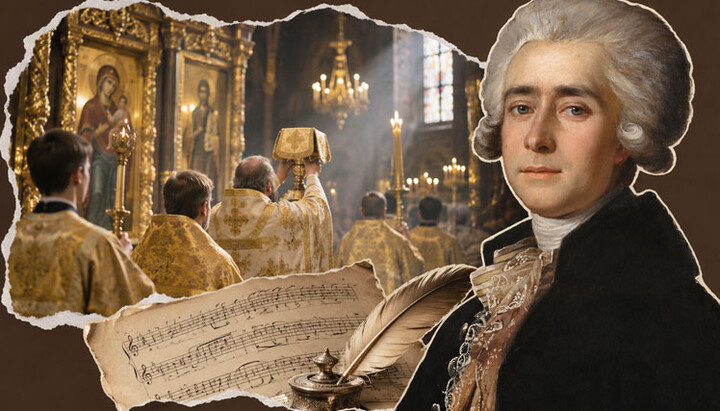
On the lectern, the singers have printed sheets of music. At the top, the title in large type: "Cherubic Hymn No. 7". Below it is the author's name: Dmitry Bortniansky, with the note "edited by P. I. Tchaikovsky". It is unusual to see the names of two outstanding men side by side.

The singers look at the music, the choir director sets the pitch, and a smooth four-part harmony spreads through the church. But the main event of these minutes takes place behind the iconostasis, in the altar. The Cherubic Hymn was written for the sacred rite which the singers see only out of the corner of their eye, or do not see at all.
What happens in the altar during the singing
The Cherubic Hymn is sung at the Liturgies of Saints John Chrysostom and Basil the Great. While the choir smoothly draws out the melody, preparations are under way in the altar for the Great Entrance—the transfer of the Holy Gifts from the table of oblation to the altar table.
In the altar during these minutes, special prayers are read, the chains of the censer jingle, and the smoke of incense rises upward. The deacon walks around the altar table, then comes out of the altar and censes the icons, the priest, and the people.
The Great Entrance divides the Cherubic Hymn in two. The boundary between the parts falls on the word "Amen".
People bow their heads as the clergy come out through the north doors, while the priest and deacon pronounce a long petition with various commemorations.
In the Church's tradition, this procession is interpreted in two ways. Saint Symeon of Thessalonica saw in the bringing out of the Gifts an image of Christ's Second Coming in glory. Another interpretation views the procession as the Savior's path to burial, where the priest and deacon recall Joseph and Nicodemus, and the altar represents the tomb. The music at this time creates a reverent background for the sacred rite.
The structure of Bortniansky's Cherubic Hymn
The Seventh Cherubic Hymn was written by Bortniansky for four voices. The exact year of its composition is unknown; the earliest edition to have reached us was published in Saint Petersburg in 1815.
The score comprises exactly sixty measures. The texture is mostly homophonic: the voices move together, as a single chordal fabric. Only in the very first measure does a brief imitation flash by, as if the choristers were gathering momentum in order to go on shoulder to shoulder.
Toward the end, the musical pattern changes. In the forty-fifth measure, the melody moves into the upper voices—the sound grows brighter and airier. In the fifty-second measure, the whole choir enters, the main key returns, and the hymn is crowned by a broad cadence with a growing volume.
Pauses in the singing occur only where the text itself requires them—at commas or periods. The measured pace of the voices lies exactly upon the slow tread of the sacred procession. The music merely assists the prayer and does not overshadow the actions in the altar.
A boy from Hlukhiv in the capital chapel
The man who wrote these sixty measures had himself, as a child, once gone through training at the kliros. Dmitry Bortniansky was born in Hlukhiv. The birth register has not survived, and the date of his birth was derived conditionally—from the feast day of the Holy Great Martyr Demetrius of Thessalonica.
At the Hlukhiv singing school, up to twenty boys studied at one time. The boys were taught not only part-singing, or "Kyivan" chant — they also learned the violin, the gusli, and the bandura. The best were sent to the capital. In the summer of 1758, Marko Poltoratsky, director of the Court Chapel, selected ten Hlukhiv boys, among them seven-year-old Dmitry, and took them to St. Petersburg.
Seven years later, the Italian composer Baldassare Galuppi came to St. Petersburg. Poltoratsky managed to arrange lessons with him for Bortniansky.
Thus the Hlukhiv singing school met European composition, after which Bortniansky developed a musical style that for decades afterward was recognized from the first chords of his works.
Why did Tchaikovsky correct someone else's notes?
More than half a century had passed since Bortniansky's death when his manuscripts landed on the desk of Pyotr Ilyich Tchaikovsky. In the summer of 1881, the publisher Jurgenson conceived the idea of issuing a complete collection of Bortniansky's sacred compositions — 118 works for unaccompanied choir — and invited Tchaikovsky to serve as editor.
The composer took up the task without much enthusiasm, seeing nothing of significance for Russian music in Bortniansky's creations. "Like oases in a desert," in his opinion, there flickered barely "a dozen decent pieces." Tchaikovsky proposed limiting the edition to two or three of the best compositions, but the publisher insisted on the complete collection.
The editorial work stretched from June to November 1881. Tchaikovsky completed forty arrangements, taking as his basis the Court Chapel editions of the 1810s–1840s. In the spring of 1882, already writing from Naples, he asked Jurgenson for only one thing: "Publish as well as possible, that is, with as few mistakes as possible, and don't worry about deadlines."
Two surnames on one page
No one has yet compared the seventh Cherubic Hymn with the St. Petersburg edition of 1815 in such a way as to separate precisely the author's hand from the editor's pencil. What exactly Tchaikovsky corrected in this chant remains unknown.
Today, in choir-loft music collections, different versions of Cherubic Hymn No. 7 lie side by side. It reached the modern choir loft in the redaction of two composers.
One wrote it for the court choir; the other criticized his predecessor's music, yet meticulously checked every measure for the sake of the edition's purity.
When the deacon takes the censer and comes out of the altar together with the priest, centuries-old disputes recede. The singers turn the page, the choir strikes the first chord, and the music becomes a reliable support for the divine service.