
The Nativity Fast: when it begins and why it lasts 40 days
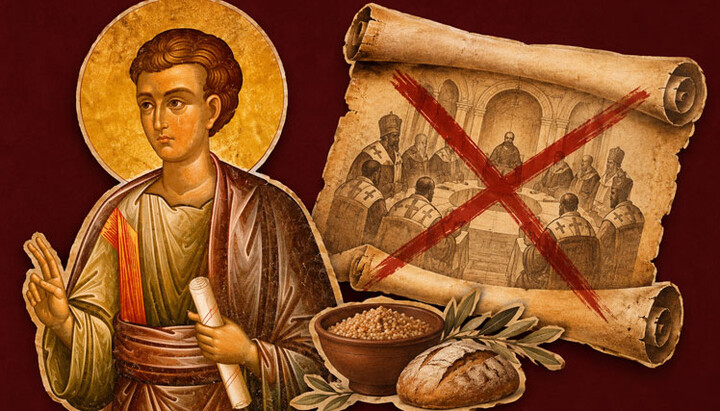
The decision establishing the length of the fast before Christmas is often attributed to a council held in 1166. Yet the hierarchs gathered at that council were debating an entirely different issue.
Orthodox Christians will soon begin the forty-day Nativity Fast. It is widely believed that its duration was established in 1166 by a council under Patriarch Luke Chrysoberges. At first glance, there seems little room for debate: we have a year, the name of the initiator, and a decision.
Only one detail is missing – a reference to the actual document. A look at the proceedings of that council, however, makes this seemingly coherent account fall apart. The bishops who gathered in Constantinople at the time were discussing an entirely different subject.
What was debated at the Council of 1166?
On March 2, 1166, a council did indeed convene in the Byzantine capital during the reign of Emperor Manuel I. Yet the issue on the agenda had nothing to do with the Church calendar. Theologians and hierarchs debated the meaning of Christ’s words in the Gospel of John: “My Father is greater than I” (John 14:28). It was a contentious doctrinal question that had fueled heated controversy for years. The decrees of that council contain not a single reference to the Nativity Fast.
How, then, did Patriarch Luke Chrysoberges become associated with it? This was a classic case of two separate documents being conflated. Patriarch Luke did address the question of fasting before Christmas, but not at the March council. He did so in a separate response, the exact date of which remains unknown – presumably 1166 or 1168.
What is particularly interesting is the content of that response. The patriarch did not establish a forty-day fast as a binding law.
He openly acknowledged that there were no written rules on the matter and that Christians should therefore follow unwritten tradition and begin fasting after November 14. If a person was ill, however, the bishop could shorten the fasting period. There was no major calendar reform in the twelfth century. The patriarch merely referred to a custom that had long been established in the Church.
Why is the Nativity Fast called St. Philip’s Fast?
If there was no formal decree establishing the fast, where did its alternative name – St. Philip’s Fast – come from? Perhaps the holy Apostle Philip fasted more rigorously than Christ’s other disciples or left behind particular rules on abstinence? No, there is no such symbolism behind the name.
The explanation lies entirely in the Church calendar. The Church commemorates the holy Apostle Philip on November 14 according to the Julian calendar, which corresponds to November 27 on the Gregorian calendar. The fast begins the following day. This year, for example, the apostle’s feast falls on Friday, November 27, and the fast begins on Saturday, November 28. Count the days from November 15 through December 24 according to the Julian calendar, and you get exactly forty. This is why the liturgical rule refers to the Nativity Fast as the second forty-day fast.
Associating the beginning of a fasting period with a particular saint was not unique to the Christian East.
In the fifth century, in the West, Bishop Perpetuus of Tours prescribed fasting three days a week “from the day of St. Martin’s burial until Christmas.” The feast of St. Martin of Tours fell on November 11, and the Western fast became known as St. Martin’s Fast. Later, in 567, the Council of Tours required monks to fast “every day of December until Christmas.” The underlying principle was the same: the medieval calendar revolved around saints’ feast days, and the feast of the Apostle Philip provided a natural starting point for the fast in the East.
Where did the forty days before Christmas come from?
That explains the name. But who established the forty-day period if it was not the Council of 1166? The answer lies in the records of Byzantine monasteries.
In the second half of the ninth century, the Studite Hypotyposis, one of the monastic rules of the Byzantine capital, was compiled in Constantinople. It already referred to the fast as St. Philip’s Fast and prescribed forty days of fasting, beginning on November 14. This duration subsequently became established under the influence of Byzantine monastic rules – those of the Stoudios and Evergetis monasteries.
For monks, this approach made perfect sense: the Church observed a forty-day fast before Pascha, so they would fast for the same length of time before the Nativity of Christ. Monastic communities, however, followed their own rules, while laypeople followed different customs.
How long did laypeople fast in Byzantium?
Until the twelfth century, Byzantine laypeople fasted for only about a week before Christmas – roughly from December 18 to 24. A similarly brief period of spiritual preparation for the feast survives in the Armenian tradition, in which the faithful observe a five-day fast before Theophany.
The shorter duration of the winter fast is also attested by Theodore Balsamon, a late twelfth-century canonist of Constantinople. In his commentary on Apostolic Canon 69, Balsamon wrote that there was only one forty-day fast – the one preceding Pascha.
The canonist also considered a shorter fast sufficient for laypeople, since Great Lent remained the only obligatory forty-day fasting period.
Interestingly, Balsamon’s words have come down to us in different versions. Some sources give a period of five days, while The New Tablet maintains that Balsamon prescribed fasting for no fewer than seven days. In any case, even ancient Typika contain indications that the duration of the fast was not uniform for everyone for a long time.
How a monastic rule became a universal practice
Today, the forty-day Nativity Fast has become an established practice throughout the Church. How did this transition to a new tradition take place?
Without a single stroke of the pen. Monastic rules simply began to supersede parish customs. Patriarchal rulings – such as Patriarch Luke’s response concerning unwritten tradition – and canonical interpretations like those of Balsamon gradually brought lay practice into line with the monastic calendar over the course of decades. No formal reform was ever announced – the change came about organically.
We can now trace St. Philip’s Fast to two distinct sources: the feast day of the holy apostle and a monastic tradition that the Church eventually adopted as a universal rule.