A political commissar’s vocabulary: Three interviews with Epifaniy Dumenko
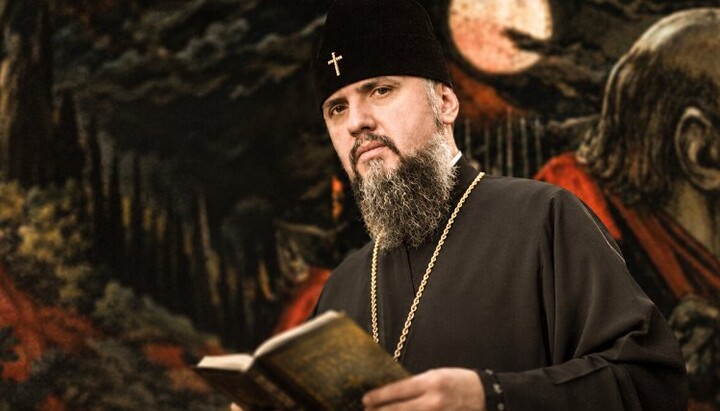
Епифаний Думенко. Фото: СПЖ
Over six days, from October 12 to 17, 2026, OCU head Epifaniy Dumenko gave three extensive interviews: to Ukrinform on the sidelines of Forum 2000 in Prague, to participants at the forum itself, and to Radio Liberty. Taken together, they paint a revealing picture of how the OCU leader views fellow Ukrainians who worship in churches outside his jurisdiction, what he considers victory, and whom he regards as the enemy. More than that, these interviews once again show that Epifaniy is prepared to bend the truth when the facts become inconvenient. Let's take a closer look.
“Capitulation”
The most revealing admission came in Prague. Dumenko outlined three conditions that, according to him, the UOC has set for dialogue: an end to forcible church seizures, a resolution of the problem of invalid canonical ordinations, and acknowledgment of the shortcomings of the OCU's “autocephaly.”
According to Dumenko, “they” – meaning the UOC – “want the OCU to acknowledge that it is not an autocephalous Church.” He then declared: “We will not agree to such terms of capitulation.”
Among the conditions the OCU leader calls “capitulation” is an end to forcible church seizures. He could have separated that demand from the others and said, “We condemn violence, but we are prepared to debate autocephaly.” He did not. Nor did he say, “We do not seize churches.”
Instead, he spoke explicitly of capitulation. In effect, Dumenko openly treats the UOC's conditions for dialogue as an indivisible package – and calls accepting that package capitulation.
In the same interview, Dumenko expressed confidence in achieving “victory on the religious front.” He said that “the aggressor country is trying to break us morally and spiritually, behind the lines,” and insisted that the process of parish transfers “continues and is irreversible.”
Front lines, rear areas, victory, capitulation, aggressor – reading all this, one cannot help thinking these are the words of a political commissar rather than a pastor.
When Christians speak about people who profess the same faith, they generally reach for a very different vocabulary: brother, reconciliation, repentance, love.
Not one of those words was used by the OCU leader in reference to the UOC.
“There is no pressure”
A Radio Liberty journalist asked Dumenko about church seizures. His answer was blunt: “There is no pressure.”
According to him, parish transfers are “a democratic process, a process of free choice,” with decisions made by the communities themselves. He added that the “Russian Church” incites believers to resist in order to create the impression of coercion.
Rather than respond with words, let us respond with facts.
On October 15, the UOC's Church of the Intercession in Zhukivka, near Brovary, was sealed. A parishioner said that activists, having failed to persuade the rector to “transfer,” simply forged the documents.
On October 7, authorities in Kalush announced that St. Nicholas Church, taken from the UOC in March 2022 with the involvement of territorial defense forces, would be handed over to an OCU community that, by the mayor's own admission, “does not even exist in reality yet.”
On October 2, OCU activist Oleksandr Onyshchenko announced from the bell tower of St. Seraphim Church in Sloviansk that the church had been “liberated from the Muscovites,” effectively acknowledging that his associates had broken down its doors the previous day.
In Cherkasy, the UOC cathedral was stormed in October 2024, and one of the attackers, Davyd Pshenichnyi, fired a traumatic pistol inside the church. On October 15, the same Pshenichnyi shoved a lawyer representing the Lavra monks from behind in the corridor of an appellate court.
But perhaps the most revealing evidence contradicting Dumenko's claims came not from the UOJ, but from the state itself.
Around the same time, DESS head Viktor Yelenskyi complained that courts in Vinnytsia Region alone were hearing more than 100 lawsuits over parish “transfers.” He acknowledged that the main problem facing OCU supporters was legal challenges to the procedures for convening and conducting parish meetings.
If everything is voluntary, if “the community itself makes the decision,” where do more than a hundred lawsuits in just one region come from?
Those lawsuits are being filed by the very parishioners on whose behalf the decisions were supposedly made.
Moreover, the Supreme Court recently sent a case involving the “transfer” of a church in Kremenchuk back for reconsideration. According to the rector, the decision was made by people who were not members of the religious community, and the meeting lacked a quorum.
Is this the “democratic process” Dumenko is talking about?
Dumenko, of course, knows all this. He knows who Pshenichnyi is. He knows about Zhukivka and Kalush. He knows about the hundred-plus lawsuits in Vinnytsia Region alone. So when he says “there is no pressure,” it is not out of ignorance. He is speaking to a foreign audience that he expects will never check the facts.
In plain English, that is called lying.
“Even Jews say so”
Asked about religious persecution, the OCU leader replied that Ukraine enjoys “complete freedom of religion.” To support his claim, he cited Jews: “Even Jews say that, despite the war, there is now greater religious freedom in Ukraine.”
He did not specify which Jews had supposedly said this.
Let us set aside the fact that religious freedom for Jews tells us nothing about religious freedom for UOC believers. More importantly, in the very same answer, Dumenko himself spelled out the condition attached to this “complete freedom.” UOC believers, he said, “must clearly state that they are not the UOC, but the ROC in Ukraine.”
In other words, you are free to practice your religion – provided you first renounce your own Church's name and accept the label we have chosen for you. That is not freedom of religion. It is the “freedom” to agree with an accusation and accept a label imposed on you.
“Everyone has the right to practice their faith freely, and no one is infringing on the rights of those who wish to remain part of the ROC,” he said elsewhere.
But what about the millions of people who attend UOC churches and have no desire whatsoever to “remain part of the ROC”? They simply want to belong to their own Church – and that is precisely the right being taken away from them.
Now consider some figures Dumenko conveniently leaves out.
On October 3, DESS official Viacheslav Horshkov acknowledged that 7,907 clergy members in Ukraine had been granted exemptions from mobilization, while the existing criteria effectively prevent UOC communities from obtaining such exemptions for their clergy.
In just the first two weeks of October, TRC personnel detained a UOC hieromonk on his way to study in Athens, a parish rector with a deferment because he cares for a child with a disability, a rector in Volniansk whose sister had been killed during shelling of his church, and a professor at the Kyiv Theological Academy.
Meanwhile, OCU “bishop” Kyrylo Mykhailiuk, convicted of selling 291 supposed deacon's ordinations to draft evaders for $1,000–$2,000 each, received only a suspended sentence.
Is this what “complete freedom of religion” looks like in Ukraine in 2026 – when viewed from somewhere other than Prague?
Vance and “Russian propaganda”
A Radio Liberty correspondent reminded Dumenko that U.S. Vice President JD Vance had publicly spoken about restrictions on freedom of conscience in Ukraine.
The OCU leader's response deserves a closer look.
Dumenko claimed that Vance's statements were rooted in Russian propaganda, which, he alleged, is spread in the United States by paid operatives. According to him, the UOC leadership “hires expensive lobbyists and prominent lawyers – Robert Amsterdam or Tucker Carlson.”
Interestingly, he initially named UOC Protodeacon Vadym Novynskyi as an example, prompting the interviewer to correct him.
“So there are these powerful mouthpieces that essentially spread all this Russian propaganda for money. And someone who hasn't fully understood the situation can, of course, get the wrong impression,” Dumenko said.
There are several layers of falsehood here.
First, Tucker Carlson is neither a lawyer nor a lobbyist, and Dumenko offered no evidence that Carlson receives money for his position on the UOC. Nor can he substantiate that allegation. Publicly accusing a prominent journalist of being bought and paid for without presenting a single fact is what any country would call defamation.
Second, Vance's position predates any supposed lobbying campaign.
Back in April 2024, while still a senator, he called it disgraceful that Washington had failed to use its assistance to Ukraine to secure guarantees of religious freedom, even as Kyiv was preparing legislation to ban the UOC.
This was the position of someone for whom religious freedom was a matter of personal conviction, not the product of somebody else's campaign.
Third, and most tellingly, when asked about contacts with the current U.S. administration, Dumenko could not name a single meeting. He merely replied: “We cooperate, participate in events, and bear witness to the truth.”
The interviewer reminded him that during Trump's first term, the OCU leader had met twice with Secretary of State Mike Pompeo.
Now, judging by his response, those doors appear to be closed to him.
And Dumenko can think of nothing better to do than portray the second-highest official in the U.S. government as a victim of paid Russian propaganda.
This is more than a careless remark. It is the political shortsightedness of a man accustomed to having the state solve all his problems.
A few days later, former C14 leader Yevhen Karas responded to Trump's remarks about the need for elections in Ukraine by calling for UOC churches to be “de-occupied” in order to deprive Putin of his “strategic reserve of saboteurs and agents.”
The logic is the same as Dumenko's: the UOC is a bargaining chip, and anyone who opposes the campaign against it is working for Moscow. Including, apparently, the vice president of the United States.
Does Vance's circle share that logic? We may soon find out.
“They do not deny our autocephaly”
At Forum 2000, Dumenko claimed that the Local Orthodox Churches that have not recognized the OCU “do not deny our autocephaly as such.” Instead, he said, they merely “have certain conditions for beginning official communion” and are waiting for the war to end and the ROC's influence to weaken.
“There is no religious issue as such here,” he added.
Let's examine that claim.
In July 2026, Bulgarian Patriarch Daniel explicitly stated that the Bulgarian Church does not recognize the OCU and considers the UOC, headed by Metropolitan Onuphry, to be canonical.
On October 17–18, more than 2,000 clergy and laypeople signed an open letter opposing concelebration between Patriarchs Daniel and Bartholomew because of the OCU's Tomos.
In Georgia, during celebrations marking 1,700 years of Christianity, the Synod of the Georgian Church invited a UOC delegation. Patriarch Shio received its members separately and conveyed his respect for Metropolitan Onuphry.
The Churches of Jerusalem, Antioch, Serbia, Poland, the Czech Lands and Slovakia, and Albania have taken no steps toward recognizing the OCU in seven years. The Albanian Synod, moreover, long ago issued a clear and detailed written response to the Phanar's justification of the “Ukrainian ordinations.”
Is this what Dumenko means by “not denying” the OCU's autocephaly?
But the central issue is not even that.
It is his statement that “there is no religious issue.” Dumenko himself says that recognition of the OCU depends not on the canons, not on ordinations, and not on the faith, but on “the end of the war” and “the weakening of the ROC.” In doing so, he effectively admits that the OCU's position rests on the war.
But what happens when the war ends – as it inevitably will?
The one argument he offers the Local Churches will simply disappear.
The language of hostility
Now consider how the OCU leader speaks about people.
Referring to the monks of the Kyiv-Pechersk Lavra, he says: “They are hired hands, temporary hired hands in our Ukrainian holy sites.”
So the men who raised the Lavra from ruins and rebuilt it while Dumenko was still in school are hired hands? Monks who have lived there since the late 1980s are merely temporary occupants?
What, then, should we call the OCU “brethren” who arrived to find everything already built and restored? During their years at the Lavra, they have failed not only to restore deteriorating holy sites but even to remove garbage without the help of bloggers.
Dumenko speaks even more harshly about UOC clergy as a whole. According to him, “the clergy of the Moscow Patriarchate in Ukraine have worked and continue to work in the interests of the aggressor country.”
Epifaniy claims that UOC pastors and parishioners “deceive many Orthodox Ukrainians.” And he describes the UOC itself as “an integral part of the ROC.”
Consider what this means.
In Dumenko's view, all UOC priests are “working for the aggressor,” along with tens of thousands of people associated with the Church – including Ukrainian soldiers, hundreds of volunteer chaplains, aid workers, and fathers of fallen servicemen.
For example, during the very days when Epifaniy was talking about “working for the aggressor,” a funeral was held in Sumy for the father of a UOC priest who had died while serving in the Ukrainian Armed Forces.
Was he “working for the aggressor” too?
Dumenko is not misspeaking. He is deliberately attaching a label and resorting to collective accusations. Throughout history, this tactic has been used to justify some of the most horrific crimes. To accuse an entire Church of working for the enemy is no longer an assessment. It is a verdict. The OCU leader understands this perfectly well, yet he continues because he is convinced he will never be held accountable.
But he will have to answer for his words, because they are being heard loud and clear by those who consider themselves his flock.
On October 13, the OCU-affiliated platform Pravoslavni Skhidniaky posted a supposedly humorous video showing a man in a cassock burying a “UOC believer” who “doesn't like the Ukrainian language.”
In an earlier video in the same series, the same man was hiding the body of a “UOC priest.”
On October 7, activist Davyd Pshenichnyi displayed three-liter jars outside the courthouse hearing the Lavra case. The jars bore portraits of UOC hierarchs made to resemble severed heads. He explained that this was what “every conscious Ukrainian dreams of.”
On October 15, the same activist took part in an assault on a lawyer inside the courthouse.
Criminal proceedings have also been opened against Kyiv FM host Bohdan Butkevych, who called UOC clergy “FSB colonels” and “degenerates.” The case concerns incitement of religious hatred and was opened following a court ruling secured by UOC lawyers.
There is a direct line between Epifaniy's talk of “hired hands” and “working for the aggressor” and the images of “heads in jars” displayed by an activist. One identifies the enemy. The other shows what should be done to enemies. And Dumenko has never condemned these outrageous acts – not once, not with a single word.
He did, however, condemn Vance.
The only voice from within the OCU to call the behavior outside the courts what it really is came not from Dumenko, but from commentator Tetiana Derkach. She described the spectacle as a “circus” and a form of fanaticism that “differs from patriotism as much as a sewer differs from a canal.”
When a laywoman says what the “primate” himself should have said, that tells us everything we need to know.
What another Primate said that same week
For comparison, we need look no further than one date.
On October 18, the day Radio Liberty published its extensive interview with the OCU leader, Metropolitan Onuphry said in a sermon: “Love for enemies destroys evil, while revenge multiplies it.” He was speaking about those who are actually waging war against Ukraine. And these words came from a man whom Dumenko and Yelenskyi have accused for years of failing to condemn the war strongly enough.
A week earlier, Metropolitan Onuphry had said: “God created man to live in peace, not for wars and hostility.”
People may have different views of the UOC. But here are two men speaking in the same week, using two entirely different vocabularies. One speaks of love, peace, and enemies who must be loved. The other speaks of fronts, rear lines, capitulation, hired hands, and aggressors. The first speaks like a man who lives and breathes the Gospel. The second speaks like a political commissar, "politruk."
Dumenko heads a church organization sustained by state support and speaking the language of the state. And his mission is much the same as that of a political commissar: not to reconcile people, but to explain to the rank and file who the enemy is.
The problem is that the enemy he has designated consists of several million Ukrainians. They do not “wish to remain part of the ROC.” They simply want to worship in their own churches and be left in peace.
Dumenko promises them “complete freedom” if they agree to call themselves the Russian Church. He assures Western audiences that “there is no pressure,” while portraying the U.S. vice president as a victim of propaganda.
And as long as this continues, talk of “dialogue” is meaningless.
Talk of Christianity even more so.
Read also
The Council of Crete: a decade of unity in name only
Constantinople marked the anniversary of the Council of Crete with a theological conference in France. They spoke about the unity of Orthodoxy, although over the past years there has noticeably been less of it.
Yelensky’s plan: Why is DESS demanding what the UOC has already done?
DESS is demanding that the UOC take steps it has already taken, while offering no assurance that further demands will not follow. What is behind Yelensky’s ultimatum?
Why OCU hierarchy lacks canonical ordination: what Local Churches say
The OCU head refuses to address invalidity of his ordinations. But almost all Local Churches speak of it – even those that recognized the OCU.
Why nation-first advocates do not call for peace
Ukraine’s population is declining by nearly one million people a year, and experts are warning of the nation’s demographic extinction. Yet the leaders of the Orthodox Church of Ukraine (OCU) and the Ukrainian Greek Catholic Church (UGCC) continue to call for war and mobilization.
The deception that decided the fate of the Tomos
In 2008, the "Filaret problem" derailed Yushchenko's plan. In 2018, Poroshenko solved it in just one hour – with a police escort for the Greeks and verbal promises to Filaret.
Lawyers in the crosshairs: How UOC is being stripped of its right to defense
Activists harass UOC lawyers outside courthouses, call them “traitors” on air, and promise them a “warm welcome” at hearings. The Church’s right to a legal defense is at stake.