Bonfire on Champel hill
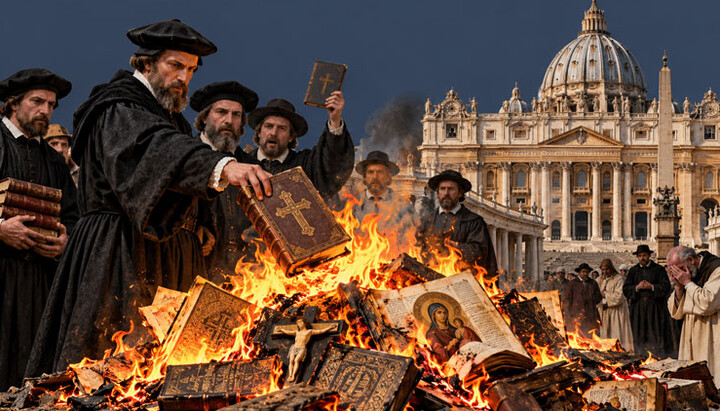
Sacrilege of Calvinists. Photo: UJO
October 27, 1553. The outskirts of Protestant Geneva, Champel hill. The air is dense and acrid, stinging the eyes: green wood is burning together with wet straw. In the center of this hellish pyre, books tied to the belt of a 42-year-old Spaniard burst into flame. Michael Servetus (Miguel Servet), a physician ahead of his time, a geographer, a polyglot, and a man with a truly fatal talent for asking uncomfortable questions, screams in inhuman pain.
That scream made all of intellectual Europe shudder. But it did not stir a shadow of doubt in the eyes of those who threw the wood onto the fire. Servetus was not burned by savage barbarians. Not by bandits. And not even by the Catholic Inquisition, from which the Spaniard had fled all his life. He was put to death by the most enlightened, consistent, and deeply believing people of that era, the Geneva Calvinists. And the sentence was signed by John Calvin himself — a man who had once fled persecution for his faith and was now sincerely convinced that he was performing an act of the highest, God-pleasing mercy.
That pyre became a thunderclap that split the Christian world. It posed a pointed question: does faith, ideology, or any institution that claims to possess absolute truth have the right to put people to death for dissent? But one must cast far from one's mind the familiar stereotype of the "freedom-loving scholar" and the "evil fanatic."
The Clash of Two Giants of the Renaissance
On Champel hill, two titans of the Renaissance and two mighty systems of thought collided.
Servetus was a rebellious poet of theology.
A physician by vocation, he was the first in the West to describe the pulmonary circulation of the blood. But he dissected not for the sake of science: Servetus sought to understand how the Spirit of God fills the human body with the breath of life. For him, the Bible was not a dry code of legal articles but a living, breathing Ocean. And gazing into that ocean, he allowed himself to reflect in a way that, in Calvin's view, was forbidden.
"Three Persons in one God?" Servetus exclaimed indignantly. "Show me that in Scripture!" He wrote the treatise "On the Errors of the Trinity" and the fundamental work "The Restoration of Christianity" not for the sake of schism. He believed he was giving the world a purified, primordial Truth.
The Rebellious Anatomy of European Theology
And at the opposite pole stood John Calvin, the architect and jurist of the Reformation. He turned Geneva into a "Protestant Rome," a thoroughly ordered community of God where there was no place for debauchery, card games, or carousing. But the price of this holiness proved to be steel: discipline, denunciations, censorship, absolute control. For Calvin, the Reformation was not the chaos of free-thinking but the restoration of the Sacred Order. And the main load-bearing pillar of that order was the dogma of the Holy Trinity.
When Servetus began bombarding Calvin with letters bearing insolent notes in the margins, the Reformer saw in him not merely an opponent, but a deadly virus. In a letter to Farel, Calvin drops a chilling phrase: if Servetus comes to Geneva, he will not leave alive.
Servetus took a reckless step: he secretly came to a sermon of Calvin himself in Geneva. He was recognized. Arrested. And the millstones of theological justice began to turn with the inevitability of fate.
Theology in the Trap of Ideology
Why did Calvin — a genius, a humanist, whose mind illumined Europe — show such ruthlessness? The answer is simple. As soon as living faith turns into a political institution, theology inevitably becomes ideology.
For Calvin, Servetus had committed not an intellectual error. He had committed a spiritual act of terror.
The logic of the Geneva court was also simple. If a person errs in rites, it is a sin. But if he denies the Trinity, he destroys the very foundation of salvation. To allow Servetus to teach is to allow him to lead thousands of souls into eternal perdition. And therefore, to burn one heretic is not cruelty. It is active mercy toward the others, whose souls will be saved from infernal contagion. One must not kill a man, but if it is for God, then one may.
An Eternal Verdict on Religious Violence
Calvin's chief mistake was that he failed to understand the most important thing: the Creator of the Universe cannot be defended by the hands of an executioner. At the moment when a system takes upon itself the role of "God's advocate" by means of the stake, it commits sacrilege, substituting itself for God.
Servetus's contemporary, the humanist Sebastian Castellio, then uttered words that became an eternal verdict on any religious violence: "To burn a man is not to defend a doctrine. It is simply to burn a man."
Castellio discovered the chief Christian truth that Geneva had forgotten: when we kill for views, we do not kill heresy. We kill Christ Himself in the person of that man, destroying the very Love on which the Gospel stands.
The Tragic Lesson of the Geneva Stake
The story of the stake on the hill of Champel is not a dusty exhibit of the 16th century. It is a mirror in which each of us sees ourselves. Replace "the dogma of the Trinity" with "racial hygiene," "class struggle," "national interests," or "the one true ideology" — and you get the exact mechanism of any totalitarianism:
- The emergence of a group of people convinced of their monopoly on Absolute Truth.
- The dehumanization of the one who thinks differently: he is no longer a person who errs; he is a "parasite," an "enemy of the people," a "threat to security."
- The legitimization of violence: humanism is declared weakness, and the destruction of a person — a "sacred duty for the sake of the higher good."
A robber kills for a wallet, and his evil is local. An ideological fanatic kills for the sake of "higher justice" — and his violence becomes endless. Calvin sincerely loved God — and precisely for that reason was absolutely merciless toward Servetus.
Does a community have the right to defend its boundaries? Undoubtedly. Geneva had every right to say to Servetus: "We do not share your views. You will not teach this in our churches." The logic of orthodoxy is the logic of exclusion from the community. But the moment orthodoxy takes up the sword and moves from exclusion to physical destruction, it signs its own spiritual defeat. A truth that must be defended with pyres, prisons, and censorship ceases to be the Truth.
The irony of history is both merciless and beautiful. Three hundred and fifty years after the execution, in 1903, the descendants of the Genevan Calvinists erected a memorial stone on the site of the pyre. An official act of repentance is carved upon it: they, devoted followers of Calvin, officially condemned "an error belonging to the age of our reformer." The execution of Michael Servetus has left us a chief ethical and theological lesson: the Truth has no need of executioners.
Freedom of conscience is not a guarantee that you will not err. It is the sacred right to seek God without fearing that your sincere searching will be answered by the flames of a pyre. And every time we deny another person the right to seek, the smoke over the hill of Champel begins once again to darken our own sky.
Read also
Confession from afar: from ancient letters to mobile phones
When someone is confined to a hospital bed or trapped under shelling, a difficult question arises: Can a phone conversation with a priest take the place of sacramental confession?
A tale of two oaths and a mother on a mountain
The story of a drought in Judea reveals the depths of God's justice and the price of a human promise.
Collapse of Babel's tower of globalism
October 24 is United Nations Day. An analysis of the crisis of secular institutions and the ideology of globalism through the prism of biblical Babylon and Pentecost.
Archpastor's word for weary city dwellers
When exhaustion weighs us down, we turn to ancient sermons to ask profound questions about human destiny and the nature of existence.
Brother of tax collector and brother of Lord
The Gospel is silent about the son of Alphaeus, and commentators have argued for centuries over who he was. And the Church commemorates two apostles named James in close proximity.
Prayer commemorations instead of loving embraces
At every Orthodox wedding, the choir sings a hymn to the martyrs. For families separated by war, these words carry a special meaning.