Obedience to Patriarch and bishop: ROC's new ordination questionnaire
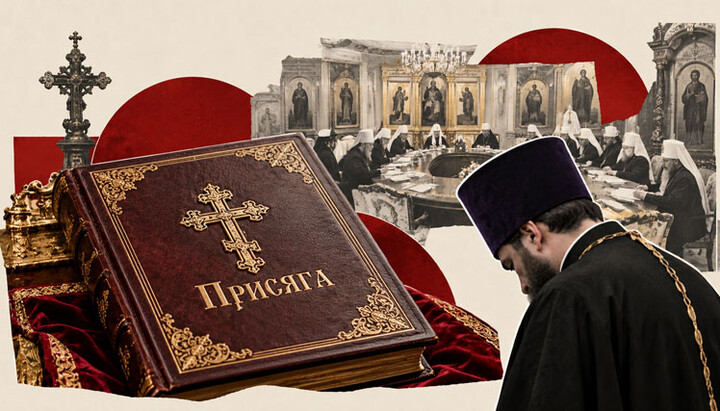
The ROC's new ordination questionnaire places clergy under the Patriarch's direct authority. Photo: UOJ
On October 22, 2026, the Synod of the Russian Orthodox Church (ROC) adopted a decision that appears largely technical in the official record: It amended the ordination oath and, for the first time, approved a standardized ordination questionnaire.
The news that attracted widespread coverage in secular media concerned social media. Under the revised oath, candidates for ordination pledge "not to speak publicly on behalf of the Church without the blessing of the ecclesiastical authorities, not to make statements in the media or online (including on social networks and other social media) that discredit the Orthodox Church or distort its teachings, and not to use the internet for personal gain."
But another change deserves close attention. Under the newly approved questionnaire, candidates must pledge "to remain faithful to His Holiness the Patriarch of Moscow and All Rus' and to obey him and their diocesan bishop, as well as the Holy Synod of the Russian Orthodox Church, in all things."
Where did the ordination oath come from? What did the previous wording say, and what has changed? Most importantly, why does this new formulation raise serious concerns?
What exactly did the ROC Synod decide?
The decision was recorded in Journal No. 82 of the Synod's October 22, 2026, meeting. The accompanying background note explains that the Synod had approved a standardized ordination oath on March 22, 2011 (Journal No. 21), but had never formally approved a uniform questionnaire.
While working on the topic "The Priest and the Parish on Social Media," the Inter-Council Presence's Commission on Church Administration, Pastoral Care, and the Organization of Church Life discovered that dioceses were using different versions of the questionnaire. The commission requested copies of the forms in use and received 209 responses.
Both the oath and the questionnaire are mandatory for every candidate seeking ordination to the diaconate or priesthood. They are separate documents. The oath is a solemn pledge made before the Cross and Gospel. The questionnaire is a written declaration containing information about the candidate and the obligations he undertakes, signed by both the candidate and the bishop.
In practice, however, both documents are signed on the same day, kept in the cleric's personnel file, and treated similarly in ecclesiastical court proceedings.
The provision concerning obedience to the Patriarch and Synod appears as the second item in the questionnaire, immediately after the candidate's pledge "to carry out his ministry in accordance with the rules of the Holy and God-bearing Fathers and the statutes and traditions of the Russian Orthodox Church."
No official explanation has been given for this change.
Where did the ordination oath come from?
The ancient Church had neither ordination oaths nor questionnaires for priests and deacons. Instead, candidates underwent examination, their lives were attested to, and they made a profession of faith.
The written ordination oath appeared in the Russian Church in the 17th century under Patriarch Joachim. Under Peter I, a pledge of loyalty to the sovereign was added. During the Synodal period, the wording was repeatedly revised, and political elements were not removed until the 1990s.
The reforms of Peter the Great help explain much of this history. The Spiritual Regulation of 1721 introduced a mandatory oath for members of the Ecclesiastical College, while supplementary provisions followed in 1722. As historian V. Bezhanidze noted, the fifth provision of the original supplements required candidates for priestly ordination to swear that they would not conceal schismatics.
That same year, a Synodal decree dated May 17 required priests to report premeditated crimes disclosed during confession. The decree included a special oath for clergy (Complete Collection of Laws of the Russian Empire, Collection 1, Vol. 6, No. 4012).
In other words, the oath originated not as a theological act but as an instrument of state control over the clergy. It required priests to demonstrate loyalty to the throne and subordinated even the confidentiality of confession to the interests of the state.
This arrangement persisted until the end of the Russian Empire.
A written declaration survives from the future Hieromartyr Joseph (Petrovykh), made before his ordination as a hierodeacon in 1901. In it, he reaffirmed his oath of allegiance to the emperor and pledged to fulfill his duties in accordance with ecclesiastical rules, statutes, and instructions from his superiors, "in complete obedience."
Historian P. V. Znamensky described how, in the 18th and 19th centuries, candidates for ordination were questioned at a special desk in the ecclesiastical consistory, following procedures resembling judicial interrogations. The Russian term dopros, meaning "interrogation," entered the name of the document through precisely this practice.
For a long time, no single Synod-approved version of the ordination oath existed. Even under Patriarch Alexy II, dioceses used their own forms. A uniform oath was approved only in 2011, under Patriarch Kirill, while the questionnaire remained a diocesan document until October 2026.
In the 2011 oath, candidates pledge to conduct their ministry "in all things according to the word of God, the canons of the Church, and the instructions of the ecclesiastical authorities," and to celebrate services and sacraments "according to the established order of the Church, making no arbitrary changes."
Here, the hierarchy is represented by the collective term "ecclesiastical authorities," while personal obedience is directed exclusively toward the candidate's own ruling bishop. This is entirely consistent with canonical tradition.
Do other Churches have similar requirements?
In the Local Orthodox Churches of the Greek tradition, there is no ordination oath for deacons and priests. Something comparable exists only in the rite of episcopal consecration, where the future bishop professes the dogmas he undertakes to uphold. During the preparation of this article, no evidence of a comparable document was found in the Serbian, Bulgarian, Romanian, or other Orthodox Churches.
Another historical detail is particularly revealing: In the Russian tradition, it was the bishop, not the priest, who traditionally promised obedience to the Patriarch.
Professor A. A. Dmitrievsky, in his book The Candidate for Ordination (Kyiv, 1904), cites a 17th-century episcopal pledge: "To follow in all things and always obey my father, the great lord, His Holiness [name], Archbishop of Moscow and All Russia and all the northern lands, the Patriarch."
This makes sense. For a bishop, the Patriarch is the "first" described in Apostolic Canon 34. For a priest, the immediate holder of ecclesiastical authority is his ruling bishop. The new questionnaire imposes on priests an obligation that tradition reserved for bishops, effectively placing the Patriarch in the position that belongs to the diocesan bishop.
Surprisingly, the closest parallel comes not from the Orthodox East but from the Latin West.
Canon 273 of the Roman Catholic Church's 1983 Code of Canon Law imposes on clerics a special obligation of reverence and obedience both to the Supreme Pontiff and to their own ordinary, or ruling bishop: “Clerici speciali obligatione tenentur Summo Pontifici et suo quisque Ordinario reverentiam et oboedientiam exhibendi”.
This provision has a doctrinal foundation. Chapter 3 of Pastor aeternus, the constitution adopted by the First Vatican Council in 1870, defines the Roman bishop's authority over all churches, pastors, and faithful as ordinaria et immediata – ordinary and immediate – and pronounces anathema on those who deny it.
The dual structure of obedience in Latin canon law – to both the pope and one's bishop – follows directly from the doctrine of the Roman Pontiff's immediate universal jurisdiction. Orthodox ecclesiology rejects that doctrine and therefore cannot adopt its corresponding legal expression.
How do the old and new texts differ?
In earlier ordination questionnaires, loyalty to the Patriarch and obedience to the diocesan bishop appeared in separate provisions.
For example, in the 2002 Moscow questionnaire for candidates to the priesthood, Item 15 required candidates "to remain faithful to His Holiness the Patriarch of Moscow and All Rus' and to the ecclesiastical authorities." Item 16 required them "always to follow the instructions of the diocesan bishop and to do nothing without his consent." The questionnaire for deacons contained the same two commitments in Items 12 and 14. The Synod was not mentioned in either document.
Under this arrangement, the Patriarch was owed "loyalty," while the diocesan bishop was owed obedience to his instructions. Loyalty to the Patriarch and the ecclesiastical authorities meant fidelity to Church unity, not direct administrative subordination to the Patriarch. Obedience, meanwhile, was owed to one's own ruling bishop.
The new wording adds the verb "obey" to the pledge of "loyalty," reinforcing it with the words "in all things." The Patriarch, diocesan bishop, and Synod are grouped together, with the Patriarch named first, ahead of the ruling bishop. All three authorities are thereby presented as exercising the same kind of direct authority over a priest.
The previous arrangement followed a clear hierarchy: priest – bishop – Patriarch and Synod. Under the new arrangement, every priest is directly subordinate both to his bishop and to the Patriarch.
Why the new wording is canonically problematic
The hierarchical structure of church authority. The canonical order of the Orthodox Church rests on the principle that authority over clergy belongs to the bishop within his own diocese, while primacy among bishops is exercised collegially rather than through direct control.
Apostolic Canon 34 instructs the bishops of each nation to recognize the "first among them" and regard him as their head, and "do nothing of consequence without his consent." But the canon concerns relationships among bishops. It also specifies that each bishop is responsible for matters pertaining to his own diocese and that the first bishop must do nothing without the consent of the others.
Apostolic Canon 39 states: "Let not the presbyters or deacons do anything without the sanction of the bishop." It explains why: The bishop is entrusted with the people of the Lord, and of whom will be required the account of their souls.
Canon 9 of the Council of Antioch reiterates that each bishop has authority over his own diocese and is responsible for governing it.
Apostolic Canon 35 and Canon 22 of Antioch prohibit bishops from exercising authority outside their own dioceses. "But if he be convicted of doing so, without the consent of those persons who have authority over such cities and places, let him be deposed, and those also whom he has ordained."
None of these canons establishes the direct subordination of a priest to another bishop, even if that bishop is the Primate of the Church.
The patristic foundation. Hieromartyr Ignatius the God-Bearer writes to the Smyrnaeans: “Follow the bishop, all of you, as Jesus Christ followed the Father, and the presbytery as the apostles.” Clearly, this refers to one's own ruling bishop within one's own Church, not to a "bishop over bishops."
Hieromartyr Cyprian of Carthage expresses the same principle in his letter to Pupianus: “You ought to know that the bishop is in the Church, and the Church in the bishop.” And in opening the Council of Carthage in 256, he speaks on behalf of all the bishops: “For none of us sets himself up as a bishop of bishops.”
The new questionnaire effectively makes the Patriarch the immediate superior of every priest, bypassing the ruling bishop. In doing so, it turns him into precisely such a "bishop of bishops."
The Statute of the Russian Church itself. The current ROC Statute states that the Patriarch "has primacy of honor among the episcopate of the Russian Orthodox Church and is accountable to the Local and Bishops' Councils" (Chapter IV, Section 2).
It also specifies that he governs the Church "jointly with the Holy Synod, serving as its chairman" (Chapter IV, Section 4) and "is the diocesan bishop of the Moscow Diocese" (Chapter IV, Section 9).
The Patriarch's powers concerning dioceses are defined in Chapter IV, Section 7. He may "offer brotherly counsel to bishops," "oversee the fulfillment of their archpastoral responsibilities in governing their dioceses," and "receive complaints against bishops and take appropriate action."
The Statute does not grant the Patriarch direct authority over clergy in other dioceses. Ordination, appointments, and the exercise of "paternal correction and disciplinary measures" concerning clergy are assigned to the diocesan bishop under Chapter XV.
Journal No. 91 from the same Synod meeting identifies Patriarch Kirill as "the diocesan bishop of the Moscow Diocese." For a cleric serving in Omsk or Chita, for example, the Patriarch is not his diocesan bishop.
The new questionnaire therefore requires obedience that is not established by the Statute and, indeed, conflicts with its provisions.
The Moscow Patriarchate’s own document on primacy. In 2013 the Holy Synod approved the document “The Position of the Moscow Patriarchate on the Issue of Primacy in the Universal Church.” It distinguishes several levels of primacy.
At the diocesan level, "primacy belongs to the bishop," who possesses "the fullness of authority – sacramental, administrative, and teaching" within his ecclesiastical jurisdiction. At the level of an autocephalous Local Church, "primacy belongs to the bishop elected as Primate," with that primacy deriving from his election by the Council or Synod.
The document goes on to state explicitly: "The Primate does not possess sole authority in an autocephalous Local Church but governs it in a conciliar manner." His authority is that of the "first among equal bishops," while the "powers of the Primate of an autocephalous Local Church are determined by the Council (Synod) and enshrined in the statute."
In other words, the Moscow Patriarchate itself established that full authority over clergy belongs to the diocesan bishop, while the Primate is first among equals and exercises powers limited by the Church's Statute. The 2026 questionnaire, requiring every candidate for ordination to "obey the Patriarch in all things," contradicts that position.
Interestingly, the 2013 document was drafted in response to Constantinople's claims to authority over the Local Churches. Yet the very model Moscow rejected at the universal level is now being reproduced within the Russian Church itself.
The demand for unconditional obedience. Another problem is the questionnaire's requirement that priests and deacons obey the Patriarch, Synod, and their own bishops "in all things." This conflicts with both Church canons and the wording of the ordination oath.
Canon 15 of the First-and-Second Council of Constantinople of 861 condemns those who separate from their Patriarch before a conciliar judgment has been issued. However, it makes an exception when a Primate publicly preaches a heresy condemned by councils or the Fathers. Those who separate from such a bishop are not only exempt from ecclesiastical penalties but are considered worthy of the honor due to Orthodox Christians, because they have separated themselves from a false bishop rather than a true one.
Thus, in Orthodox understanding, obedience even to one's own bishop or Patriarch is conditional and limited by fidelity to Orthodoxy and the canons.
The 2026 questionnaire removes that qualification, demanding obedience "in all things" without explaining the scope or limits of that obligation. Taken to its logical conclusion, this wording reduces diocesan bishops to intermediate links in an administrative chain of command – effectively turning them into vicars of the Patriarch. This is not yet heresy, but it represents a serious shift in ecclesiology, now enshrined by the Synod in a mandatory document.
Defenders of the new wording might argue that the Patriarch is the "head" of the bishops under Apostolic Canon 34, that the Synod is the highest governing body between Councils, and that clergy are obligated to follow Church-wide decisions.
All of this is true.
But such obedience is mediated through the diocesan bishop. Decisions of the Patriarch and Synod reach priests through their bishops and become binding as those bishops receive and implement them within their dioceses. That is precisely why the previous wording clearly distinguished "loyalty" to the Patriarch from obedience to the bishop.
A more appropriate formulation might read: "To remain faithful to His Holiness the Patriarch and the Holy Synod as the supreme authorities of Church governance, and to obey one's diocesan bishop in all matters that do not contradict the word of God and the sacred canons."
More than a theological debate
This issue is not merely academic.
Since 2022, the ordination oath has become a central argument in disciplinary proceedings against priests who refused to recite the Patriarch's newly introduced prayer for "Holy Rus'." Their refusal was treated as a violation of their oath. The priests facing disciplinary action argued that the oath itself required them to celebrate services "according to the established order of the Church, making no arbitrary changes." The prayer, however, had been introduced by order of the Patriarch's first vicar without the text being reviewed by the Synod.
Moreover, the Church's Statute does not authorize the Patriarch to change liturgical practice unilaterally. As one of the priests put it, "The ecclesiastical authorities cannot demand of a cleric anything that contradicts these documents."
The new requirement to "obey the Patriarch in all things" effectively removes that defense. A directive from the Patriarch becomes directly binding on every cleric, without the involvement of the diocesan bishop or review by a conciliar body.
Ultimately, the new questionnaire's wording conflicts with the Apostolic Canons, the teachings of the Church Fathers, the Russian Church's own Statute, and its 2013 position on primacy. And regrettably, it is this change – rather than the new social media rules – that may prove to be the most lasting consequence of the ROC Synod's October 22 meeting.
Read also
A political commissar’s vocabulary: Three interviews with Epifaniy Dumenko
In just six days, the OCU leader managed to call an end to church seizures “capitulation,” describe Lavra monks as “hired hands,” and portray the U.S. vice president as a victim of propaganda.
The Council of Crete: a decade of unity in name only
Constantinople marked the anniversary of the Council of Crete with a theological conference in France. They spoke about the unity of Orthodoxy, although over the past years there has noticeably been less of it.
Yelensky’s plan: Why is DESS demanding what the UOC has already done?
DESS is demanding that the UOC take steps it has already taken, while offering no assurance that further demands will not follow. What is behind Yelensky’s ultimatum?
Why OCU hierarchy lacks canonical ordination: what Local Churches say
The OCU head refuses to address invalidity of his ordinations. But almost all Local Churches speak of it – even those that recognized the OCU.
Why nation-first advocates do not call for peace
Ukraine’s population is declining by nearly one million people a year, and experts are warning of the nation’s demographic extinction. Yet the leaders of the Orthodox Church of Ukraine (OCU) and the Ukrainian Greek Catholic Church (UGCC) continue to call for war and mobilization.
The deception that decided the fate of the Tomos
In 2008, the "Filaret problem" derailed Yushchenko's plan. In 2018, Poroshenko solved it in just one hour – with a police escort for the Greeks and verbal promises to Filaret.