
The death of the Theotokos became Her second birth
The Gospel says nothing about the passing of the Most Holy Theotokos – yet the Church made this event one of the great feasts of the year.
Indeed, not one of the Evangelists devotes so much as a single line to how the Mother of God died. We are given no exact date of Her repose, no place, no circumstances of Her death or burial. By comparison, Scripture tells us quite plainly about the death of the Apostle James (Acts 12:2). But about the Theotokos, whose image stands at the very heart of the entire Gospel story – not a word.
Strange, isn’t it?
And yet the Church does far more than simply commemorate the day of Her repose. It has made this event one of the Twelve Great Feasts of the year, built churches and monasteries dedicated to the Dormition across the world, and developed an entire iconographic tradition around it.
So where did all this knowledge come from if its principal source – Holy Scripture – is silent about the Dormition?
Who is the child in Christ’s arms?
The answer lies in the composition of the icon of today’s feast. More precisely, in one detail that is very easy to miss: we may kiss the icon countless times without ever really stopping to look at it.
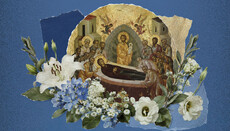
Look closely at any icon of the Dormition. In the center lies the Most Holy Theotokos on Her deathbed. Around Her stand the grieving apostles. And behind the bier stands Christ, surrounded by a radiant halo.
In His arms is a child – tiny, swaddled like a newborn.
Our first thought might be: surely this is the Christ Child from the Nativity icon. Except that here, for some reason, the Savior seems to be holding Himself against His own chest.
But no. This is not a reference back to the beginning of the Gospel story. The child in Jesus’ arms is the soul of the Theotokos.
For centuries, iconographers have depicted Her soul in precisely this way – tiny, swaddled, helpless – because they wanted to convey something far greater than the simple passage of a soul into eternal life.
The Mother who once cradled the newborn God in Her arms now becomes a newborn Herself, cradled in the arms of Her own Son.
Mother and Child have changed places.
Becoming a child in order to be saved
Once we begin to grasp the meaning of this image, the icon ceases to be merely an illustration of the feast. It begins to preach – without saying a word.
In the Church’s understanding, death is not dissolution into nothingness. It is not the erasure of the person. It is a second birth – another coming into the light, only in the opposite direction.
The Lord Himself once told His disciples something remarkably similar: unless you turn and become like children, you will never enter the Kingdom of Heaven (Matt. 18:3).
The icon of the Dormition of the Most Holy Theotokos shows us what this actually looks like – through the example of the first human being for whom that Kingdom was opened.
You cannot enter it armed with authority, earthly achievements, or even all the wisdom accumulated over a lifetime.
You enter Paradise when God takes you – small and helpless – into His arms.
For anyone afraid of growing old, of one day becoming dependent on loved ones, of becoming physically weak, there is immense comfort in this image.
The Church tells us that throughout the entire journey to our heavenly home, there will be Someone there to catch us and carry us safely through.
Monasteries that died – and were born again
Coincidence or not, this same cycle of death and resurrection seems almost etched into the history of Ukraine’s great monasteries that were granted the status of Lavra and dedicated to the Dormition of the Most Holy Theotokos.
The main cathedral of the Kyiv-Pechersk Lavra was blown up in 1941, at the height of the war. For decades, nothing but ruins stood in its place. It was rebuilt only in 1998–2000 and reconsecrated on August 24, 2000 – Ukraine’s Independence Day.
The Dormition Cathedral of the Sviatohirsk Lavra suffered a different fate. During the Soviet era, it was turned into a cinema, while the monastery itself spent years functioning as an ordinary Soviet tourist center. The monks returned only in 1992, and the monastery was granted Lavra status in 2004.
Twice in the twentieth century, these monasteries traveled the same road as their Most Pure Protectress – through death to new life.
Perhaps that is why their dedication to Her Dormition has become more than a tribute to tradition. It is a living testimony that true monasticism is precisely this: dying to the world in order to rise into eternal life.
When we come to church for the festive service, let us look at the icon a little more closely.
Look at the hands of Christ. Look at the soul of His Mother wrapped in swaddling clothes.
And perhaps then we will finally understand: there is no need to spend our lives proving to everyone how grown-up we are.
It is enough to be a seasoned adult on the outside, yet remain a pure child within – so that one day, when the time comes, our Savior may take that soul into His arms and carry it to Heaven.