
The bride in the window frame
The author of the earliest account of St. Thecla’s life was defrocked. Yet it was his book that preserved the only ancient description of the Apostle Paul’s appearance.
Around the year 200, the Carthaginian theologian Tertullian wrote a treatise on Baptism. Some in his day argued that women were permitted to teach and baptize, citing Thecla, a disciple of the Apostle Paul. Tertullian responded that “a presbyter in Asia who composed this writing, as though intending by his own work to add to Paul’s authority, was exposed, confessed that he had done it out of love for Paul, and was removed from his office.”
There you have the earliest review of the book we know as the Acts of Paul and Thecla. Its author was exposed and defrocked. Later, the historian Eusebius of Caesarea classified the Acts of Paul among spurious writings, while St. Jerome placed it among the apocrypha. Scholars still debate, however, whether Tertullian was referring to the exact text that has come down to us.
The Church, meanwhile, did not forget Thecla and continues to honor her memory to this day. She is venerated as Equal-to-the-Apostles and Protomartyr, and her name is invoked when women are tonsured into monasticism. How did a saint known to us from a noncanonical apocryphal work find her way into the Church calendar?
A unique portrait of the apostle
Let us begin with the fact that the New Testament tells us nothing about what the Apostle Paul looked like. The Acts mentioned above describe him in remarkable detail as “a man of small stature, bald-headed, bow-legged, of noble bearing, with eyebrows that met, a somewhat prominent nose, full of grace.”
Hardly the imposing figure one might imagine in a great preacher. Short, bald, bow-legged, with eyebrows meeting over the bridge of his nose. And yet there was something about him – a dignity and grace visible at first glance. We have no other ancient description of the Apostle Paul’s appearance.
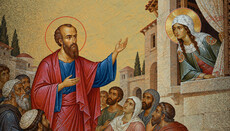
Paul preached in Iconium, while the young Thecla listened to him from her window for three days and three nights. Her distraught mother complained that Thecla “clung to the window like a spider.”
When Paul was thrown into prison, Thecla slipped in to see him at night. She paid whatever she had for the chance to see her teacher: her bracelets to the gatekeeper, her silver mirror to the guard. And once again, she sat at the Apostle’s feet until morning.
A mother who demanded her daughter be burned
At the trial, Thecla’s own mother demanded her death. “Burn the unmarried woman in the midst of the city theater!” she cried to the executioner.
What had her daughter done to deserve such a fate? The heart of the accusation lies in that final word: “unmarried.” A young woman who rejected an advantageous marriage had shattered her family’s plans – and her mother could not forgive her for it.
The flames, however, did not kill Thecla.
Popular retellings say that Thecla cut her hair and came to look like a young man.
Thecla did indeed ask her teacher: “I will cut my hair and follow you wherever you go.” Paul answered with a father’s sober caution: “The times are evil, and you are beautiful. Take care that another temptation does not come upon you, worse than the first.”
The Apostle would not let her make such a sacrifice. Yet some time later, when she set out to find Paul in Myra, she nevertheless “girded herself and altered her tunic after the fashion of a man’s garment,” and went to him accompanied by young men and women.
The lioness, the seals, and the baptism controversy
The most dramatic part of the story unfolds in Antioch, where Thecla is thrown to the wild beasts. A lioness lies down at her feet, then kills a bear that attacks her, only to die herself fighting a lion. Then Thecla throws herself into a pool of seals and cries out: “In the name of Jesus Christ, I baptize myself on my last day!”
This scene became the stumbling block in theological disputes.
The episode in the apocryphal text, in which St. Thecla essentially baptizes herself, became an argument in the controversy over who has the authority to administer the sacrament.
The peaceful death of a holy woman
After the flames, the lions, and the seals, the story ends on a surprisingly peaceful note. Thecla withdraws to Seleucia, “where, having enlightened many by the word of God, she fell into a blessed sleep.”
A later version of her life would add a far more dramatic ending: the ninety-year-old Thecla, fleeing her pursuers, disappears into a mountain that opens before her. Tradition variously identifies the place of her death as Seleucia or the Syrian town of Maaloula. The Church nevertheless honors her as the Protomartyr because of her sufferings in the flames and the arena, even though, according to her life, she ultimately died in peace.
Legend is no obstacle to holiness
And so, the author of the life of St. Thecla the Protomartyr was defrocked, and the book itself was numbered among the apocrypha. Yet the saint has been venerated for nearly two thousand years.
The explanation is simple: the Church honors the saint on the basis of traditions that preserved her memory regardless of what was written in this questionable account.
That is why the story of St. Thecla must be approached with caution.
Some of it is tradition, some of it legend; some of it involves real people and real places. But at the heart of the story is a young woman who spent three days at her window listening to the Apostle preach, gave up her precious mirror for a night at his feet, and refused to renounce God – neither before the flames nor before the beasts.