Why Pochaiv elder goes to Lutsk court
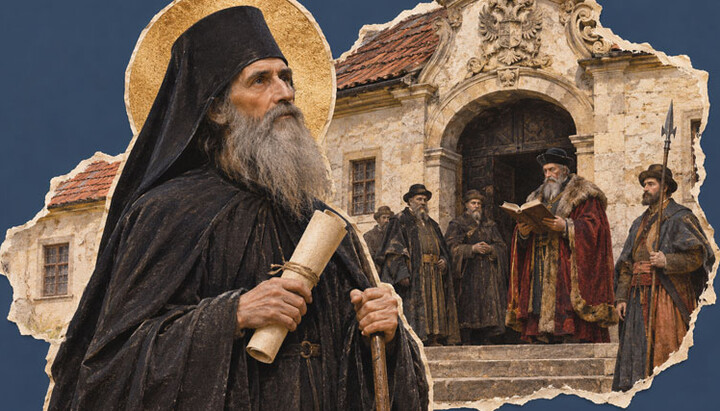
Old age did not stop the ascetic from boldly defending Church property in lawsuits, while keeping his secluded prayerful contemplation.
In the early spring of 1641, an aged monk appeared on the streets of Lutsk. He was in his tenth decade, yet his step remained firm, and his gaze beneath the monastic kukol was clear and calm. In his hands the elder held a paper scroll. The hegumen of the Pochaiv Monastery had come to the land court in order to personally enter a written protestation into the official court book. The registers of legal proceedings of the Polish-Lithuanian Commonwealth have preserved his secular name — Ivan Zalizo.
A man who had dedicated his life to seclusion appeared before the eyes of the secular judges of the Commonwealth for the sake of restoring trampled truth. And all because the nobleman Andrei Firlei had burst onto monastic lands with an armed retinue, broken down the wooden fences, driven out the brethren, and carried off to his Kozin castle the chief holy treasure of Pochaiv — the wonderworking icon of the Most Holy Theotokos, together with its gilded oklads, silver chalices, sacred vessels, and ancient Gospels.
The court clerk recorded the elder's complaint while the hegumen stood patiently by. Doubting counselors suggested that he resign himself, leave his offenders to God's judgment, and quietly withdraw into his cave seclusion. But the elder understood: the holy treasure and the monastery's lands remain the property of the whole Church. Therefore, defending the monastery in court was for him as sacred a duty as nighttime prayer in his cell.
The land at the mountain's summit
The spiritual path of St. Job of Pochaiv began in Pokuttia. As a ten-year-old boy, Ivan left his parental home for the Transfiguration Monastery in Uhornyky. Two years later he received monastic tonsure with the name Job. After being ordained to the rank of hieromonk, the future elder long avoided the pastoral lot out of profound humility.
Soon afterward, at the request of the pious Prince Konstantin Ostrozhsky, he became head of the Exaltation of the Cross Monastery near Dubno. The monastery was situated on an island washed by a river on three sides.
For about 20 years St. Job governed the Dubno brethren, setting the household in order, preserving Orthodox manuscripts, and establishing a strict cenobitic rule.
In 1604 the ascetic sought deeper solitude and moved to Pochaiv Mountain. But instead of a silent wilderness, the Lord entrusted him with the governance of the monastery. As early as 1597, the pious widow Anna Hoyska had signed a deed of gift, transferring to the monks the wonderworking icon of the Mother of God, lands, six peasant households, and an annual contribution from the Orlia estate.
However, after her death, her heir Andrei Firlei, who held different views on the faith of his forefathers, decided to take the riches back. It is telling that in 1618, with the blessing of Hegumen Job, the book "The Mirror of Theology" by Kirill Trankvillion-Stavrovetsky was printed at Pochaiv, thereby underscoring that the monastery continued its work of enlightenment despite pressure from outside.
A six-year dispute in the royal court
The Pochaiv hegumen did not shy away from difficulties. The attack by Firlei's servants and the brazen Sunday raid of July 14, 1641, when an armed mob burst into the divine service, beat the monks, and trampled the crops, demanded a legal response.
Venerable Job initiated a protracted legal case. The Pochaiv hegumen personally sent complaints to Kremenets, demanded a boundary survey of the estate, and insisted on the exact observance of the Statute. When the magnate's attorney, Daniil Grudnitsky, tried to contest the jurisdiction of the case, the hegumen responded with successive lawsuits. In March 1642, the sub-chamberlain Daniil Elovitsky rode the boundaries of the estate and officially confirmed that the monks were in the right.
The six-year dispute passed through arbitration courts and continued up to the Lublin Tribunal. In the summer of 1646, the supreme Crown Tribunal obliged the magnate to return all the property seized from the monastery. To this Firley gave a cunning reply, claiming that the precious vestments, the icon case, and the church vessels had burned in a fire in a walled-up castle. Nevertheless, the hegumen compelled the nobleman to acknowledge himself a debtor of the monastery.
In August 1628, the elder took part in the Kyiv Council, convened for the defense of Orthodoxy.
His signature stands beneath the council's canonical declaration: "Ioann Zhelezo, Hegumen of Pochaiv."
The Heavenly Radiance of the Enclosure
For the laymen of Pochaiv, the hegumen remained a strict administrator of the monastery's affairs, but for the brethren he was an ardent man of prayer and an ascetic. When lawsuits and everyday cares receded into the background, Venerable Job would retire to a narrow cave carved into the ancient rock.
The space there was so cramped that the elder could pray only bent over, spending whole days and nights in the cold seclusion. On a stone ledge beside him lay a copy of the Pochaiv icon of the Mother of God.
From long standing on his knees, the Venerable one's legs would swell and become covered with sores, yet he did not abandon his podvig.
One night, a monk who was passing by approached the opening in the rock and saw heavenly light illumine the Venerable one's cave and shine upon the monastery's church. He fell to the ground in fear, realizing what unknown power sustained the hegumen who bore the Pochaiv Monastery on his shoulders.
A Lamp on the Mountaintop
Venerable Job departed to the Lord on October 28, 1651, having foretold to the brethren the day of his repose. He was in his hundredth year. Around him raged the storms of war that laid waste the Volhynian lands, but on Pochaiv Mountain prayer never ceased.
On August 28, 1659, by a miraculous revelation to Metropolitan Dionysius (Balaban) of Kyiv, the incorrupt relics of the holy elder were taken up from the earth and placed in the church for veneration.
The holy elder was able to show that humility has nothing in common with indifference and cowardice. To defend holy things, to uphold the truth in the land courts, and to cultivate the monastery's land is both possible and necessary when spiritual responsibility for a flock has been laid upon you. Prayerful standing and the court scroll in the elder's hands proved to be two sides of one ministry of the Venerable one to the Savior Christ.