
Blessed Matrona of Moscow: God's gift of love and prophecy
Natalia remembered a strange dream: a white bird with a human face and closed eyes perched on her right arm. She felt the dream was prophetic.
I have seen a completely blind person only once in my life. A fragile, slender, almost weightless girl of about twelve was slowly walking through the courtyard of the Lavra, leaning on the arm of a young woman whose hair had already turned completely gray. They looked very much alike, except that the mother's face bore the unmistakable marks of suffering – in the faint wrinkles around her eyes, her tightly pressed lips, and the intent gaze of her blue eyes.
The girl was her mother's complete opposite. Her face seemed more like an image painted by a gifted iconographer than a human face, so delicate, gentle, and exquisitely formed were her features.
A passerby might have thought she was simply squinting against the bright July sun. The very possibility that she was blind seemed so incongruous, so difficult to believe.
It was impossible not to admire her – the very embodiment of angelic beauty, moving slowly beneath the shade of ancient chestnut trees. A passerby might have thought she was merely squeezing her eyes shut against the brilliant July sunshine, so improbable did her blindness seem.
Yet the child really was completely blind. After taking a few more steps, she put on a pair of large dark glasses with a practiced motion, and the angelic quality of her face seemed suddenly obscured by the stark ordinariness of an accessory for the blind. Her mother, unaware of this transformation, continued to guide her special child gently and carefully forward – toward the Lord and His saints, into the caves of the Lavra.
I confess that the scene left a profound impression on me. Why was this child suffering? The question would not leave me alone. Had the Lord visited her with suffering, or was He punishing her? And if her blindness was a punishment, who was being punished?
"Neither this man nor his parents sinned, but that the works of God should be revealed in him," the Lord said (John 9:3). But could those words apply here?
Natalia Nikonova, an ordinary Russian woman from the village of Sebino in Tula Governorate, probably gave little thought to Scripture as she looked at her blind infant daughter. She could not yet know that the tiny girl in her arms would one day become a saint of the Orthodox Church.
Natalia remembered a strange dream she had had several days before the baby's birth: a white bird with a human face and closed eyes had settled on her right arm.
The dream seemed prophetic to her and, in a sense, determined Matrona's fate. She was a late-born fourth child, not particularly wanted by an already impoverished, though devout, family. Her parents had initially planned to place her in an orphanage, but decided against it.
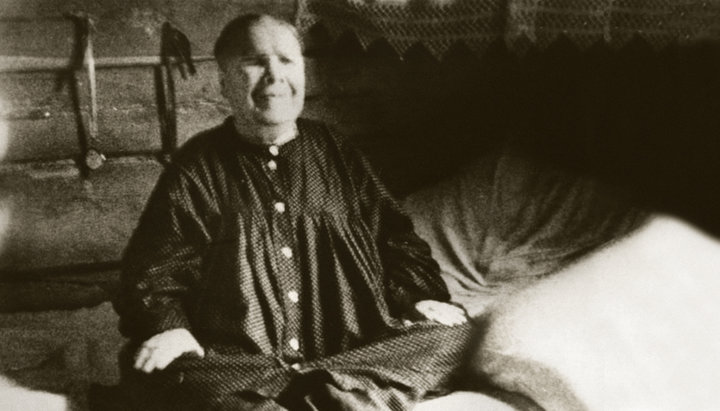
The infant truly resembled a helpless little bird. She was not merely blind – she had no eyes at all. Her empty eye sockets were covered by tightly closed eyelids, just like those of the white bird in her mother's strange dream.
Extraordinary events accompanied Matrona throughout her life.
The first occurred at her baptism. When the priest immersed the infant in the baptismal font, those present saw a column of light, fragrant smoke rise above her. The priest foretold that the child would lead a holy life and added that one day Matrona would predict his death. According to her life story, this later came to pass.
The blind little girl continued to astonish those around her. On Wednesdays and Fridays, she would sleep all day and refuse food. A clearly visible, raised mark in the shape of a cross appeared on her chest. At night, she somehow managed to take icons down from the walls and play with them.
By the age of seven, she had begun to manifest gifts of prophecy and healing. Her family noticed that she seemed to know not only people's misdeeds but even their thoughts. She sensed approaching danger, warned of disasters, and comforted those in sorrow.
Carts carrying visitors from all over the surrounding countryside constantly stood outside the Nikonov home. Even bedridden patients, it was said, walked out of their humble cottage on their own feet.
Matrona's family did not always understand her seemingly strange remarks. They were even more bewildered when the righteous St. John of Kronstadt publicly called the fourteen-year-old girl his successor and the "eighth pillar of Russia."
At seventeen, Matrona lost the ability to walk.
"I did not try to avoid it – it was God's will," she told her mother.
For the rest of her life, Matrona, who through prayer was said to heal extraordinarily serious illnesses and help people who seemed to have no hope left, could not take a single step unaided. Perhaps it was precisely in this weakness and helplessness that her strength was made manifest.
When reading the lengthy account of the blessed woman's life, one sometimes wonders how she managed to survive such inhuman conditions. Unable to walk, homeless, and penniless, she lived in Moscow through the turmoil of revolution, war, and the postwar years. Yet for nearly three decades, she carried out a ministry of prayer that helped save many people from spiritual ruin and, at times, even physical destruction.
She saved others without sparing herself.
Here is just one example from the recollections of Zinaida Zhdanova, who knew the blessed woman well:
"I came to Sokolniki, where Matushka often stayed in a little plywood house that had been lent to her temporarily. It was late autumn.
"I entered the little house. It was filled with thick, damp, chilling steam. An iron stove was burning.
"I went over to Matushka. She was lying on the bed facing the wall and could not turn toward me. Her hair had frozen to the wall, and we could barely pull it free.
"I was horrified.
"'Matushka, how can this be? You know that my mother and I live alone, that my brother is at the front, that my father is in prison and we don't know what has happened to him. We have two rooms in a warm house, 48 square meters, with a separate entrance. Why didn't you ask to stay with us?'
"Matushka sighed deeply and said, 'God did not permit it, so that you would not regret it later.'"
There are many such examples in the life of the holy eldress.
Attempts were made to arrest her on numerous occasions, but the Lord protected His faithful servant. She thanked Him through unceasing prayer and through her constant struggle for every soul that came to her seeking help.
"And with God's help," Zhdanova recalled, "she prevailed. She never grumbled or complained about the hardships of her spiritual struggle.
"I cannot forgive myself for never having shown Matushka the compassion she deserved, even though I saw how difficult everything was for her and how deeply she suffered for each of us.
"The light of those days still warms me. Oil lamps burned before the icons in the house, and Matushka's love and quietness enveloped the soul. There was joy, peace, and a warmth filled with grace.
"The war was raging, yet we lived as though we were in heaven."
Those who knew the blessed eldress remembered how she comforted everyone who came to her for help.
She never lectured people, preached at them, or treated them with excessive severity. Instead, she would calm them, stroke their heads, offer guidance, or gently correct them. A mother's patience, warmth, compassion, joy, and light – perhaps these were what drew thousands of suffering people from every corner of the country to a blind woman who could not walk. She offered each person specific advice about what to do in a particular situation, prayed for them, and gave them her blessing.
Some of her teachings were more general in nature – a kind of guide to life that remains relevant to anyone today.
She taught people not to judge their neighbors: "Think about yourself more often. Every sheep will be hung by its own little tail. Why concern yourself with other people's tails?"
She urged love and forgiveness toward the elderly and infirm: "If elderly people, sick people, or those who have lost their reason say something unpleasant or offensive to you, do not listen to it. Just help them. You must help the sick with all diligence and forgive them whatever they say or do."
She warned against attaching importance to dreams: "Pay no attention to them. Dreams can come from the evil one, to upset a person and entangle the mind in troubling thoughts."
She cautioned against visiting fortune-tellers and practitioners of magic: "For someone who has willingly entered into an alliance with the powers of evil and taken up sorcery, there is no way out. You must not go to folk healers. They may cure one thing but harm the soul."
She also urged people to take care of their health: "You must seek medical treatment. The body is a little house given by God, and it needs repairs."
The blessed woman warned people against running from one spiritual father to another in search of "elders" or "clairvoyants." Instead, she taught them to entrust themselves to God's will, live in prayer, and patiently endure suffering.
Matrona understood well that the widespread abandonment of the Church, militant atheism, growing alienation and hostility among people, the rejection of traditional faith by millions, and sinful lives without repentance would bring grave spiritual consequences upon the world.
"How I pity you, who will live to see the last times," the eldress told those close to her.
"Life will grow worse and worse. It will be difficult. A time will come when they will place a cross and bread before you and say: Choose!"
She often repeated: "If a people lose faith in God, calamities befall them. And if they do not repent, they perish and disappear from the face of the earth. Pray, ask, repent! The Lord will not abandon you and will preserve our land!"
Those who knew Blessed Matrona also spoke of the mystery of her inner spiritual life.
Why did a saint who helped so many people without seeking anything in return never manage – or perhaps never consider it necessary – to restore her own ability to walk and make her difficult existence at least a little easier?
Zinaida Zhdanova recalled:
"Matushka seemed to know everything that would happen in advance. Every day of her life was filled with the sorrows and grief of those who came to her, with helping the sick, comforting them, and healing them.
"She would take a weeping person's head in both hands, show compassion, and warm that person with her love. The visitor would leave feeling as though they had wings.
"And she, exhausted, would only sigh and pray throughout the night.
"There was a little hollow on her forehead from her fingers, from making the sign of the cross so often. She crossed herself slowly and reverently, her fingers finding that hollow..."
The earthly sufferings of the blessed eldress came to an end on May 2, 1952.
"Are you afraid of death too?" asked the priest who came to hear her confession and give her Holy Communion.
"I am afraid," the blessed woman replied.
She asked to be buried at Danilov Cemetery, near the church, "so that I can hear the services."
In 2004, St. Matrona of Moscow was canonized for veneration throughout the Russian Orthodox Church.
Sadly, today, for many of her devotees, the image of Blessed Matrona has become surrounded by strange practices and beliefs that directly contradict the Orthodox worldview, including supposed healing through specially blessed or enchanted water. Some of these practices verge on paganism.
In certain respects, we look upon the holy eldress as though we ourselves were blind, stubbornly refusing to see the One by whose will her miracles were performed. Our Christian vision, obscured by the enormous dark glasses of superstition, speculation, and an aura of magic, fails to see Christ and, because of our lack of faith, the workings of His providence in human life.
For many people, Blessed Matrona has become a kind of idol, a "dear little Matronushka" from whom they expect to receive whatever they desire if only they approach her in a particular way. Is this what the saint herself would have wanted? The answer is obvious. Though deprived of physical sight, the blessed woman saw more clearly than many of us.
If you have not yet read the life of St. Matrona, I sincerely encourage you to find the time to do so.
The spiritual achievement of the blessed eldress does not lie in the many healings she performed, the help she gave to those who suffered, or the terrible illnesses she was said to cure. It lies in her extraordinary patience, purity of heart, and fervent love for God.
It was precisely this kind of patience, which sustains Christians through the last times, that the Fathers of the Church foretold.
The life of St. Matrona confirms their teaching – both as a lesson and as an undeniable truth. Physically blind, she taught, and continues to teach, those of us who are spiritually blind how to see the world. Unable to walk, she teaches those of us who stumble spiritually not to turn away from the straight but difficult road that leads to Christ.
I cannot explain why, but I can never look at an icon of St. Matrona without being moved. I immediately remember the girl I once saw in the courtyard of the Kyiv Lavra. I see the same touching, angelic vulnerability in the saint's holy face.
O holy eldress, Blessed Mother Matrona, pray to God for us sinners!