
God as prosecutor: the central Catholic delusion no one talks about

Why union with the Vatican is dangerous not because of beards or calendars, but because it turns our relationship with God into bookkeeping.
Some people think Catholics cross themselves “the wrong way”; those more informed say their dogmas are wrong. But almost no one knows about the main, practical delusion.
Today, Ukraine is being quite openly steered toward Catholicism. The Uniate Church (Catholic of the Eastern rite) has long enjoyed every possible preference from the state. The OCU is actively engaging in dialogue with the Uniates under the convenient slogan: “We are essentially the same.”
The Patriarchate of Constantinople is at the final stage of unification with the Vatican. According to statements by certain hierarchs, all that remains unresolved is the question of primacy.
Among people distant from church life there is a widespread belief that no Orthodox country is economically successful, and therefore, if Catholicism replaces Orthodoxy, life will immediately improve.
Dogmatic obstacles
Orthodox Christians resist this unification, but often cannot even answer a basic question themselves: what exactly distinguishes Orthodoxy from Catholicism? Are these differences really so serious as to prevent unity?
That Catholics cross themselves from left to right rather than right to left, that they sit during services instead of standing, play the organ, shave their beards (that is, priests do) – for some this is, of course, a horror beyond words! But in reality, these are precisely the things that do not prevent unification.
The main obstacles are usually named as two dogmatic differences: Catholics assert the primacy and infallibility of the Pope of Rome, and that the Holy Spirit proceeds from the Son as well as from the Father (the filioque).
But first, very few people truly understand the essence of these dogmas. Second, they have almost no practical significance in the everyday life of believers. Even papal primacy hardly affects ordinary parish life.
And third, if desired, Catholic and Orthodox hierarchs can formulate these dogmas in such a way that everyone will be formally satisfied. For example, during the recent celebration of the 1700th anniversary of the Council of Nicaea, Pope Leo XIV together with Patriarch Bartholomew recited the Creed without the filioque – and no one accused him of heresy.
Yet there is one Catholic teaching that leaves its imprint on literally every action of a believer, shapes their entire religious worldview, and will not disappear even if the highest hierarchs remove all dogmatic contradictions. This teaching is called the “juridical theory of atonement.”
God demands satisfaction
The first echoes of this teaching appeared in the West as early as the fourth century, but it was formulated by Anselm of Canterbury in the eleventh century. After him it was developed by Thomas Aquinas and other medieval theologians, and following the Council of Trent (1545–1563) it became the official doctrine of the Catholic Church. The Second Vatican Council (1965) rephrased it somewhat, but its essence remained unchanged.
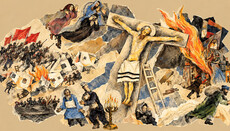
The essence of this theory is as follows: Adam and Eve inflicted a grave offense upon God by violating the commandment not to eat from the tree of the knowledge of good and evil. This offense required proper satisfaction. And since man is mortal, he is fundamentally incapable of offering such satisfaction to an infinite God. Therefore, the infinite Son of God became incarnate, died on the Cross, and thereby made satisfaction for the offense.
In other words, man – Adam – placed God in a state of offense, in which God remained until He saw His Only-Begotten Son crucified on the Cross. Only then was God satisfied, and the offense expiated. But all this concerns original sin.
The accounting of sin
But what about the sins of each individual person? The juridical theory teaches that Christ’s sacrifice on the Cross satisfies divine justice in principle and restores the violated “legal order,” but does not automatically forgive the sins of each person.
Even if a person repents of their sins, repentance removes guilt (culpa), but the person still remains subject to temporal punishment (poena temporalis) and must still make satisfaction (satisfactio) for sin. There are various ways to render this satisfaction. One can engage in ascetic feats and works of mercy. One can endure various sufferings, whether involuntary or deliberately undertaken. One can receive an indulgence – that is, a release from punishment.
An indulgence assigns to a person part of the “supererogatory merits” of the saints. In the past these were sold for money; today the mechanism is somewhat different. If even that is insufficient, then after death the person enters purgatory, where suffering makes up the missing balance.
Thus the sacrifice of Jesus Christ itself forms a kind of infinite treasury of satisfaction, from which the Church, in the person of the Roman Pope, can under certain conditions distribute these “points” to people, compensating for what is lacking to satisfy their personal sins.
A contradiction with the Gospel
This teaching translates the relationship between God and man into a juridical plane, where the decisive role is played not by our alienation from God, but by our guilt and the satisfaction we must render. God cannot forgive us simply because we repent.
Within this system of coordinates, the parable of the Prodigal Son becomes utterly impossible. A father who has been offended by his younger son cannot receive him back merely because he returned home. No – he must demand satisfaction. Moreover, the son must return the entire portion of the inheritance that he squandered so foolishly.
The forgiveness of the thief on the Cross likewise becomes impossible. Or rather, forgiveness is possible, but what is to be done with all the evil the thief committed during his life? It remains, and satisfaction must be rendered for it. By this logic, the thief should have gone to purgatory, not heard the words: “Today you will be with Me in paradise” (Luke 23:43).
In general, the juridical theory of atonement transforms God from a loving Father into an offended ruler, thirsting for satisfaction, and compels man not to change inwardly, not to cleanse his soul from the corruption of sin, not to love God with all his heart, but to pay Him this satisfaction.
The relationship between God and man is reduced to a legal scheme: “you earned it – now receive it.”
God and man within this theory are two legal subjects, and love between them recedes into the background or is confined within the same categories of guilt and satisfaction. Ascetic feats, works of mercy, and the keeping of commandments – instead of being expressions of our love for God (“If you love Me, keep My commandments” (John 14:15)) – are transformed into a kind of spiritual capital used to pay off our transgressions.
Currency for heaven
This worldview is vividly portrayed in many works of Western literature. For example, Victor Hugo in The Hunchback of Notre-Dame (19th century) describes how the Catholic priest Claude Frollo, who raised his orphaned younger brother Jean, adopts an abandoned child – the monstrously deformed Quasimodo.
And here is how he views his act: “The ugliness of the child only increased Claude’s compassion for him and made him vow to raise the foundling out of love for his brother. By this act of mercy he seemed to be atoning in advance for the future sins of little Jean. Claude appeared to be storing up for his brother a capital of good works in case he himself should prove incapable of accumulating such funds – the only currency accepted in heaven.”
God the Physician, not the Judge
Orthodoxy thinks in an entirely different way. God is truly the Father from the parable of the Prodigal Son. For Him, the inheritance the son squandered is of absolutely no significance. What matters is that the son “came to himself,” returned, responded to the father’s love, and became capable of receiving it.
Orthodoxy affirms that Jesus Christ came to heal the sinful nature of man, not to “settle accounts” with God the Father.
For Orthodoxy, what matters is that a person loves God, not that he fully pays Him back for all his sins. What matters is that a person turns away from sin and is united with God in Christ (“that through these you may become partakers of the divine nature, having escaped the corruption that is in the world because of lust…” (2 Peter 1:4)).
A mental trap
Two points must be emphasized here. First, this fundamental difference in worldview and attitude toward God will not disappear even if all dogmatic disputes are resolved and all canonical problems settled.
Second, one can absorb this Gospel-alien juridical theory of atonement even without uniting with Catholics. One can, while formally remaining within Orthodoxy, construct one’s relationship with God in legal categories: “you earned it – now receive it,” “you give to me, I give to you.” And in order to prevent this, it is not enough merely to resist unification with Catholicism – one must assimilate the teaching of the Gospel and the holy fathers.