Fate of Studite text in Kyiv
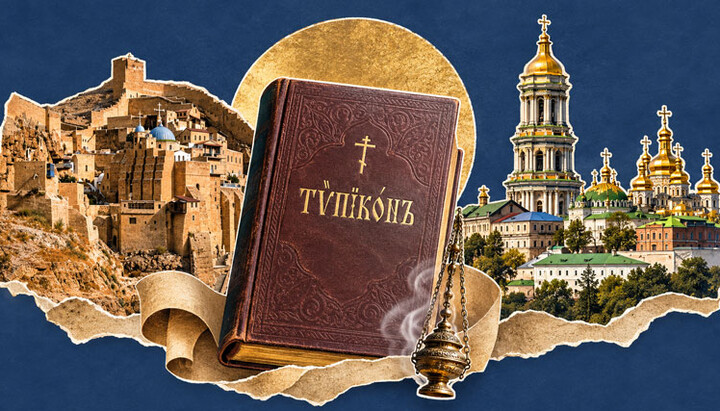
Древние рукописи расходятся в деталях доставки греческого пергамента в Киев, но доказывают: жизнь общины меняет не текст, а личная духовность.
When a historian opens the ancient chronicles of the eleventh century, intending to trace the chronology of the appearance of the monastic rule in Rus', he immediately runs into a tangled detective plot. The two principal sources of that era give completely different answers to the question: who exactly brought to the Pechersk hills the Greek parchment that determined the life of Russian monasticism for centuries to come?
The Primary Chronicle asserts that the rule was transmitted by the Studite monk Michael, who arrived in Kiev together with the Greek Metropolitan George. However, St. Nestor the Chronicler, in the Life of St. Theodosius of the Caves, set forth an entirely different version. According to his account, the Kievan hegumen himself sent one of his monks to Constantinople to Ephraim the Eunuch, so that he might personally copy the complete rule of the Studion Monastery and send it to the brethren on the Dnieper.
Behind this discrepancy in the sources one can discern the complex process of seeking the ideal order for the young Kievan community. But on one key point both ancient authors were in exact agreement: the copy received was read before the whole brotherhood, after which the life of the monks of the Caves was reorganized according to the strict rules of the Constantinopolitan coenobium.
A Law from the Shores of the Sea of Marmara
To appreciate the scale of what was taking place in Rus', one must transport oneself to the shores of the Sea of Marmara. The renowned Studion Monastery, founded in the fifth century by the patrician Studius, reached its flowering through the reform of St. Theodore the Studite. An experienced Byzantine administrator, he created a system of communal life in which personal property was ruthlessly eradicated, while daily arduous labor was proclaimed an integral part of salvation.
Until 1062, the community of the Caves existed in entirely different conditions. In a cramped underground cave, under the guidance of St. Anthony of the Caves, about fifteen monks gathered.
It was a classic cave life, in which each monk struggled in seclusion, relying on his own spiritual experience.
However, the community's numbers grew rapidly. In 1062 the brethren emerged from their underground cells onto the surface of the hill. Under the guidance of St. Theodosius, the monks built a wooden church of the Most Holy Theotokos, surrounded the site with a wooden fence, and constructed many cells. It was at this very moment that the ancient cave seclusion gave way to an organized coenobium. The parchment read before the monks demanded complete renunciation of personal possessions, a common table in the refectory, and the strictest discipline
An Axe in the Abbot's Hands
But the main historical lesson of this reform lay elsewhere. The parchment scroll brought from Byzantium might have remained merely a dry set of foreign instructions had it not been for the personality of the Kievan abbot. St. Theodosius of the Caves did not limit himself to the public reading of the rules. He applied the new rule in his own life, demonstrating to the brethren that the law lives only when the lawgiver himself fulfills it.
Ancient Paterikon records have preserved detailed descriptions of his daily governance of the monastery. Every night St. Theodosius made a round of the monastery courtyard. If behind the door of a cell he heard idle conversation among the monks, the abbot would knock lightly on the door and pass by, and in the morning would gently admonish the guilty without naming names.
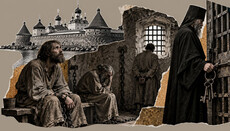
The struggle against personal property was waged relentlessly. If the hegumen found hidden food, extra clothing, or concealed coins in a monk's cell, he immediately confiscated these things and threw them into the blazing stove. An episode from the Life has been preserved in which St. Theodosius ordered a monk to hurl his accumulated wealth into the fire with his own hands.
Yet the holy abbot never demanded of those under him what he did not do himself.
Beneath his simple coarse cloak he wore a prickly woolen hair shirt. The hegumen himself carried water from the well, chopped wood, baked bread in the bakery, and worked at the hand millstones in place of weary brethren.
When Grand Prince Izyaslav came to the monastery after the midday meal, the gatekeeper refused to open the gates for him, citing the hegumen's prohibition against admitting anyone after the meal. The ruler was indignant: "I am the prince, will you really not open for me?" but he was forced to wait at the closed gates while the gatekeeper ran to fetch the abbot. St. Theodosius came out to the ruler, bowed to him, and calmly explained the rules of the community's life. The prince departed, having gained still greater respect for the new monastic order.
The Monk's Hidden Gold
The dramatic denouement of this story came after the repose of the great founder of the Caves. The parchment of the Studite Rule continued to be carefully preserved in the monastery library. Pilgrims visiting Kyiv copied its lines and carried them to other monasteries of ancient Rus'. The Kyiv Caves Monastery remained for all the principal model of true communal life.
However, on leafing through the pages of the Kyiv Caves Patericon of the late eleventh century, a completely different picture emerges. The rules remained the same, but sinful human nature quickly took its own.
In the stories of the Patericon there appear accounts of monks who had amassed whole fortunes in their cells. The monk Arephas the Polotsk man kept such a quantity of riches that when robbers attacked he lost an enormous fortune, yet he would not agree to give a poor man even a single small coin. Another monk of the Caves, St. Theodore, found in a cave a buried treasure of gold and silver and for a long time struggled with the temptation to flee the monastery with these riches.
The strict articles of the Byzantine Rule categorically forbade such things. But beside them there was no longer a hegumen who every night knocked at the doors of the cells and threw the hidden goods into the red-hot stove.
The Living Power of the Strict Letter
The history of the application of the Studite parchment in Kyiv leaves room for reflection on the nature of all laws and rules. The manuscript brought from Constantinople did indeed lay the foundation of Russian monasticism, creating a system of spiritual and economic order.
But archival records and the tales of the Patericon have clearly demonstrated: the most perfect rule, written on the finest parchment, remains merely a dead letter if there is no human effort behind it to fulfill it.
The Studite rules worked not because princely charters or the authority of Byzantine patriarchs had confirmed them. They lived for as long as St. Theodosius of the Caves himself took up the axe, kneaded the dough, and watched over his disciples at night.
As soon as a living example was replaced by the formal observance of ancient rules, hoards of money appeared in the cells once again, and the monks began to divide into rich and poor. For a written law is powerless to save a man without the inner fervor of his soul.