
Five tiers of sacred art
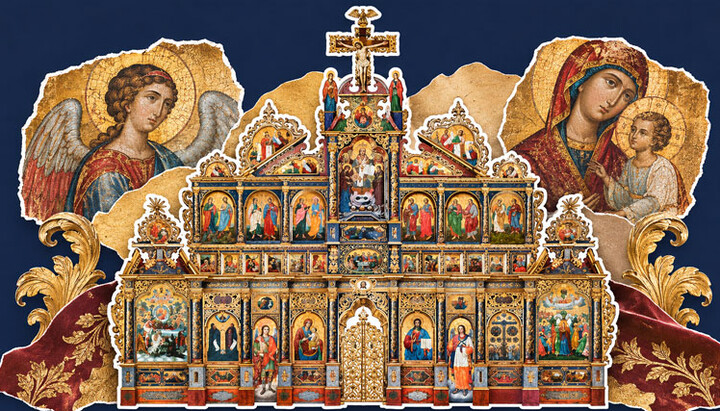
A monumental wooden iconostasis stands in a museum, drawing the viewer's gaze upward from the dark scenes of its lowest tier to the gilded carvings surrounding the cross at its summit.
Inside the National Museum in Lviv stands an enormous wooden structure. Five tiers of painted, varnished, and gilded panels rise toward the ceiling. Hieromonk Job (Kondzelevych) created this monumental ensemble with a team of woodcarvers between 1698 and 1705. The monks of the Church of the Exaltation of the Cross at the Manyava Skete commissioned the work.
The iconostasis has had a turbulent history. In 1785, Austrian authorities closed the skete, and its wooden furnishings were moved to nearby Bohorodchany. Later, in 1916, during World War I, the iconostasis was taken to Vienna. From Austria, it traveled to Warsaw, and only in the 1920s did this masterpiece of religious art return to Lviv.
The lowest tier consists of the predella panels – small icons positioned beneath the principal images. One depicts the encounter on the road to Emmaus. The risen Savior walks with His disciples along a summer path. Nearby are other small scenes: "The Crown of Thorns," "The Temptation," and "Christ and Nicodemus." Here, the paintings focus on Jesus' earthly journey, during which the suffering Messiah accomplishes the work of salvation.
Gilded carvings of the local tier
Moving upward, the eye reaches the local tier, where the woodcarvers displayed extraordinary imagination. The Royal Doors are covered with delicate openwork carvings of acanthus leaves and heavy clusters of fruit. In oval cartouches, Hieromonk Job depicted the Annunciation and the four Evangelists. The encounter between the Most Holy Virgin and the Angel is painted with remarkable lightness, while a small wooden Crucifixion rises above the doors.
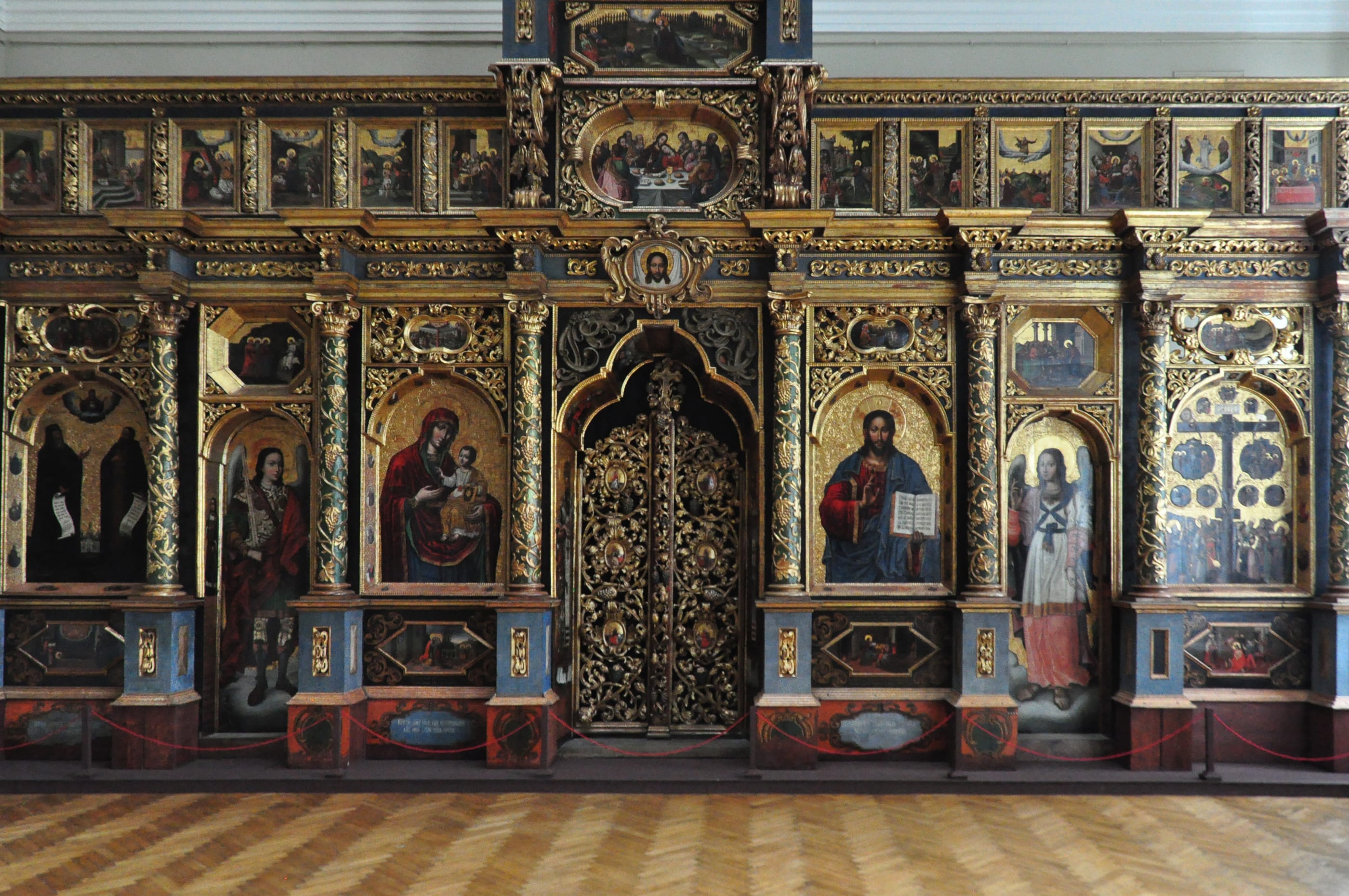
The side deacon's doors feature the Archangel Gabriel. Museum curators regard this image as a pinnacle of Baroque craftsmanship. The Archangel's wings seem to flutter against the golden background, while the painter's brush captures the soft folds of his light-colored garments.
On either side of the doors stand monumental figures of the venerable elders of the Kyiv Caves Monastery. St. Anthony of the Caves is depicted wearing a dark monastic hood, with a long gray beard. Beside him stands St. Theodosius of the Caves, his head uncovered.
Their figures occupy nearly the entire surface of their panels. Behind the ascetics are green hills and the golden domes of the Dormition Cathedral of the Kyiv-Pechersk Lavra. The saints hold open scrolls bearing words of spiritual instruction, inviting the viewer to contemplate the greatness of their ascetic labors.
The festal tier
The third tier consists of twelve small icons depicting the major feasts of the Church. The master shared the work with his assistants. He painted the most intricate faces and central figures himself, leaving backgrounds and details of clothing to the artisans in his workshop. As a result, the quality of painting varies slightly between neighboring panels, preserving visible traces of the collaborative effort.
The Resurrection of Christ is depicted through His Descent into Hades. The Savior, dressed in white, tramples the shattered bronze gates. From the dark abyss emerge the foreparents Adam and Eve. The radiant figure of Christ stands out against the dark rocks.
Artists of the Zhovkva school knew how to combine the strict Byzantine canon with Western European printmaking traditions. The composition radiates triumph, as brilliant golden light breaks through the darkness of the underworld.
A throne amid radiant clouds
The fourth tier contains the Deesis. At its center sits Christ the Great High Priest. The Savior wears an elaborate sakkos, with a precious mitre upon His head. Angels support His throne, while cherubim stand motionless at its foot. His right hand blesses the worshippers, and His left rests upon an open Gospel.
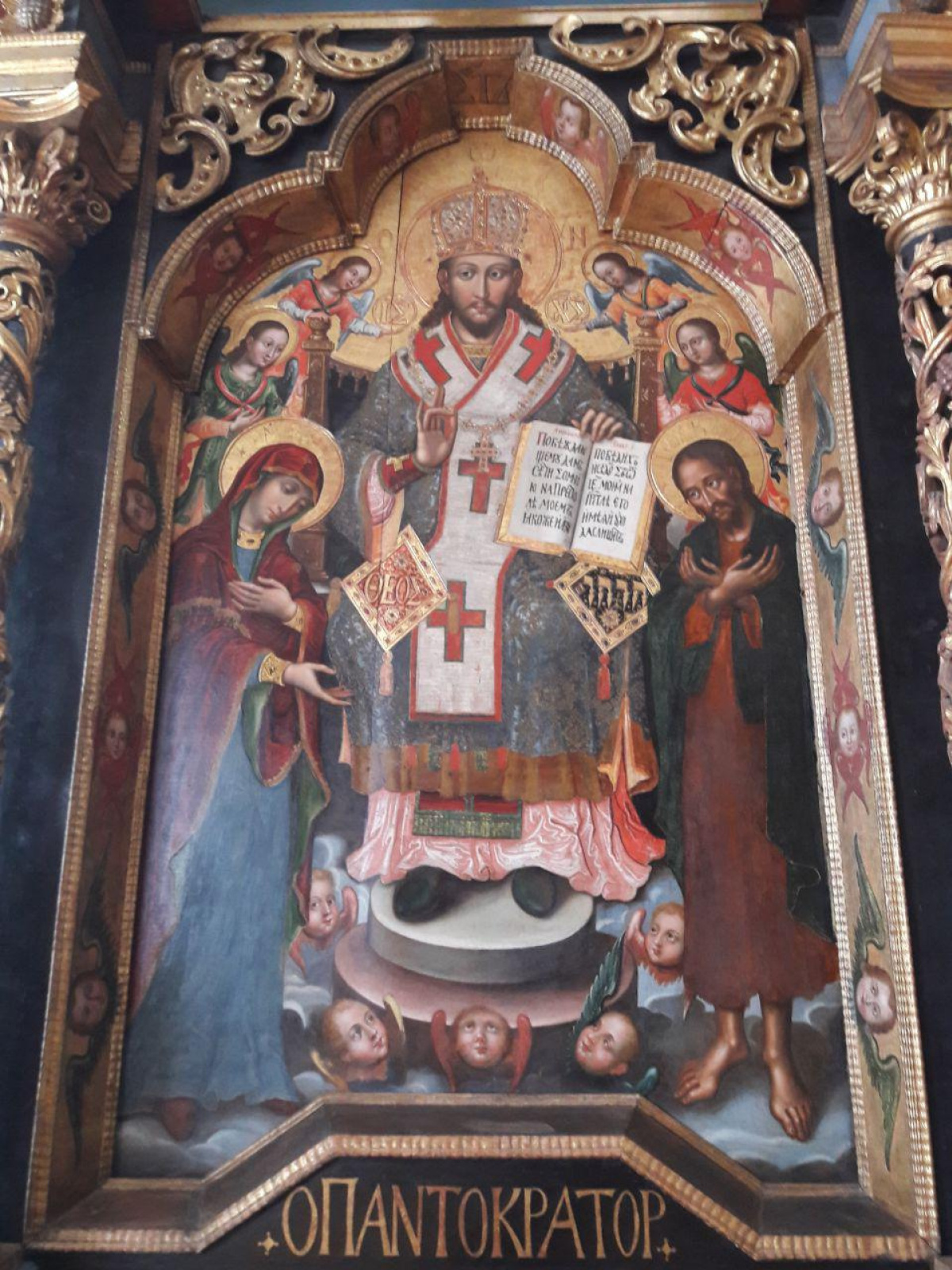
Two staffs stand on either side of the episcopal throne. One bears the Greek inscription "ΘΕΟΣ" (God). On the other, Hieromonk Job placed the Hebrew Tetragrammaton.
The Hebrew inscription contains a small error in its lettering, suggesting that the iconographer was unfamiliar with the language of the ancient texts but sought to convey the majesty of God's Old Testament Name.
Blood above the Crucifixion
The fifth tier of the iconostasis features shaped wooden panels depicting the Old Testament prophets. They hold long scrolls bearing prophecies of the Savior's coming. Every figure turns toward the center, directing attention to the summit of the iconostasis.
At the very top stands the original Crucifixion, flanked by the Mother of God and the Apostle John the Theologian.
A carved vine emerges from the wound in the Savior's side. Bluish clusters of grapes and green leaves wind around the wooden beam, linking the instrument of execution with the image of a living vineyard.
Above Christ's head is a three-dimensional figure of a pelican. The bird pierces its own breast with its beak to feed its young with its warm blood. This is an ancient allegorical representation of the Eucharist.
A digital replica of an ancient masterpiece
In 2020, specialists from the Lviv museum worked with a team of researchers on an extensive photogrammetric survey of the iconostasis.
They took approximately 40,000 high-resolution photographs to create a detailed three-dimensional model of every inch of its surface.
The museum's windows were shielded from direct sunlight, with white fabric used to diffuse the light.
Now even a blind person can explore a three-dimensional replica of the masterpiece by touch, feeling the depth and intricacy of its centuries-old carvings.
The iconostasis now stands outside a church, removed from the liturgical life for which it was created. Yet its purpose as an aid to prayer remains.
The viewer's gaze rises from the lower tiers, with their sorrowful scenes of Christ's Passion, passes through the ranks of saints, and finally rests at the summit, where a carved vine grows from the Savior's pierced side – a symbol of humanity's eternal salvation.