Five tiers of high art
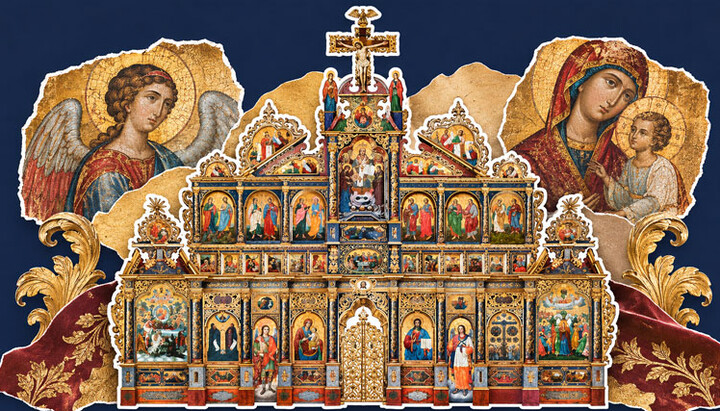
Огромный деревянный ансамбль стоит в музейном пространстве, увлекая взор от темных пределов к резному золоту верхнего креста.
In the hall of the National Museum in Lviv one can find an enormous wooden structure. Five tiers of boards, covered with varnish and gold, rise upward. Hieromonk Job (Kondzelevych) created this monumental ensemble together with woodcarvers between 1698 and 1705. The commission came from the brethren of the Church of the Exaltation of the Cross at the Maniava Skete.
The fate of the work proved a difficult one. In 1785 the Austrian authorities closed the skete, and the wooden furnishings were transported to nearby Bohorodchany. Later, in 1916, during the First World War, it was taken to Vienna. From Austria the iconostasis ended up in Warsaw, and only in the 1920s did this monument of painting return to Lviv.
The lowest tier of the iconostasis is formed by the predella. These are small icons placed beneath the local icons. On one of them the master painted the scene of the meeting at Emmaus. The Risen Savior walks with His disciples along a summer path. Nearby are other small scenes: "The Crown of Thorns," "The Temptation," "Christ and Nicodemus." Here the painting is focused on the earthly path of Jesus, where the suffering Messiah accomplishes the work of salvation.
The Golden Carving of the Local Tier
Rising higher, the gaze comes to rest on the local tier. It is here that the carvers displayed remarkable imagination. The Royal Doors are covered with delicate openwork carving of acanthus leaves and heavy clusters of grapes. In oval cartouches Hieromonk Job depicted the Annunciation and the four Evangelists. The meeting of the Most Holy Virgin with the Angel is painted in an airy manner, and above the doors is placed a small wooden Crucifix.
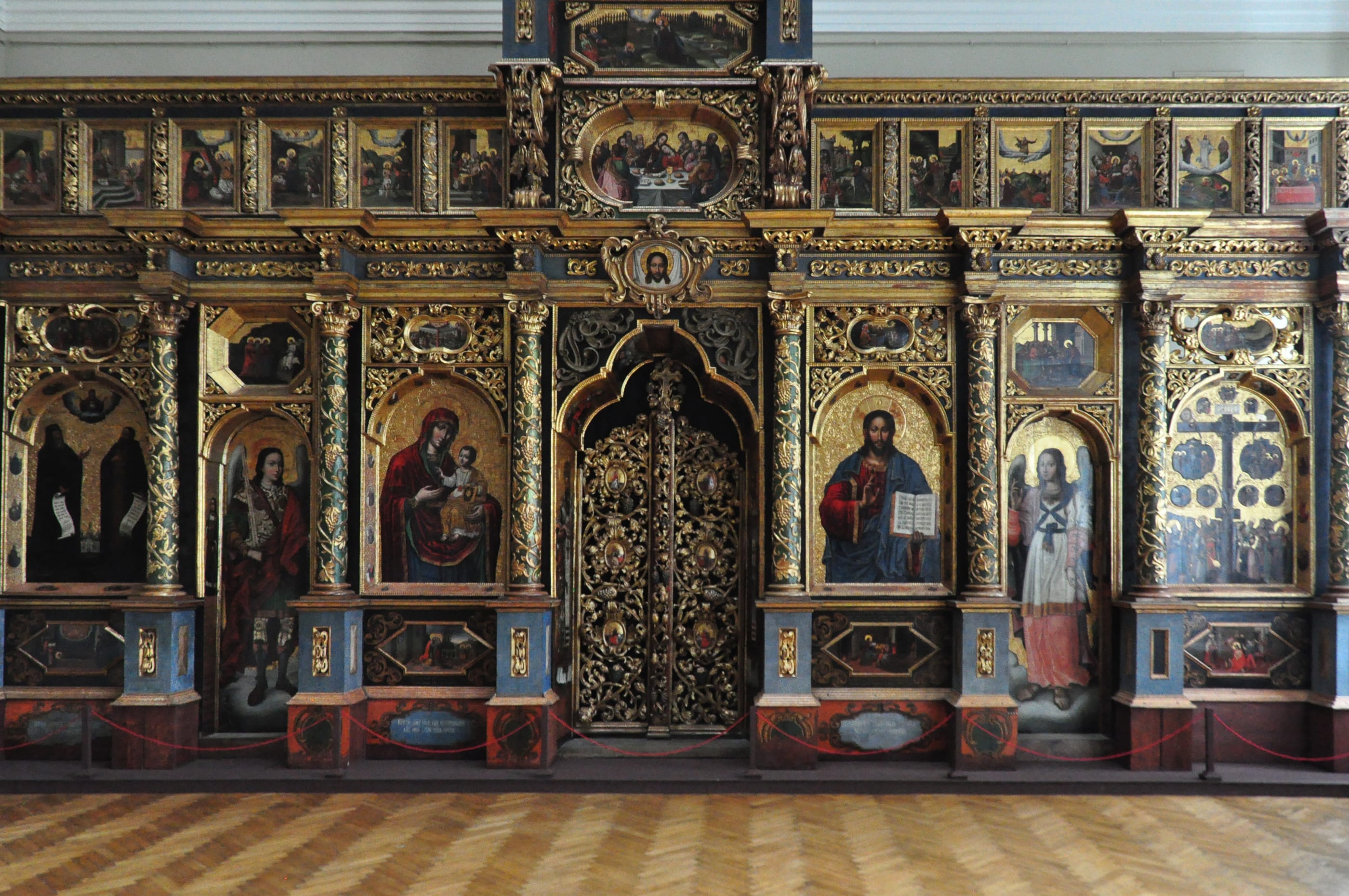
On the side deacons' doors is placed the figure of the Archangel Gabriel. Museum curators call this image the pinnacle of the Baroque era's craftsmanship. The Archangel's wings seem to tremble against the golden background, and the brush conveys the soft folds of his light vestments.
On either side of the doors stand the monumental figures of the Venerable Fathers of the Caves. St. Anthony of the Caves is depicted in a dark monastic cowl, with a long gray beard. Beside him stands St. Theodosius of the Caves, bareheaded. Their figures occupy nearly the entire surface of the board. Behind the ascetics one can see green hills and the golden domes of the Dormition Cathedral of the Kyiv Caves Lavra. The saints hold open scrolls with texts of their teachings, causing one to stand still before the grandeur of their feat.
The Feast Tier
The third tier is formed by twelve small feast icons. The master shared the work with assistants. The most complex faces and central figures he painted himself, while the backgrounds and fragments of garments he entrusted to the craftsmen of the workshop. Because of this, the level of painting on neighboring boards differs slightly, preserving the living traces of collective labor.
The Resurrection of Christ is painted through the scene of His descent into hades. The Savior in white garments tramples the shattered bronze gates. From the dark abyss the forefathers Adam and Eve emerge. The luminous figure of God stands out against the background of dark rocks. The students of the Zhovkva school knew how to combine the strict Byzantine canon with the Western engraving tradition. The composition breathes triumph, breaking through the darkness of the underworld with bright golden light.
The Throne in Shining Clouds
The fourth tier is occupied by the Deisis. In the center sits Christ the Great High Priest. The Savior is vested in a lavish sakkos, and a precious miter rests upon His head. The throne is upheld by angels, and cherubim stand motionless at its foot. The Lord's right hand blesses those at prayer, while in His left lies an open Gospel.
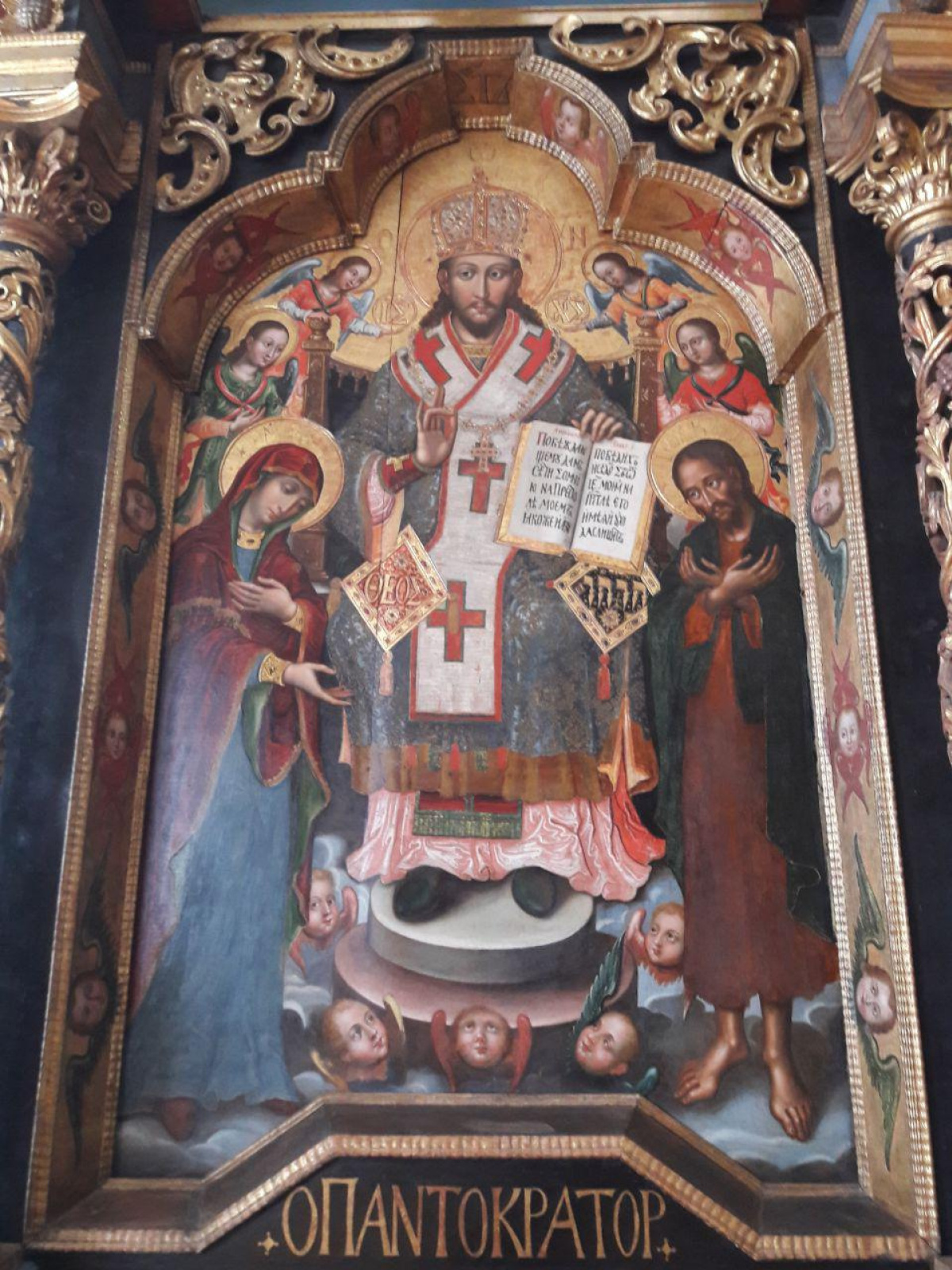
On either side of the hierarch's throne stand two staves. On one of them is inscribed "ΘΕΟΣ." On the other staff, the master Iov placed the Hebrew Tetragrammaton. It is written with a small error in the letters, which reveals the icon painter as a man unfamiliar with the language of ancient texts, yet striving to convey the majesty of the Old Testament Name of God.
Blood above the Crucifix
The fifth tier of the iconostasis contains shaped panels with images of the Old Testament prophets. In their hands are long scrolls with prophecies about the coming of the Savior. Each figure is turned toward the center, toward the summit of the iconostasis.
At the very top stands the original Crucifix, flanked by the Mother of God and the Apostle John the Theologian. From the wound in the Savior's side grows a carved vine. Bluish clusters and green leaves wind around the wooden beam, uniting the tree of execution with the image of the living vine.
Above Christ's head is mounted a sculptural figure of a pelican. The bird tears open its breast with its beak to feed its chicks with hot blood. This is an ancient allegorical image of the Eucharist.
A Digital Cast of an Ancient Work
In 2020, specialists of the Lviv museum, together with a team of researchers, carried out large-scale photogrammetry of the iconostasis. The experts took about 40,000 high-precision shots in order to create a detailed three-dimensional model of every centimeter of the surface. The windows of the hall were shielded from direct sunlight, with the light diffused by white cloths. Now even a blind person can touch a three-dimensional copy of this monument, feeling with their fingertips the depth of the old carving.
The iconostasis stands outside a church and is now deprived of liturgical life. But its prayerful purpose remains.
The viewer's gaze rises from the lower tiers with their bitter scenes of the Passion, passes through the ranks of saints, and comes to rest at the summit, where the carved vine grows from the open side of the Savior, underscoring the symbolism of the eternal salvation of mankind.