Legends surround Johann Georg Pinsel
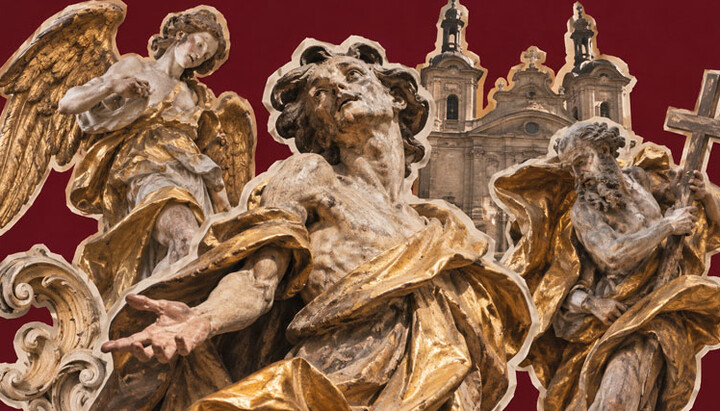
Загадочная личность галицкого скульптора до сих пор притягивает внимание исследователей и поклонников его творчества.
In the low narthex of a village church, to the left of the entrance, stands a stone figure of an elder. The stone seems subject to a prayerful impulse: an enormous beard falls in straight waves all the way to the feet, carved furrows form the relief fabric of the vestments, and the sunken eyes are fixed on something beyond the space around him. This is the Venerable Onuphrius the Great. The limestone preserves the marks of the chisel of a master who worked at the very limit of the expressive possibilities of the Rococo. Every fold on the hermit's face is cut with such plasticity that the heavy block seems weightless.
A few years ago a landslide struck the church. Multi-ton boulders broke through the roof, destroyed the ceilings, and tore up the wooden floor. One boulder, weighing several dozen tons, which fell directly onto the narthex, stopped two centimeters from the statue's foot. The villagers saw in this event the intercession of the hermit himself, who by his prayer had preserved the holy place.
The Unknown Life of a Genius
In the parish register of the city of Buchach there appears an entry about a Roman Catholic wedding. The "altar sculptor" Johann Georg Pinsel is getting married. His wife is the widow Elizabeth, née Mayevska.
Then the master has two sons, Bernard and Antony. At the baptism of his elder son Bernard, the godfather is the architect Bernard Meretyn. Two prominent figures of Baroque Galicia, the builder and the carver, are briefly united by spiritual kinship.
After Pinsel's death, the master's widow married again. And in the genius's biography there remained neither a date of death, nor a cause of death, nor a place of burial.
Three short entries in the parish registers, and nothing more is known about the man. The master left no self-portraits, signed not a single one of his works, and preserved no personal letters. The personality of the great carver seems to have dissolved between the lines of parish records.
Rumors About the Deceased
When documents are silent, traditions and legends come to the fore. An entire mythology has grown up around the figure of the carver. It was said that the master was a madman who broke his own creations in fits of rage. It was claimed that he committed suicide and was buried without a funeral service beyond the cemetery fence. Some authors wrote that he was a secret agent of the Kaniv starosta Mykola Potocki.
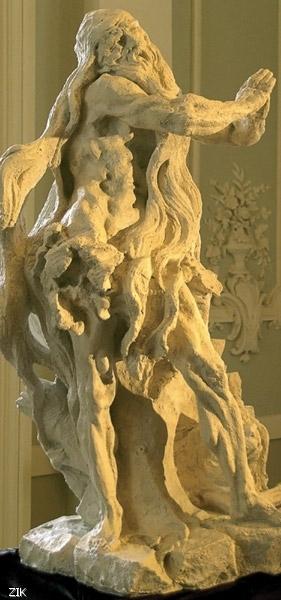
But the stone hermit in the narthex has no need of invented details from the life of his author. The realism that the master put into the limestone block is enough for him.
The stone statues of saints on the façade of the Cathedral of St. George in Lviv, carved by Pinsel in 1759–1761, remain the only work of his preserved in its original form. There, on the monumental façade, the Great Martyr George the Victorious tramples the serpent while on earth epochs and political regimes change.
The Rescue of the Wooden Altar
The great master worked not only with stone but also with linden wood. Wood demanded a different approach to the work. But the wooden figures proved more vulnerable than the stone blocks.
In Horodenka, the master created a large altar ensemble of eighteen sculptures for the church. In the Soviet years, the church was handed over to a vocational school. Only five figures survived. The remaining thirteen, according to the recollections of parishioners, were simply chopped up for firewood. The museum researcher Borys Voznytsky, who came to save the sculptural heritage, pulled a saw out of the body of a wooden figure and retrieved the mutilated fragments of statues from cellars, gathering them from abandoned crypts. Eyewitnesses later recalled: "Back then, none of this was needed by anyone."
The Lviv Art Gallery holds the "Sorrowful Mother of God," created by the master around 1758. The tall figure of painted and gilded wood strikes the viewer with its drama. The Most Holy Virgin has bowed her head, her hands are pressed to her breast, and the dynamic folds of her mantle form a sculpted rhythm. Every line of the garment conveys inexpressible sorrow.
The sculpture that did not reach the exhibition
In the autumn of 2012, a major exhibition of the master's works was being prepared at the Louvre in Paris. Wooden sculptures were being brought to the royal chapel from Lviv, Ternopil, and Ivano-Frankivsk. For almost two years, specialists carried out the restoration of the wooden pedestals, removing the destructive woodworm beetle in special chambers.
But Saint Onuphrius of Rukomysh did not travel to Paris. The village community refused to give up its sacred treasure for the exhibition.
The people did not want to part with the figure that had protected their church during a collapse.
The carver's art was created not for exhibition halls or display cases, but for the prayerful standing of the faithful before God. The stone hermit remained in the narthex of the village church, and the folds of his stone mantle preserve the memory of the brilliant sculptor.