
Justice should not be based on labels
In Ukraine, labels are increasingly used instead of evidence. Some are condemned for their affiliations, while others are forgiven for betrayal. When the law becomes selective, justice turns into an instrument of pressure, not protection.
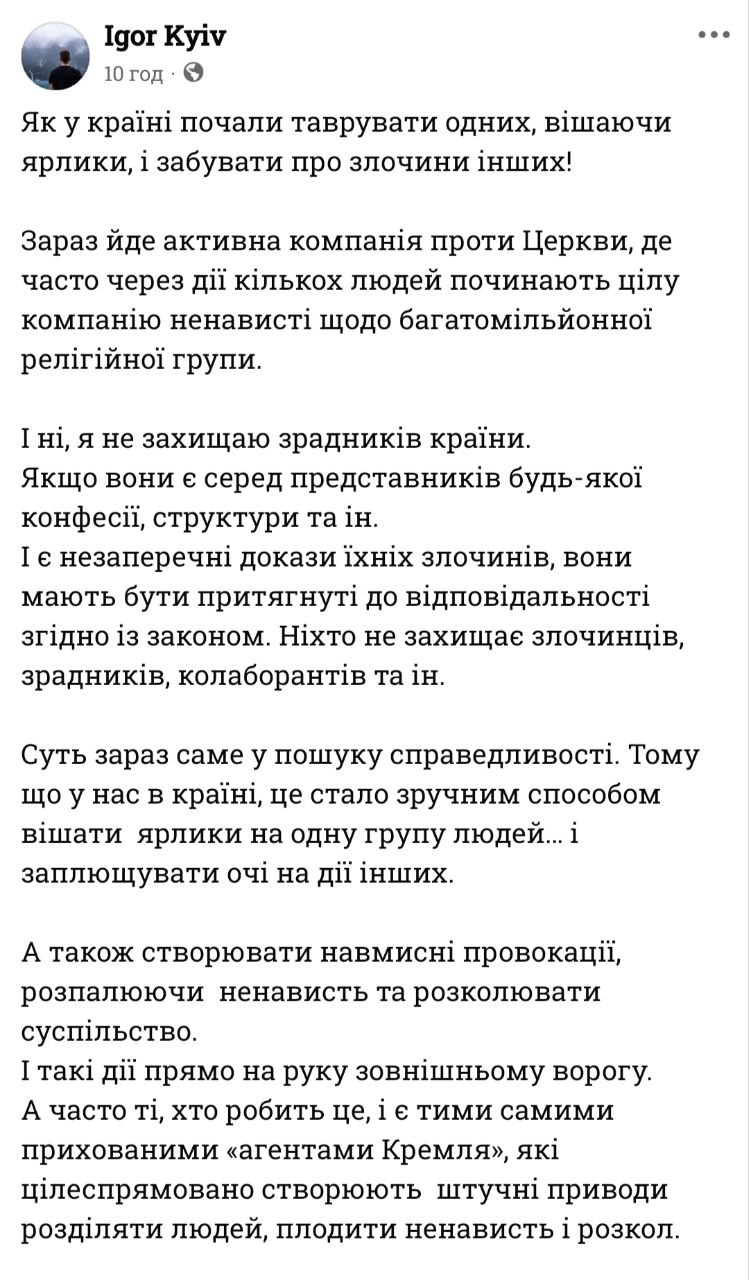
This is how the country has come to brand some with labels while forgetting the crimes of others. There is now an active campaign against the Church, where the actions of a few are used to justify a whole campaign of hatred against a multi-million-strong religious group.
And no, I am not defending traitors to the country.
If such people exist among representatives of any confession, structure, or institution, and if there is undeniable proof of their crimes, they must be held accountable according to the law. No one defends criminals, traitors, or collaborators.
The essence of the matter now lies in the search for justice. Because in our country, it has become a convenient way to label one group of people while turning a blind eye to the actions of others. It has also become a means of deliberate provocation, fueling hatred and dividing society.
Such actions serve the interests of the external enemy. And often those who do this are the very same hidden “agents of the Kremlin” – people who deliberately create artificial pretexts to divide citizens and spread hatred and discord.
Now, let’s look at some figures. Take, for example, the security services and those among them who, from 2014 to 2025, defected to the enemy’s side. That means they betrayed not only the people and the country but also their oath.
As of March 1, 2014, about 1,619 SBU officers were stationed in Crimea. Only 217 of them moved to mainland Ukraine – the rest stayed in Crimea, resigned, or joined Russian structures.
During the war, there were hundreds of cases of treason among this agency’s personnel, including generals and high-ranking officials, even after the full-scale invasion.
Yet for some reason, no one has dissolved these structures, banned them, or shouted that they are working for the enemy. No one calls them FSB agents.
So why such selectivity in deciding who gets labeled “agents of the Kremlin” and who doesn’t? In percentage terms, there were far more traitors among these structures than among believers of the Church.
Is that not hypocrisy?
Let’s move on.
Regarding the police: according to the ISW, in the occupied regions, around 14,000 police officers joined Russian structures, going over to the enemy’s side.
As for the military: of 13,468 Ukrainian servicemen stationed in Crimea as of March 1, 2014, about 3,991 left for the mainland, meaning a significant portion stayed behind, transferred to Russian service, or resigned.
And now, figures after 2022.
According to Ukrainska Pravda (October 2023), about 400 former Ukrainian police officers were working for Russian law enforcement agencies in the occupied territories.
There are thousands of criminal proceedings for collaboration or treason since 2022. Hundreds of law enforcement officers and officials have been suspected or detained.
These are verified cases – and who knows how many more remain unknown? In truth, these figures may be only a drop in the ocean. We are dealing with tens of thousands of betrayals and defections to the enemy.
I have often heard from my friends in the military that as soon as Russian forces approach a city within 20–30 kilometers, the first to flee are the police and military commissariat officers – even before civilians are fully evacuated, and while the city is not yet occupied. The very same people who often have immunity from mobilization, and who should be protecting civilians, are the first to run. Now, many of them fight only in the rear – against their own people.
And yes, I stand for objectivity. I do not wish to resemble those who brand everyone for the deeds of a few, even if there are many such individuals.
I am not claiming that there are no decent people in the police, the SBU, or other security structures. There are, of course. I am not trying to condemn everyone.
There are also cases of heroism, of those who died fighting for their country. Such people deserve honor and respect.
But one cannot deny the fact that thousands of people serving or having served there have already betrayed the country – or are ready to do so at any moment, given the chance.
Nor can one deny that many now serve not the people of Ukraine or the country’s interests, but those of the authorities. They have become the political army of politicians, fighting against their own citizens, defending the interests of power and the system – not of law and country.
And often they are the very first to violate the law and the Constitution. Some remain deeply involved in corruption, violence against civilians, and many other crimes.
When it comes to the security agencies – where there have been real criminal cases, including among generals and high officials, and cases of deliberate treason – the state, for some reason, does not conclude that “the whole structure is traitorous.”
But that logic somehow does not apply equally to everyone.
When it comes to other groups, the authorities act on the principle of collective guilt: a few incidents, and suddenly the entire group is branded.
And this is just one example – about the security services.
How many thousands of traitors have there been among deputies, ministers, and officials of all ranks? Thousands!
So why aren’t they being banned?
Why are some organizations and structures outlawed and branded as enemies of the people, while others continue to exist with impunity?
As a result, the system itself demonstrates double standards.
Where there are thousands of proven cases, there are no systemic conclusions.
Where there are no mass verified facts, there suddenly appears public hysteria, slogans, media frenzy, and cries of “enemies of the people.”
If the state truly seeks justice, it must be consistent.
Justice is not about selectively calling enemies those who are convenient targets and sparing those who are not. Justice means one law for all. One logic. One principle.
You cannot defend the state with lies.
You cannot protect the country through injustice.
You cannot safeguard the future with double standards.
If we believe that betrayal is a crime, this must apply to every individual case.
Not to millions of people “by association,” not by faith or religion, not by label, gender, age, or social status.
According to Article 24 of the Constitution of Ukraine – which, by the way, cannot be limited even during wartime or martial law –
all are absolutely equal before the law.
There can be no restrictions or privileges for any particular group of citizens.
The Constitution explicitly forbids it.
Law is an exact concept.
Guilt is an individual category.
And here lies the main lesson for us all:
if the state does not apply laws equally, if it turns a blind eye to some crimes while zealously branding others, it destroys the very idea of justice.
Justice is not a tool of convenience or propaganda.
Justice is the protection of every citizen and the safeguard of the nation as a whole.
As long as some are burdened with labels and mass accusations, while others with proven cases of treason remain unpunished, we lose faith not only in the government but in the very institutions meant to protect the people.