
Those killed on Euromaidan are equal to angels: theology or heresy?
The head of the UGCC has described those killed during the Euromaidan protests as equal to angels. Let us examine this claim in light of the Church’s teaching.
On the eve of the Day of Dignity and Freedom, which in Ukraine is observed on November 21 and coincided with the feast of the Synaxis of the Archangel Michael, the head of the Greek Catholics, Sviatoslav Shevchuk, declared that those killed on the Euromaidan are equal to angels. “It is no coincidence that we called our Maidan heroes the Heroes of the Heavenly Hundred. We have equated them with the host of light, at whose head eternally stands the Archangel Michael,” said the head of the UGCC.
And this is not the first such statement by the leader of the Greek Catholics, nor by representatives of “patriotic” confessions in general.
Is it really the case that, in order to become equal to angels, it is enough to take part in mass unrest? And if, during a political upheaval, you are killed by a bullet from an unknown sniper – do you thereby have grounds to expect admission into the heavenly host? And in general, is it really true that “heroes do not die,” and that a patriot may hope that “Bandera will come and restore order,” or is all this nothing more than empty rhetoric?
Let us turn to the Sacred Tradition of the Orthodox Church and determine what the Church actually teaches about angels and about the posthumous fate of a human being.
The teaching on angels
Children are often told that their deceased relatives – father, mother, grandmother, and so on – have gone to heaven and “become angels.” In much the same spirit, for eight years now in Ukraine, the lofty rhetoric about the “Heavenly Hundred” has been heard, which became the basis for Shevchuk’s statement that those killed on the Maidan should be equated with the heavenly host led by the Archangel Michael.
But what does the Church say about this? Do people really become angels after death?
Some Holy Fathers expressed the view that the destiny of humanity is to replenish the number of angels after the fall of demons. For example, Blessed Augustine wrote: “Humanity, which was perishing in sins and calamities, both inherited and personal, must, as it is restored to its former condition, make up for the loss in the number of angels that occurred as a result of the devil’s destruction.”
Similar ideas are also found among some Eastern Fathers. For example, St. Anastasius the Sinaite writes: “When the number of righteous men reaches the number of fallen angels and the heavenly realm is filled [by them], then the end [of this age] will come.”
However, the Church did not accept this teaching, although even among saints closer to our time, such as St. Barsanuphius of Optina, one can encounter similar views.
The reasons why the Church does not accept this opinion are as follows.
First, the nature of an angel and that of a human being are different. St. John of Damascus, in An Exact Exposition of the Orthodox Faith, writes of angels: “An angel is a noetic essence, ever-moving, endowed with free will, incorporeal, serving God, having received immortality for its nature by grace – the form and definition of which essence is known only to the Creator.”
The nature of angel and human is different: neither can an angel become a human being, nor a human being an angel.
As for human nature, St. John writes: “God creates man with His own hands, from both visible and invisible nature, according to His image and likeness: forming the body from the earth, and giving him a rational and intelligent soul by His own breath (Gen. 2:7; 1:26–27), which is what we call the divine image. For the expression ‘according to the image’ denotes the rational and free-willed, while ‘according to the likeness’ denotes likeness through virtue, insofar as it is possible [for man].”
Thus, neither can an angel become a human being, nor a human being an angel. Those passages in Scripture in which people are spoken of as angels (for example, concerning John the Baptist: “Behold, I send My angel before Your face, who will prepare Your way before You,” Matt. 11:10) should be understood metaphorically, not implying a transformation of one nature into another.
Second, the creation of anything – including man – is a free decision of God, not conditioned by any circumstances. St. Gregory of Nyssa teaches that God brought man into being “out of an abundance of love.” If we accept the claim that man is meant to replenish the number of fallen angels, then it would follow that the fall of the devil and a portion of the angels became the reason for God’s creation of man – which is not true.
Third, the Church teaches that the goal of human life is not to become an angel, but to become godlike by grace. The Apostle Paul writes: “He who is joined to the Lord is one spirit with Him” (1 Cor. 6:17). “God became man so that man might become god” (St. Athanasius the Great). In the Sacrament of Communion, we partake of Christ, not of angels:
“The Eucharist is called Communion because through it we partake of the Divinity of Jesus. It is also called participation because through it we enter into communion with Christ and share in both His flesh and His divinity” (St. John of Damascus).
Many similar statements can be found among the Holy Fathers. Let us cite a few more:
- “The end of a virtuous life is likeness to God” (St. Gregory of Nyssa);
- “The goal of all Christians is one – to be in living union with God” (St. Theophan the Recluse);
- “The true aim of our Christian life consists in the acquisition of the Holy Spirit of God” (St. Seraphim of Sarov).
Therefore, statements that a human being can be numbered among the angelic ranks are figurative expressions indicating that man is called to something higher than earthly existence. Is this what Sviatoslav Shevchuk meant? Not at all.
The criterion by which the head of the UGCC equates the “heroes of the Maidan” with angels is the mere fact of their death during the Euromaidan events. Does this correspond to Church teaching? Clearly, no.
A human being cannot become an angel under any circumstances.
The teaching on the posthumous fate of man
The Apostle Paul expressed the core of this teaching as follows: “It is appointed unto men once to die, and after that comes judgment” (Heb. 9:27).
The Holy Fathers, based on Scripture, teach that at the moment of death the soul departs from the body and enters the spiritual realm. Then it undergoes the so-called tollhouses, during which its inclination toward sin or virtue is revealed. A particular judgment is rendered, after which the soul enters one of the states called paradise or hell.
Remaining there, the soul either suffers in anticipation of eternal torment or rejoices in anticipation of eternal blessedness. At the same time, the prayers and almsgiving of the living can influence its fate.
After the Second Coming of Christ and the general resurrection, the final and universal Last Judgment will take place, at which the destiny of each person will be determined definitively.
By what criteria, then, can we speak of a favorable posthumous fate?
Scripture points to the following:
– Faith and Baptism: “He who believes and is baptized will be saved; but he who does not believe will be condemned” (Mark 16:16);
– Communion: “Unless you eat the Flesh of the Son of Man and drink His Blood, you have no life in you” (John 6:53–54);
– Mercy: “For I was hungry and you gave Me food…” (Matt. 25:32–36);
– The Book of Life: “And whoever was not found written in the book of life was cast into the lake of fire” (Rev. 20:12, 15);
– Conscience: “Their conscience also bearing witness…” (Rom. 2:12–16).
Nowhere in the Church’s teaching is there even a hint that dying in a political confrontation is a criterion at God’s judgment.
Moreover, in the case of those killed on the Maidan, no one particularly troubles themselves with examining their faith, their religious affiliation, or their moral character. Sviatoslav Shevchuk simply enrolled them all among the angels.
Why?
As is often said in such cases: nothing personal.
Greek Catholics were both among the organizers and among the principal beneficiaries of the Euromaidan. And therefore, in the rhetoric of the Uniates, the state coup (for it was precisely a change of power that resulted from the Euromaidan) has gradually begun to be transformed into a sacred event.
In the teaching of the Church, there is nowhere even a hint that the criterion at God’s judgment is a person’s death in a political confrontation.
The sacralization of the Maidan
History teaches us that every victorious revolution strives to sacralize itself and those who died for it. This has always been the case, everywhere, and the Euromaidan is no exception.
Citizens of Ukraine who lived in the Soviet Union well remember how the heroes of the October Revolution of 1917 were honored, how poems were composed in their honor, and legends created about them. V. Lenin still lies unburied because the Soviet authorities needed “relics” to which people would come to venerate.
The dominant ideology of the USSR was atheism, yet propaganda nevertheless instilled from early school years the mantra: “Lenin lived, Lenin lives, Lenin will live,” as if acknowledging the posthumous existence of man.
Today, the same process is taking place – only with different names and a different ideological foundation.
In Ukraine today, popular mantras include: “Our religion is nationalism, our prophet is Bandera,” “Bandera will come and restore order,” “Heroes do not die,” and the like. These are heard at demonstrations and torchlight marches; they are sung by members of parliament and by “clergy” of the OCU and UGCC alike.
Already on the eve of the first anniversary of the Maidan’s victory, in 2015, Sviatoslav Shevchuk declared:
“The holy blood of the heroes of the Heavenly Hundred has watered the freedom of Ukraine… The history of the new Ukraine will increasingly reveal the meaning of the Paschal sacrifice of the Revolution of Dignity.”
Christians call “holy blood” the Blood of Christ, and the “Paschal sacrifice” the prototype of Christ’s sacrifice on the Cross. How appropriate are these words when applied to those killed on the Maidan, whose moral qualities (not to mention sanctity) remain highly questionable?
Shevchuk was echoed by Vasyl Rudeyko, a Greek Catholic priest and lecturer at the Ukrainian Catholic University in Lviv: “The Revolution of Dignity is like the sacrament of baptism for Christians.”
In 2021, speaking in the chapel on the Alley of the Heroes of the Heavenly Hundred, Shevchuk said:
“For the seventh year in a row we come to this Kyiv hill, to a holy place that has become a Ukrainian Golgotha. Here is the place of the dramatic battle between good and evil, light and darkness, dignity and contempt.”
The Uniate Metropolitan Borys Gudziak also spoke about the sacralization of the Maidan: “I ask everyone, especially journalists, to create lives of these martyrs who gave their lives for your and my dignity, for our freedom.”
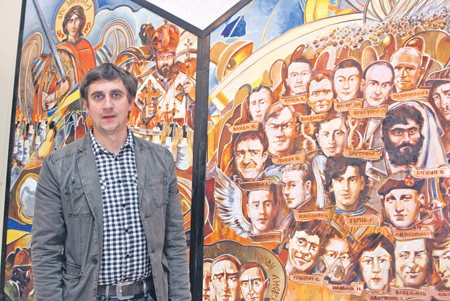
An image titled an “iconostasis” of the Heavenly Hundred was even created by artist Roman Bonchuk as part of the project of the first Museum of the "Heavenly Hundred" in Ukraine in Ivano-Frankivsk. Among others, Sviatoslav Shevchuk, an active participant in the "Revolution of Dignity," is depicted there.
Anyway, perhaps Euromaidan led to unprecedented results in improving the earthly life of Ukrainians? Maybe for this reason it's worth considering its victims "angels" or "equal to angels"?
What are the fruits of the Maidan?
Those who sacralize the Maidan declare those who stood on one side of the confrontation as “warriors of light.” But what about those on the other side? After all, 17 law enforcement officers were killed on the Maidan, and another 1,127 were wounded.
Did they not wish good for Ukraine and its people? Did they not desire a better life? On what grounds were they assigned to the side of darkness?
The Lord said: “Every good tree bears good fruit, but a bad tree bears bad fruit. A good tree cannot bear bad fruit, nor can a bad tree bear good fruit” (Matt. 7:17–18).
What, then, are the fruits of the victorious Maidan?
The loss of Crimea, war in the Donbas, sharply increased utility costs, rising prices for food, gas, and electricity, and so on. Why did approximately five million people leave Ukraine after the Maidan to seek work abroad in order to support their families who remained at home?
Was this what people stood for and died for on the Maidan?
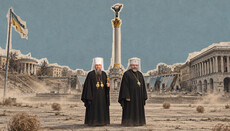
Did the Maidan fulfill its promises? Let us recall its main slogan – European integration. It was even called the Euromaidan. The well-known publication Forbes once published a very telling image from the Maidan.
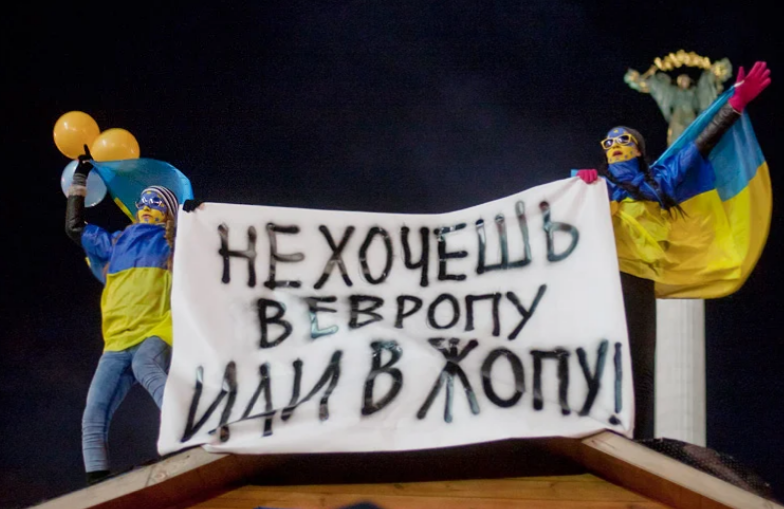
But even if life had improved after the Maidan, from a religious point of view, neither political, nor economic, nor social successes can serve as criteria by which a person may be counted among the “warriors of light” or the forces of darkness.
Yet Sviatoslav Shevchuk does precisely this.
Conclusions
First, a person’s posthumous fate is by no means determined by the fact of their death in an internal political confrontation. Other criteria exist for this – those rooted in faith and morality.
A person’s posthumous fate is not determined by death in political conflict.
Second, statements that people are counted among the angelic ranks do not reflect the teaching of the Church, even if similar ideas can be found with some of the Fathers of the Church.
Third, there are no theological grounds for dividing those killed on the Maidan into “warriors of light” and those who do not belong to this host.
Fourth, what is happening in Ukraine today is, in effect, a betrayal of those who stood on the Maidan and died there. The ideals of the Maidan have been betrayed by those whom the Maidan brought to power. People did not go to the Maidan in order to receive what we now have. This is a bitter truth – but it is the truth.
Fifth, like any revolution, the “Revolution of Dignity” does everything it can to sacralize itself. This is done so that those who came to power after the Maidan can retain it – so that no one dares question the cause of the Maidan or ask uncomfortable questions of those who benefited from it.
And finally, the statements of Sviatoslav Shevchuk are nothing other than a speculation on the deaths of people, on the tragedy that unfolded in our country nearly eight years ago.
We may hope for a time when those who died on both sides of the confrontation will not be turned into symbols or categories, but remembered with sorrow, and entrusted to God in prayer – that He may forgive them their sins, voluntary and involuntary, and grant them rest among the righteous.