
The Patriarch of Georgia and the Pope of Rome
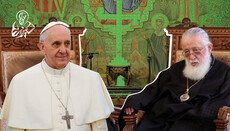
The Greek editorial board of UOJ reflects on the actions of the late Patriarch Ilia during his meeting with the Pope of Rome.
Ten years ago, in October 2016, the ever-memorable Patriarch Ilia II of Georgia received Pope Francis in Tbilisi. That meeting brought genuine joy to the souls of Orthodox believers, for – we dare to say – it became a model example of how an Orthodox Primate, who respects both his Church and his episcopal dignity, may receive the Pope of Rome without compromising Church Tradition or causing scandal among the faithful.
At the time, on the occasion of that visit, we published the following text under the title: “A Patriarch Who Respects His Church and Himself. Patriarch Ilia II Addresses Pope Francis: ‘Only true faith and true love will open the path to unity.’”
We are bound to give glory and thanksgiving to the Triune God, for at decisive moments in the life of His Church, He raises up personalities who become pillars – enduring examples of Orthodox consciousness and dignity.
We are speaking, of course, of His Beatitude, the Primate of the small yet historic and Apostolic Georgian Church, Ilia II, and of the stance he took during Pope Francis’s visit to Georgia (September 30 – October 2, 2016).
Some would have preferred that the Patriarch ignore the Pope entirely – neither attend any reception nor meet him at all. Yet it is difficult to say how feasible such a rigid approach would be in modern conditions – both given the particular relationship between society, state, and Church in Georgia, and within the broader geopolitical context. We must not forget that the Pope is also the head of the Vatican state.
A careful reading of reports by Vatican correspondents and Western media reveals a clear bias against the Georgian Church, often portrayed as lacking even basic Christian love and being under the sway of extremist elements unwilling to engage with anything coming from the West. In such a climate, a total refusal by the Patriarchate to engage in any aspect of the papal visit would likely have played into the hands of the Catholic side, which, bypassing the Orthodox Church, might have built direct bridges with the country’s political leadership. There is no need to elaborate further on this point.
And yet, the central issue is not whether the meeting took place, but its format and content. The Tradition of our Church does not impose an absolute rule in such matters – it varies according to circumstances, while always remaining within the strict bounds of Orthodox ecclesiology and canonical Tradition.
Before turning to the visit itself, it is worth noting the position of the Georgian Patriarchate toward Orthodox faithful who protested against the Pope’s visit. There was no contempt, no disparaging or offensive labels – no “Taliban,” “fundamentalists,” “fanatics,” “mentally unstable,” or “zealots.” On the contrary, with exemplary respect for its flock, the Patriarchate issued an official communiqué clearly explaining that the Pope’s visit was “aimed at strengthening international relations in order to preserve peace in the region,” while “prayerful and sacramental communion between us and the Roman Catholic Church has been broken since the Middle Ages, and as long as dogmatic differences remain, according to the Canons of our Church, Orthodox do not participate in their services.”
The communiqué concluded: “The Georgian Church maintains a strict position on ecumenism: it withdrew from the World Council of Churches in 1983, did not participate in the recent Pan-Orthodox meeting in Crete, and issued criticism of the documents of that meeting, as well as of the joint statement adopted at the recent Orthodox–Catholic meeting in Chieti, Italy” (Communiqué of the Georgian Patriarchate, September 28, 2016). If only all Local Orthodox Churches followed the example of the Apostolic Church of Georgia in their treatment of the faithful!
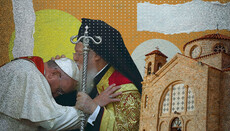
Let us now turn directly to the papal visit. Anyone who carefully followed the lengthy broadcasts of CTV (Vatican Television) and the reports of international agencies could easily see the irreproachable dignity and consistently Orthodox stance of the Georgian Church toward its distinguished guest – the head of the Vatican state and leader of the Catholics, Pope Francis. This assessment was also confirmed to us by Georgian friends in Tbilisi.
One cannot but note the generosity of love and hospitality shown – yet without descending into cheap “affectionate rhetoric” pleasing to the papal, monarchic ecclesiology; the noble greetings that remained firmly within Orthodox ecclesiology; and the absolute respect for canonical Church Tradition demonstrated by the Patriarch and the Georgian Church as a whole.
Thus, thank God, there was not even a hint of concelebration or joint prayer; no sacrilegious “hymns” were composed for the occasion; no inappropriate forms of address were heard; no irreverent banners were displayed (such as “Blessed is He Who comes in the name of the Lord”); there were no partial concelebrations or liturgical kisses of peace; the Pope did not recite the “Our Father” – and so on. Moreover, during the visit to the cathedral in Mtskheta (October 1, 2016), the Patriarch entered the altar alone before the Pope’s arrival, venerated in solitude, and only then came out to meet him, closing the Royal Doors behind him. Anyone familiar with what occurs during papal visits to the residence of the Ecumenical Patriarchate in the Phanar cannot but rejoice for the Georgian Church – and grieve over the neglect of Tradition elsewhere.
In Georgia, thanks be to God, there was no kissing of the Pope’s hand by patriarchal archdeacons, much less by bishops – something we had, to our sorrow, witnessed shortly before in Assisi.
One cannot but rejoice at something so self-evident: “Yes” – to meetings and dialogue; but an absolute “No” – to any form of liturgical communion with the Pope.
Respecting Church order, Patriarch Ilia did not even send a formal delegation to the papal Mass at the Tbilisi stadium, which greatly disappointed the Vatican – judging by the rather bitter remarks of its correspondents. As Reuters reported, Catholics in Georgia had expected a much larger turnout than the roughly three thousand who attended the Mass in a stadium with a capacity of twenty-five thousand.
It was one of the smallest open-air papal Masses of Pope Francis’s sixteen foreign trips. Moreover, the delegation representing Patriarch Ilia II, which the Vatican had expected to see, never appeared. Some reports implied that the Patriarchate had promised to send a delegation but later withdrew. However, we were firmly assured from Georgia that the Patriarchate had clearly stated from the outset that no Orthodox delegation would attend the papal Mass.
The Patriarch’s words of greeting at the two meetings with the Pope are particularly significant. In his address at the Patriarchal residence (September 30, 2016), he responded – indirectly yet clearly – to malicious Western propaganda against the Georgian people’s faithfulness to Orthodoxy and the moral principles of the Gospel. In his address at the renowned Svetitskhoveli Cathedral in Mtskheta (October 1, 2016), Patriarch Ilia, concluding his speech, did not hesitate to strike at the very Achilles’ heel of syncretistic ecumenism, emphasizing the exclusive value of true faith and love in the quest for Christian unity.
A telling detail: the prepared text ended with the words, “May God unite Christians on the basis of true faith, amen!” But the Patriarch continued, adding with particular emphasis, addressing the Pope directly: “Only true faith and true love will open the path to unity.” Earlier, he had also stressed: “True faith, humility, repentance, and love for man – this is the shortest path to salvation.” The significance of his words did not go unnoticed by Vatican correspondent Inés San Martín.
It is also noteworthy that the Georgian Primate did not yield to the verbal pressure of the Pope, who repeatedly referred to the unity of “Christian baptism.” The Patriarch avoided the regrettably common mistake of other Orthodox Primates who, adopting a foreign ecclesiology, recognize the canonical validity of heretical baptism.
The dignity of the Georgian Church leadership was further evident in its refusal to follow the Pope everywhere like an entourage at all his events and meetings in Georgia – a spectacle which, in other contexts, is at best regrettable.
In a striking article, American theologian Jesse Dominick aptly observed: “The Pope was met with respect and dignity, but not as a right-believing bishop of the true Church. He was neither invited to homilize during any Orthodox divine service, nor to bless the Orthodox faithful, nor was he seated upon any episcopal throne, nor was the liturgical Kiss of Peace exchanged—actions which would only wound the Orthodox conscience of the faithful, causing confusion and anger.
As a wise and discerning shepherd, Patriarch-Catholicos Ilia II maintained a balance between respect for his guest and respect for his own flock and Church, and his own ordination, with all its ensuing responsibilities, setting an example for Orthodox-Catholic interactions, and giving voice to the Orthodox truth in his own speech at Svetitskhoveli Cathedral: 'True faith, humbleness and our traditions—these are the ancient treasures that we preserve and will continue to do so in future. We greet you again and confess that our unity is in the true faith. Only true faith and love will open the path towards our communion.'”
Perhaps the message the Pope received from the impeccably Orthodox stance of the Georgian Church was far stronger than the total rejection some had proposed. We admired Georgian Orthodox believers for the leadership of their Church at the Council of Crete. We admire them now for their spiritual leadership – for their Patriarch and their bishops, who once again upheld a position worthy and faithful to Orthodox Tradition.
We thank them from the heart. We pray and hope that other Orthodox Churches will follow their example.
Today, ten years later, with the repose of the Blessed Patriarch, we offer our prayer:
Ilia, Blessed and God-chosen Patriarch of Mtskheta and Tbilisi and All Iberia (Georgia) – ETERNAL MEMORY!