
From pride to altar: How LGBT agenda enters church consciousness
In Europe, it is currently the season of gay pride parades. Some church structures are also rushing to express their solidarity. How does this affect church consciousness?
The gay pride season of 2026 is in full swing: on June 12, Tel Aviv – 100,000 people; on June 13, Vienna – 320,000; on May 16, Brussels – 216,000.
The numbers are large, but that is not even the point. Christ sent His disciples into the world "as sheep in the midst of wolves" (Matt. 10:16), yet the disciples were to be salt: "You are the salt of the earth" (Matt. 5:13). In that case, being among wolves was not frightening. But the Lord then warns: "But if the salt loses its flavor, how shall it be seasoned? It is then good for nothing but to be thrown out and trampled underfoot by men" (Matt. 5:13).
This is precisely what we see today. The danger lies not in the gay parades themselves but in the fact that Christians are ceasing to be "the salt of the earth." Gradually, in small steps, they retreat from God's commandments and drift toward other commandments: tolerance, blessing, inclusion, and so forth. And now LGBT ideology is becoming the norm in the Church's consciousness, while the Gospel is reduced to a mere reminder of something that existed long ago.
How Pride is marching into the altar
In May 2026, a Queer-Gottesdienst ("queer worship service") was held among Catholics in Würzburg. It was attended by several hundred people, with a queue formed outside the church. Yet the most telling remark came from the organizers themselves: "In the past, such services took place on the margins; today we are right in the middle of things."
This was not a mere slip of the tongue. What once occurred somewhere on the periphery and was considered marginal is today being placed at the center of the Church's self-awareness. In the past, some excessively eccentric priest might have performed a church rite for people of non-traditional orientation. Today, such things are becoming a mark of good taste and almost mainstream.
In Würzburg, calls were made for the "unconditional recognition of human dignity in the Church and society—regardless of gender, sexuality, or way of life." But what, then, of the Kingdom of Heaven, into which "nothing unclean shall enter, nor anyone who practices abomination or falsehood..." (Rev. 21:27)? Or is the Church no longer guiding its believers toward that Kingdom?
Such is the rhetoric of the German Catholic priest Burkhard Hose. In his view, what is needed is a "correcting the traditional Church view of gender." In other words, the words, "So God created man in His own image, in the image of God He created him; male and female He created them" (Gen. 1:27), are said to require revision in light of "queer life realities."
In another German city, Pforzheim, Catholic and Protestant communities openly supported Christopher Street Day. They declared that the dignity of "queer people" must be respected, that the diversity of sexual identity must be recognized, and that their rights must be championed.
The local press echoes the same rhetoric: "God created us in diversity and unites us. We are firmly convinced that every person – regardless of religion, origin, social status, or sexual identity – is created by God and loved by God."
These words contain a poorly concealed manipulation. The reasoning is that if God loves everyone, then He must also love LGBT people. And if God loves homosexuals, it follows that LGBT identities and lifestyles are therefore good. But the Gospel says otherwise. Yes, Christ loves sinners, but He saves them from sin rather than legitimizing sin. He calls them to repentance rather than lulling their conscience to sleep.
When the woman caught in adultery was brought to Christ, the Lord says not only: "I do not condemn you," but also: "Go and sin no more" (John 8:11). Nowadays it has become customary to quote the first phrase and completely ignore the second.
Another recent example: on June 12, 2026, the Catholic Archbishop of Milan, Mario Delpini, celebrated a Mass for members of the Italian LGBT group Gruppo del Guado at the Church of San Carlo al Lazzaretto. During his homily, he told those gathered: "The Lord has bound Himself to you and has chosen you… because He loves you."
The rhetoric is the same, and the media have likewise picked it up. The Italian Corriere della Sera also reported that the Archbishop celebrated Mass in the church of the "rainbow scene (movida)" and that the Lord loves everyone. Moreover, this is not an isolated event. The Gruppo del Guado website features a calendar of meetings listing regular Masses at the Church of San Carlo al Lazzaretto and events connected with Milano Pride. This means that the Catholic Archdiocese of Milan is engaged with the LGBT topic on an ongoing basis.
Another Italian case is the document "Lievito di pace e di speranza", adopted on October 25, 2025, as part of the Synodal Path of the Catholic Church in Italy. The document addresses opposition to violence and discrimination, including homophobia and transphobia, as well as the pastoral “recognition and accompaniment” of homosexual and transgender Catholics.
Once again, it is worth noting the key terms: “recognition,” “accompaniment,” “non-discrimination,” “gender identity,” and “transgender people.” These are concepts that occupy a central place in the rhetoric of the Catholic hierarchy in Italy.
The Orthodox position: faithfulness or erosion of consciousness?
Protestant denominations have largely closed the LGBT question: they have accepted it and moved on. The Catholic Church has not yet arrived at full acceptance of gay ideology, but it is drifting in the same direction. What about the Orthodox? Do they steadfastly remain faithful to the Gospel, or are they also following the path of acceptance, only lagging somewhat behind the others?
Here are several examples from the current Pride season. On June 13, 2026, the Synod of the Bulgarian Orthodox Church spoke out against Sofia Pride 2026. The statement declared that the family, founded on "the blessed marital union of a man and a woman," is the natural and God-ordained environment for the birth and upbringing of children.
The Romanian Orthodox Church likewise spoke out against Bucharest Pride with much the same argumentation. Other Local Churches have also expressed their rejection of LGBT ideology.
However, there are also alarming signals. Cypriot theologian Theodoros Kyriakou declared that the Orthodox Church must revise its pastoral practice regarding LGBT people in light of contemporary scientific data. As for the fact that Holy Scripture directly condemns homosexuality and other perversions, Theodoros regards this as a relic of the past. He considers the Gospel a "historical text" that expressed the views of an entirely different era — a text that can be replaced or edited to bring it into conformity with modern science.
Even earlier, the head of the Archdiocese of the Ecumenical Patriarchate in America, Archbishop Elpidophoros (Lambriniadis), expressed sympathy toward LGBT people. He maintained that the Church accepts everyone, including LGBT people, and that they are "only now trying to attain dignity and respect."
In another interview, Abp. Elpidophoros stated that the Church cannot divide people according to their sexual behavior, and that making a person's sexual behavior a criterion for acceptance or rejection is, in his view, "utterly anti-Christian."
Archbishop of Crete Evgenios (Ecumenical Patriarchate) stated that his arms are open to homosexual people because they are "our brothers and sisters," albeit with "a different sexual orientation."
The first official document in Orthodoxy in support of LGBT was published by the Finnish Church of the Ecumenical Patriarchate. "The Church is the Body of Christ. Excluding certain members of the Body – or denying their identity – causes pain not only to those individuals, but harms the community itself, wounds the Church, deprives it of fullness and makes it weaker. In the Church, everyone – absolutely everyone, regardless of sex, sexual orientation, ethnic background, skin color, state of health, social position, etc. – must feel safe and be truly heard and accepted," stated the resolution of the Council of the Finnish Church in November 2025.
Ukraine: Between faithfulness and European integration
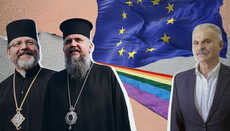
In Ukraine, the LGBT topic has not yet entered church life as directly as in European countries. But the current Ukrainian authorities have already been actively promoting it. Thus, the head of the State Service for Ethnic Policy and Freedom of Conscience (DESS), V. Yelensky said that questions of attitudes toward LGBT will generate tension as Ukraine fulfills its obligations on the path to EU accession, but assured that religious organizations are prepared to make compromises for the sake of such a lofty goal.
Another representative of the authorities, Verkhovna Rada Speaker R. Stefanchuk, discussed with LGBT representatives a draft of the new Civil Code, which is intended to ensure "the necessary social balance" and to conform to European standards.
Ukraine is moving toward membership in the European Union. This path entails fulfilling many conditions: high legal standards, combating corruption, and so forth. Among these conditions is LGBT ideology. Fighting corruption is difficult; it is far easier to compel Ukrainian religious communities to change their attitude toward LGBT. At least, that is how the authorities see it.
First they make commitments to the EU, then they introduce these norms into legislation, and then they demand that the churches refrain from interfering, "seek a balance," and "make compromises."
But as a result of this "compromise," any word about sin, repentance, or the struggle against the passions may be declared discrimination, intolerance, or an obstacle on the path to European integration. And those who dare to speak such words may be recognized as a threat to national security.
How the Church's language is changing
In this entire story, the most important and most alarming aspect is the shift in concepts. Where once the center of ecclesial consciousness was occupied by notions such as faith, salvation, sin, repentance, chastity, family, passion, and virtue, today these concepts are being pushed to the periphery of consciousness. In their place, other words are coming to the forefront: rights, dignity, identity, recognition, inclusion, safe space, non-discrimination, gender diversity, and so on. These are the concepts used by many priests and hierarchs in European countries.
In essence, a new ecclesiastical-liberal language is being created — a Newspeak in the Orwellian sense.
Christ says: "Repent, for the Kingdom of Heaven is at hand" (Matt. 4:17). The new ecclesiastical-liberal language says: "Accept us as we are."
The Gospel calls man to be freed from the bondage of the passions. The new language proposes that the Church rename passion as identity. The Lord says: "The Kingdom of Heaven suffers violence, and the violent take it by force…" (Matt. 11:12). Newspeak says: "Strive for recognition and respect for your orientation."
For the Church, the LGBT question is not merely a matter of sexual morality. It is a question of whether the Church will retain the right to name things for what they are: sin as sin, passion as passion, and moral fall as moral fall. In the broadest sense, the Church is fighting for the right to speak the truth to people. Not a human truth, which is different for everyone, but the truth of God. And the modern world urges the Church, and even pressures it, to lie.
To lie that sinners will face no punishment, that repentance is unnecessary, that the struggle against sin is a waste of time. All of this is considered inappropriate to discuss today. Good form dictates expressing tolerance and an abstract "love." But one should not forget these words of Christ as well: "For whoever is ashamed of Me and of My words in this adulterous and sinful generation, of him will the Son of Man also be ashamed when He comes in the glory of His Father with the holy angels" (Mark 8:38).