
A bow to Phanar? Why did UOC academy congratulate Constantinople’s exarch?
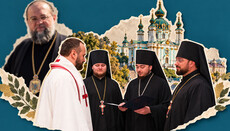
A delegation from the Kyiv Theological Academy congratulated the Phanar’s exarch, who has remained silent about the persecution of the UOC. Who authorized this gesture, and why did even OCU supporters fail to appreciate it?
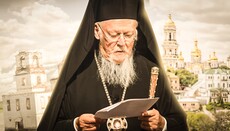
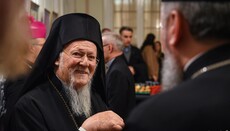
On September 20, St. Andrew’s Church in Kyiv, home to the Constantinople Patriarchate’s stavropegion since 2019, hosted celebrations marking the 50th birthday of Bishop Michael (Anishchenko) of Comana, Patriarch Bartholomew’s exarch in Ukraine.
The Divine Liturgy was celebrated by the bishop himself, together with OCU “Metropolitan” Mykhailo Zinkevych. The hymns were sung by choirs from the OCU’s Volyn Academy and the UGCC’s Three Holy Hierarchs Seminary. The Greek Catholic delegation was headed by Ihor Shaban, while the stavropegion’s press service listed among the guests “faculty members and students of the UOC’s Kyiv Theological Academy and Seminary.” Its photo report featured Bishop Michael with three KDAiS representatives wearing monastic head coverings.
According to the press release, the exarch himself “emphasized the importance of cooperation and communication among Christians and of serving people together, including between Churches that are not in Eucharistic communion.”
What are we to make of all this?
No mere bystander
Bishop Michael is not someone observing Ukraine’s church crisis from the sidelines. He represents in Kyiv the very institution that created the OCU and, under the Tomos, retained authority over it. Back in 2020, KDAiS Rector Archbishop Sylvester (Stoichev) put it more precisely than most: “Although the OCU is called autocephalous, the Patriarch of Constantinople has retained numerous levers of influence over its internal life.”
Yet in seven years, not one of those levers has been used to stop church seizures, the beating of parishioners, or the judicial dissolution of UOC eparchies.
The exarch lives in Kyiv, follows the news, and is aware of everything happening to the Ukrainian Orthodox Church. But when asked about the authorities’ actions against the UOC, he replies that he will not comment, “since the state, as the sole authority on this matter, undoubtedly possesses more detailed information.” Meanwhile, when a priest of the Constantinople Patriarchate publicly called on the exarch to respond to the persecution of the UOC, the exarch remained silent.
When it comes to judging the UOC itself, however, Bishop Michael is not nearly so cautious. In an interview with Dialog.tut, he said that to restore trust, the UOC must address its “failure to officially condemn the deliberate collaboration of individual clergy members who supported or cooperated with the aggressor,” as well as its “jurisdictional dependence” on the ROC. He also insisted that “we must accept reality: Ukraine has a local Orthodox Church.”
In another interview, he said that “everyone must come to terms with reality.”
In other words, the exarch has a position, and it is perfectly clear: the OCU is the country’s only legitimate Church, while the UOC must repent of “collaboration” and recognize the authority of the Constantinople Patriarchate.
Yet when it comes to the suffering of those upon whom this “reality” is being imposed with crowbars and clubs, the exarch somehow becomes numb and deaf.
When it suits him, the exarch finds his voice
It would be unfair, however, to portray Bishop Michael as a man who makes a point of staying away from all “worldly affairs.”
On November 18, 2025, for example, he personally appeared before the High Anti-Corruption Court to offer himself as a guarantor for former Deputy Prime Minister Oleksii Chernyshov, a suspect in the Energoatom embezzlement case.
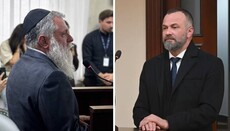
Let us emphasize: the hierarch appeared in defense of a man suspected of embezzling enormous sums of money, even though Chernyshov is neither a parishioner of St. Andrew’s Church nor one of the bishop’s spiritual children. They barely know each other. As the exarch explained, he decided to stand surety for Chernyshov because he “knows him as a good person.”
Yet the exarch has not honored a single hearing in the case of his "brothers in Christ" Metropolitan Arseniy, abbot of the Sviatohirsk Lavra, or a single session in the case of Metropolitan Pavel, with his presence, despite the fact that both UOC hierarchs were detained without any legal grounds, and the cases against them were fabricated.
Nor did he say a word when Monk Varsonofiy was murdered at that same Sviatohirsk Lavra on August 23, 2026 – a killing that drew responses from hierarchs of the Jerusalem, Antiochian, Polish, and Czech and Slovak Churches, and even from Catholic cardinals.
The exarch is equally silent about the forced mobilization of UOC clergy, even as priests are killed at the front or go missing. Moreover, it is exclusively UOC priests who are being sent to the front – the only clergy among all Ukraine’s religious denominations subjected to this treatment.
A man as well versed in theology as the exarch understands perfectly well the nature of what is happening. Yet he says nothing.
The Amsterdam documents and the exarchate
There is an even more serious consideration.
In August 2024, UOC attorney Robert Amsterdam published a letter to Volodymyr Zelensky outlining the contents of internal Ukrainian government documents that had come into his possession.
According to those documents, following the adoption of the law banning the UOC, the plan was to establish a new exarchate of the Constantinople Patriarchate in Ukraine that would “absorb” the UOC as the first step toward merging it with the OCU.
The proposed measures included creating a “toxic perception” of UOC affiliation itself, imposing sanctions on its benefactors and hierarchs, and reviewing all lease agreements with the UOC with a view to terminating them.
In other words, under these plans, the Constantinople Patriarchate would be not a mediator but a beneficiary. And its representative in Kyiv, who already heads the Phanar’s existing exarchate, would have a direct stake in the outcome.
According to sources we are not yet able to identify publicly, Bishop Michael advised the President’s Office during the preparation of anti-Church legislation and participated in compiling lists of UOC hierarchs against whom sanctions were subsequently imposed.
Some will say these are merely rumors. The problem is that far too much in the exarch’s public conduct is consistent with them.
And it was to this man that representatives of the UOC’s principal theological school came on September 20, bearing a congratulatory address and flowers.
Who authorized the academy?
This raises a question not for the exarch, but for our own academics.
The Statute on the Administration of the UOC establishes that theological educational institutions “are under the supervision of the Metropolitan of Kyiv and All Ukraine, exercised through the Education Committee under the Holy Synod” (Section X, Paragraph 2).
It is the Primate who “bears responsibility for inter-Orthodox, inter-Christian, and interreligious relations” (Section V, Paragraph 10), while the Synod “assesses the most important developments in interchurch, interconfessional, and interreligious relations” (Section IV, Paragraph 7).
On November 13, 2018, the UOC Council of Bishops resolved that the Phanar’s decisions concerning Ukraine were “invalid and devoid of any canonical force,” and that the Constantinople Patriarchate, by recognizing schismatics, had “embarked upon the path of schism.”
His Beatitude Onuphry does not commemorate Patriarch Bartholomew. Eucharistic communion between the UOC and Constantinople has been severed.
Against this background, a theological academy delegation congratulating the Phanar’s exarch is not a matter of ordinary courtesy. It is an interchurch act.
Who authorized it? The Education Committee? The Synod? The Primate?
If no one did, the academy acted over the heads of its own Church authorities, and that is a separate matter requiring discussion. If authorization was granted, UOC believers have a right to know what meaning was attached to the gesture.
There is a third possibility, and unfortunately it appears the most plausible.
For some time, there has been talk in church circles of a group of bishops who regard an exarchate of Constantinople as an acceptable “third way” – neither joining the OCU nor remaining defenseless against the state.
Rumor places the KDAiS rector among this group. That, in itself, proves nothing. But an academy is a place where the rector’s views inevitably become the institution’s line. Congratulating the exarch therefore looks like a carefully worded signal to the Phanar: we are open; we are not like “all the others.”
Ukrainian church history offers examples of where such signals can lead.
In February 2015, while still a UOC hierarch, Metropolitan Alexander (Drabynko) made a conspicuous appearance to pay his last respects to Metropolitan Methodius, head of the UAOC – a visit enthusiastically reported by the same St. Andrew’s Church website. On the feast of the Great Martyr Barbara, he would visit St. Volodymyr’s Cathedral of the Kyiv Patriarchate to venerate her relics, invariably finding himself in front of the cameras.
Back then, too, these gestures were presented as openness and a desire for dialogue, while UOC believers were left troubled and scandalized.
In December 2018, Metropolitan Alexander attended the “Unification Council” and subsequently joined the OCU.
The obvious question, then, is whether the groundwork had been laid in advance.
How the rector’s voice has changed
We are by no means accusing anyone of “laying the groundwork” for a move into the exarchate. All the more so because Archbishop Sylvester was once the most uncompromising and best-qualified critic of the Phanar in the entire UOC.
In a December 2020 interview, he spoke about Constantinople in terms no bishop of ours uses today: “Let us remember once again: Constantinople does not exist. There is Istanbul. The Greeks have mythologized Constantinople, turning it into a kind of Greek version of the legendary city of Kitezh.”
He called the legitimization of the schism “a crime of a moral and canonical nature,” and said of Patriarch Bartholomew himself: “Such a radical change in Patriarch Bartholomew’s attitude toward the Ukrainian schismatics unfortunately speaks only of his insincerity and hypocrisy. Thus, to justify his claims to special powers in world Orthodoxy, the Patriarch of Constantinople does not shy away from any means or any theories.”
In the same interview came the conclusion with which this article began: “The Patriarch of Constantinople has retained numerous levers of influence over the internal life of the OCU.”
In May 2021, speaking to the Serbian Church’s website, the rector called the Phanar’s actions “an unprecedented example of the violation of canonical and moral norms.” He said that “representatives of the Phanar were guided by their own personal, power-hungry ambitions” and explicitly used the term “Eastern papism”:
“Any bishop who believes he possesses extraordinary powers, capabilities, and status, and seeks theological justifications for that belief, inevitably embarks upon the path of papism.”
In November 2021, in a paper presented at a Kyiv Theological Academy conference, he directly linked church seizures to the Phanar: “Patriarch Bartholomew’s intervention in Ukrainian church affairs disrupted the already fragile confessional balance in Ukraine and provoked a new wave of religiously motivated violence.”
As for defending the UOC against church seizures, the rector has exactly one document of this kind to his name, and it is highly revealing.
On April 12, 2023, following the seizure of the cathedral in Ivano-Frankivsk and the demolition of a church in Lviv, Archbishop Sylvester sent Patriarch Bartholomew a letter stating: “The violence against the communities of our Church, in which bishops and priests of the Orthodox Church of Ukraine have been accomplices (and sometimes instigators), has created a deep chasm between us that is unlikely to be bridged anytime soon.”
He continued: “Nothing good can be built on violence and tears.”
The letter was addressed not to the OCU, but to Constantinople. In other words, the rector himself understood perfectly well who held the levers of influence over those seizing the churches.
As far as is known, he received no reply.
That April 2023 letter was the rector’s last forceful statement directed at the Phanar.
After that, his tone began to change.
In May 2024, he confined himself to the neutral observation that “the UOC has always had a negative attitude toward the scenario... implemented by the Constantinople Patriarchate in 2018–2019.”
Then, in November 2025, an essay of his appeared on Fordham University’s Public Orthodoxy platform, whose Orthodox Christian Studies Center can hardly be suspected of harboring hostility toward the Phanar.
This time, he spoke about Constantinople in markedly different terms: “I am fundamentally opposed to any form of Church isolationism, and therefore believe that the UOC could well begin ecclesiastical-diplomatic communication with the Church of Constantinople, with which communication is currently on hold.”
And in the same essay: “Despite my views regarding certain actions of the Church of Constantinople, I believe there are far more significant problems whose resolution requires us to seek dialogue even with those with whom we have misunderstandings.”
So we see a man who spoke of “power-hungry ambitions” and “Eastern papism” in 2021 writing about “certain actions” and “misunderstandings” in 2025.
No one denies the archbishop the right to change his views. But then we would like to understand what exactly brought about that change.
Did the Phanar revoke the Tomos? Reconsider its “new ecclesiology”? Condemn the church seizures about which the rector wrote to Patriarch Bartholomew?
No. None of that has changed.
Something else has changed: the law banning the UOC, the DESS directive, and the court proceedings against the Kyiv Metropolia.
It is not Constantinople’s position that has changed, but the degree of pressure on the UOC.
And if the rhetoric softens in direct proportion to that pressure, this is no longer theological evolution. It is a search for a way out.
In that case, allow us to suggest that the September 20 congratulations to the exarch look less like a coincidence and more like the first practical step toward the very “ecclesiastical-diplomatic communication” the rector wrote about ten months earlier.
Only it should have begun not with a bouquet, but with a public restatement of what the archbishop himself wrote to Patriarch Bartholomew in 2023.
What the commenters had to say
The most instructive part of this story is the reaction of the very audience for whose benefit, apparently, the congratulations were arranged.
Under a Facebook post titled “Greetings from the UOC” on St. Andrew’s Church’s page, commenters gathered, many of them OCU supporters.
And notably, not one of them thanked the academy.
The most popular comment, with 21 likes, sarcastically observed that the KDAiS representatives had not even concelebrated the Liturgy with Bishop Michael because “their patriarch Gundiayev forbade them to do so.”
The second most popular, with 17 likes, asked: “Wasn’t it disgusting to listen to ‘congratulations’ from murderers?!”
The comments continued in the same vein:
“Sly ones. Too bad the KGB is serious business.”
“UOC MP.”
“FSB schools in Ukraine.”
“Greetings from the ROC bosses to their UOC MP subordinates.”
“Don’t those MP people get tired of twisting their caps in every direction?”
“A new schism.”
One commenter even offered a theory about the purpose of the visit: “They’re deliberately... sucking up so that the UOC will be taken into the Ecumenical Patriarchate’s exarchate.”
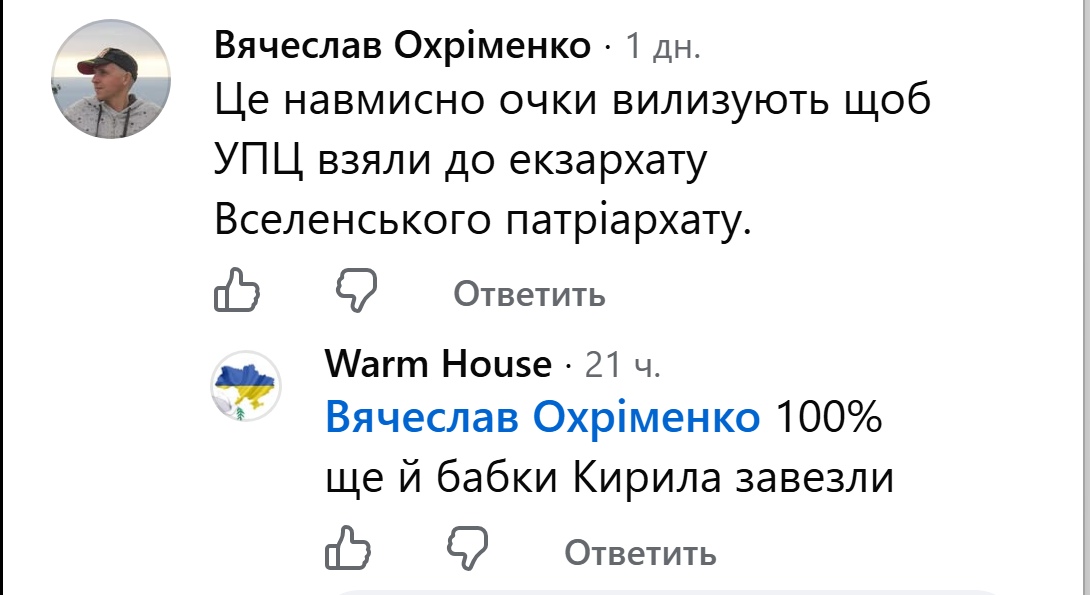
It is also worth noting that the page administrator did not delete any of these comments. Why, one wonders? If the exarchate genuinely sought dialogue, should such remarks be considered acceptable?
Exactly one person supported the congratulations: “This is very good. This is how Christians should behave.”
The conclusion is simple and unpleasant. Trying to become “one of their own” among people who regard the UOC as an “FSB school” doesn't bring any reward. Neither from society, nor from the Phanar.
It brings only humiliation: first before the exarch, then in the comments, and ultimately before one’s own flock.
The lesson of the Uniates
History has seen something similar before.
At the turn of the 1980s and 1990s, the newly legalized UGCC, with the support of local authorities, took thousands of churches from Orthodox communities in western Ukraine, while three Galician eparchies were effectively devastated.
Pope John Paul II could have stopped the violence with a single word. But he never spoke it.
That is precisely why the Orthodox side spent decades calling uniatism the principal obstacle to relations with Rome. In the 1993 Balamand Document, the Joint Commission was compelled to acknowledge that uniatism “can no longer be accepted either as a method to be followed nor as a model of the unity our Churches are seeking.”
It would never have occurred to anyone then to travel to the Vatican bearing bouquets while Orthodox communities were being thrown out of their churches in Lviv and Ivano-Frankivsk.
Those who had suffered would have been the first to misunderstand such a move.
Dialogue is possible – but not like this
No one is calling on Archbishop Sylvester and his colleagues to shut themselves off from the world. Dialogue is necessary, and the UOC understands that better than most.
But dialogue has elementary rules: you cannot beat your interlocutor and then pretend the blows are part of the negotiating process.
When Constantinople’s exarch speaks of “cooperation between Churches even where full Eucharistic unity does not yet exist,” while his fellow hierarch in America, Archbishop Elpidophoros, calls everyone who recognizes the UOC “satellites of Russia” and demands that dialogue begin with the commemoration of Patriarch Bartholomew, that is not an invitation to talk. It is an ultimatum.
The rector of the Kyiv Academy is an educated man and, judging by his writings, sincerely wishes to become a bridge between the divided parts of Ukrainian Orthodoxy.
But bridges are not built with bows and bouquets.
If Archbishop Sylvester truly seeks communication with the OCU, the UGCC, and the Phanar, there is a far more evangelical way to begin: remind these people of the truth.
The truth that hundreds of communities in Ukraine today have been driven from their churches. That they need somewhere to pray, and simply need support. That in the Church, as the Apostle teaches, “if one member suffers, all the members suffer with it” (1 Cor. 12:26).
That would be genuine dialogue.
For now, however, the congratulations offered in the academy’s name have been received not as a gesture of brotherhood, but as a slap in the face to those who today pray in forests, cemeteries, and makeshift premises because their churches were taken from them with Constantinople’s tacit blessing.
And on this point, “our own” and “the others” have proved to be of one mind.