Ukraine’s secret basements: What UOC believers already know
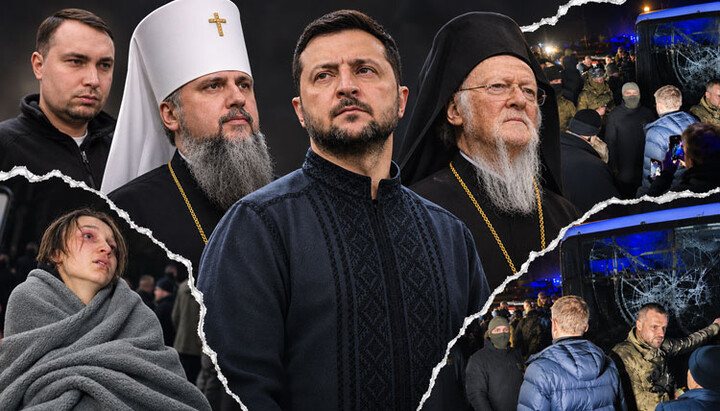
A secret detention site near Kyiv, masked enforcers, and silence from Ukraine’s “state-building” Churches: Borshchahivka has shown the country what UOC believers have been witnessing for two years.
On November 2, an incident just outside Kyiv became the talk of the country within hours. An alleged secret prison in a private house. Beaten men. A storming of the property. Gunfire and tear gas. And in the middle of it all, the head of the Presidential Office telling an angry crowd that “there are many buildings like this.”
What happened in Borshchahivka
It began with a video. A man being held in the basement of a private house on Soniachna Street in Petropavlivska Borshchahivka managed to send a recording to his relatives. He complained of severe abdominal pain, fever, and chills. His face showed signs of a beating.
His family called a private ambulance, but security guards refused to let the medical team through the gates, saying the property was a military facility. The medics called the police. Officers responded that National Guard servicemen were inside and officially dismissed reports of unlawful detention and a death on the premises as false.
Nobody knew how many people were being held inside. Local social media channels reported 40 men in the basement. Valentina Moloda, a female medical worker who was finally allowed inside with a police officer at around 6 p.m., estimated 25–30 people and said four were in serious condition. Citing law enforcement sources, TSN offered a reassuring alternative: there were not 40 hostages, just one serviceman absent without leave (AWOL).
By then, roughly 100 people had gathered outside – relatives, neighbors, and others who had seen the video. They broke down the gates and threw eggs at police. Officers responded with smoke grenades, tear gas, and warning shots fired into the air.
At around 7 p.m., National Guard Commander Oleksandr Pivnenko arrived. He insisted there was no prison, only a “temporary accommodation facility” operated by Military Unit 3121 of the National Guard’s 1st Azov Corps.
According to the general, the four injured men were AWOL servicemen who had been transferred to a National Guard medical center. He did not explain how they had been injured. The Azov Corps called the torture allegations “unverified” and promised to punish those responsible “if the investigation establishes” that violence occurred.
Late that evening, Presidential Office Chief Kyrylo Budanov arrived.
“I came to find out what is happening here,” he said.
Budanov put the number of detainees at 14; Pivnenko said there were 18. Budanov refused to call the property an illegal prison. Asked by someone in the crowd why such houses existed anywhere in Ukraine, he gave an answer that has already become a meme:
“Because there are many buildings like this.”
The men were then brought outside and loaded onto a military bus, which protesters blocked in an attempt to free the mobilized men.
Perhaps the most disturbing image was that of a teenage boy wrapped in an emergency blanket, his eyes wide with terror. Footage of him quickly spread around the world.
Accounts of how he ended up there varied throughout the first day. According to TSN, the boy had “come with the guys.” The Kyiv Post reported that he had been found in the basement. Another version suggested he had helped break down the fence and throw stones.
The following day, the teenager told his story on TikTok from Kyiv Regional Hospital, where he was being treated for cuts to his fingers, rib pain, and bruises. He said he lived about 200 meters from the house on Soniachna Street and had gone to see what was happening after friends called him.
“I saw the guys climbing trees and the fence. (...) I climbed up too, and some old guy sprayed me with a fire extinguisher.”
But the incident did not end there. Video footage shows someone striking the teenager with a shovel, knocking him off the fence into the yard.

“The farther they carried me, the more people started beating me. About ten of them, all in black uniforms, balaclavas, some kind of military clothing. I had no idea who they were. No insignia. They grabbed me by the hair and just beat me – with shovels, their feet, and their fists,” he said.
According to the teenager, his attackers cut his clothes with knives and filmed everything. Later, as activity intensified inside the building, they began cleaning him up. A woman entered, reassured him, and shielded him with her body.
Budanov then appeared. The boy said he was so disoriented from the beating that he did not recognize him.
“I thought they were going to keep questioning me, that the interrogation was about to start.”
After speaking with Budanov, the teenager was handed over to medical personnel.
This is the teenager’s account, and investigators must verify it, along with the other allegations. But the country saw two things: he entered the property over a fence and left wrapped in a blanket, suffering injuries that required hospitalization.
Between those two moments, according to his testimony, came ten masked men, shovels, and an interrogation.
The woman who “shielded him with her body” was apparently Valentyna Moloda, the same woman later described as a “fake medic.” The Security Service of Ukraine (SBU) detained her the following day, and her name was subsequently added to the Myrotvorets database.
At around 10 p.m., a group of athletic-looking young men wearing hoods and balaclavas appeared outside the house. A photographer for UNN claimed they arrived at the same time as Budanov’s motorcade.
They forcibly cleared a path for the bus and assaulted people indiscriminately. A UNN journalist was kicked after identifying himself as a reporter. A UNIAN correspondent was punched in the stomach in full view of police. A passerby returning home with his son was also attacked.
Throughout the assaults, the men shouted, “Ukraine above all!”
General Pivnenko immediately distanced himself from them.
“Those people in masks and balaclavas are definitely not our servicemen. One hundred percent. I don’t know who they are.”
Azov Corps Commander Denys Prokopenko added that the “provocations” in Borshchahivka benefited Russia.
Let us take stock, relying only on what the authorities themselves acknowledged.
A military unit was holding mobilized men and AWOL servicemen in the basement of a private house outside Kyiv. Four had injuries requiring hospitalization. The head of the Presidential Office confirmed that many such buildings exist across the country.
Meanwhile, people who came demanding answers were dispersed by masked men whom nobody claimed to know, even as those men assaulted journalists in front of police officers.
Everything else is detail.
The world is watching
By the morning of November 3, Ukrainian television channels had largely shifted to a narrative of “fake news and provocation.”
But the internet recognizes no borders. Overnight, footage from Borshchahivka spread worldwide, provoking a far louder international response than the authorities might have wanted.
The most significant reaction came from Berlin – on the very day Zelensky arrived there on an unannounced visit.
Alice Weidel, leader of Alternative for Germany (AfD), the largest opposition party in the Bundestag, wrote on X: “I expect the federal government to raise this issue today in Berlin during Zelensky’s visit.”
Within hours, her post had attracted more than 200,000 views. German and Austrian publications began reporting on “torture allegations against an Azov unit.”
Weidel had reposted Norwegian professor Glenn Diesen, whose account presented the most extreme version of events: a “Zelensky torture chamber” where the National Guard allegedly held “more than 40 mobilized men,” the youngest supposedly just 14.
In Poland, Krzysztof Mulawa, a member of the Sejm representing Confederation, one of the country’s major opposition forces, posted a collage showing Zelensky alongside the teenager wrapped in a blanket against a Ukrainian flag.
His caption ended with a question: “Should a country that tortures its own citizens be in the European Union?!” For a country that has been one of Ukraine’s strongest advocates for EU membership, such criticism is no longer confined to the political fringes.
Across English-language social media, accounts with hundreds of thousands of followers amplified the story.
British political veteran George Galloway posted just two words: “A CHILD!!!” American commentator Ian Miles Cheong wrote that Zelensky “has a lot to answer for.” DD Geopolitics captioned the boy’s photograph: “Remember this face, because Western media will make sure you never see it.”
These posts drew 150,000–200,000 views apiece within their first four hours.
One distinction matters here. Foreign accounts have described the teenager as a “14-year-old prisoner in a torture chamber.” The boy himself says he was not a prisoner. He came to the protest and entered the property by climbing over the fence.
But that hardly improves the authorities’ position. If anything, it makes matters worse. Holding adult AWOL servicemen in a basement can at least be described as “temporary accommodation.” Dragging a child inside and beating him cannot.
And all of this comes on top of what is already acknowledged: four injured men, a basement holding mobilized servicemen, and numerous similar buildings across the country.
Yet on the morning of November 3, Ukrainian media outlets preferred to focus on the medical worker’s background.
Could the next basement hold a priest?
Now consider something no Ukrainian television channel mentioned.
There is one group in Ukraine whose members are particularly vulnerable to being taken to such facilities: the clergy of the Ukrainian Orthodox Church.
In February 2025, the State Service of Ukraine for Ethnopolitics and Freedom of Conscience approved criteria for granting clergy exemptions from mobilization.
On paper, the rules applied to every denomination. In practice, exemptions have been granted to clergy from the OCU, Roman Catholic and Greek Catholic Churches, Protestant communities, Jewish and Muslim organizations, and even pagan groups.
The clergy of the country’s largest Church, however, have been left out.
According to Archpriest Dymytrii Stetsko, secretary of the Khmelnytskyi Eparchy, the state granted exemptions to 130 OCU clerics in his region while refusing to recognize UOC parishes as “critically important organizations.”
Moreover, the UOJ learned that draft notices for UOC priests were being distributed centrally through a Ministry of Defense department, bypassing local Territorial Recruitment Centers (TRCs).
In other words, this is not a matter of local officials overstepping their authority. It is a deliberate policy.

Under Church canons, a priest cannot take up arms. Meanwhile, the state does not accept UOC clergy as military chaplains. He cannot serve as a combatant under the Church's rules, and he is barred from serving as a chaplain. The only purpose his mobilization can serve, therefore, is to remove him from his parish.
As the UOJ wrote a year ago, few people in government may have read the Gospel, but they have certainly learned one verse: “I will strike the shepherd, and the sheep will be scattered.”
We know what happens next from our own reports.
On October 29, TRC personnel and police officers beat Archimandrite Volodymyr (Subbota) and took him away from a church under construction in Kharkiv. The monk has dangerously elevated blood sugar levels, and an ambulance was called to the TRC twice. Parishioners who tried to protect him were also beaten.
On October 11, Archpriest Pavlo Tovstohon was mobilized in Chernihiv. His wife wrote: “Now I’m a priest’s wife and a soldier’s wife.”
In August, authorities mobilized a protodeacon from the cathedral in Tulchyn and Archimandrite Anthony (Dzhezhela) in Volyn, who was detained at a checkpoint.
In 2025, even a bishop was mobilized – Bishop Seraphim of Novovorontsovsk.
The cases have become so numerous that UOC lawyers established a 24-hour hotline for clergy facing forced mobilization.
Now compare these accounts with what happened in Petropavlivska Borshchahivka. Where does someone forcibly bundled into a vehicle at a checkpoint end up? General Pivnenko supplied the answer: at a “temporary accommodation facility.”
A private house with a basement, one of many such properties whose existence Budanov acknowledged.
No relatives. No lawyer. No doctor.
Where a 50-year-old mechanic is held today, a priest may be held tomorrow.
And anyone who comes to demand their release can immediately be branded an “agent of Moscow.”
Nobody knows how many UOC clerics have passed through such houses. Most of the cases in our reports end with the same sentence: “The individual’s subsequent fate is unknown from the available reports.”
After Borshchahivka, that sentence has acquired a disturbingly concrete address.
A familiar playbook
The masked men who assaulted journalists outside the house on Soniachna Street did not appear out of nowhere. UOC believers have seen their kind before – or, more precisely, have grown accustomed to seeing no faces at all.
On the night of October 17, 2024, roughly 100 muscular men wearing camouflage and balaclavas stormed St. Michael the Archangel Cathedral in Cherkasy.
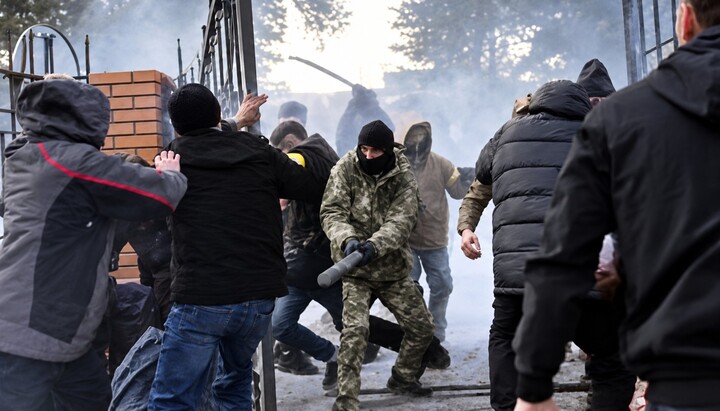
They seized parishioners’ phones, tore down cameras, broke into the eparchial dormitory where priests’ children were sleeping, and used gas and traumatic weapons. Metropolitan Theodosiy suffered a concussion after being struck with a club.
On June 17, 2025, about 50 masked men attempted to seize the UOC cathedral in Chernivtsi. Two priests were taken away by ambulance.
On February 14, 2026, masked individuals broke the locks on the Church of St. John the Warrior in Kyiv. An OCU “metropolitan” subsequently declared the church his own.
On June 4, 2026, Archimandrite Joseph was beaten during the seizure of Holy Trinity Cathedral in Kremenchuk.
The list could continue for dozens more locations.
The pattern is always the same, and in Petropavlivska Borshchahivka it unfolded almost to the letter. Athletic young men with covered faces. No identification, no insignia, no rank markings. They shout patriotic slogans and attack anyone filming, because their overriding concern is to leave no visual evidence. Police stand nearby and do nothing.
“I don’t know who these people are,” officials say at every level, throwing up their hands.
“They are definitely not our servicemen. One hundred percent,” General Pivnenko said during the yesterday's clash in Borshchahivka.
We readily believe him. Just as the men who beat believers in Cherkasy, Chernivtsi, Ivano-Frankivsk, and Kremenchuk were supposedly not “yours” either.
They are never identified. Cases opened against them for “hooliganism” never reach court. Yet they somehow appear at exactly the time and place where the authorities need a crowd dispersed and the cameras switched off.
For two years, the UOJ has warned: today they are dispersing worshippers outside a church; tomorrow they will come for you.
And now they have.
For the relatives of mobilized men.
For a passerby walking home with his son.
For journalists from UNN and UNIAN – outlets that once eagerly reported on the “voluntary transfer of religious communities.”
Welcome to our reality.
A blessing for the basement?
In a country where the Church still carries moral weight, pastors should be the first to speak after a night like this.
According to Ukraine’s official rhetoric, the country has three major “state-building” religious voices: the OCU led by Epifaniy Dumenko, the Ukrainian Greek Catholic Church led by Sviatoslav Shevchuk, and the All-Ukrainian Council of Churches and Religious Organizations, to which both belong.
By the evening of November 3, none had said a word about Borshchahivka.
The only response from Greek Catholic circles was a repost by a Lviv hieromonk about “Moscow provocateurs.”
Silence is a position, too. And what these religious leaders have said in the past helps explain it.
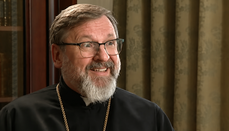
Consider Epifaniy Dumenko. In a spring 2024 interview with Radio Liberty, he praised a president who had “understood well what role the Church plays.” In other words, understood which Church could be useful and which could be banned.
Several months later, Zelensky signed the law targeting the UOC, originally Draft Law No. 8371.
On December 23, 2024, during a meeting between the Council of Churches and the president at St. Sophia of Kyiv, Epifaniy thanked Zelensky for supporting the law on “spiritual independence.”
In April 2026, he promised the president: “We believe that we will continue working closely together for the good of our Ukrainian state.”
Now consider Sviatoslav Shevchuk. At that same December meeting, the UGCC leader blessed the president: “May the Lord God bless you and give you the strength to continue serving Ukraine and the Ukrainian people for many years.”
In April 2026, sitting across from Zelensky, he declared: “Today, a free Ukraine means religious freedom.” He said this in a country where, at that very time, UOC priests were being detained outside churches and taken to TRCs.
Then there is the All-Ukrainian Council of Churches. On August 17, 2024, three days before the parliamentary vote on the law targeting the UOC, the Council told the president that it supported the country’s “course toward spiritual independence.” Its support was so enthusiastic that Zelensky later told Piers Morgan, incorrectly, that the Council had actually “excluded the Moscow Patriarchate.”
Since then, the Council has devoted itself to what the president calls “advocating for Ukraine internationally.”
Roman Catholic Bishop Vitalii Kryvytskyi tells Americans that “today in Ukraine there are no signs of persecution specifically for religious belief.”
A delegation from the World Council of Churches is assured that “there is no religious persecution during the war.”
Epifaniy tells Apostrophe that persecution “does not actually exist.”
The Council, which is supposed to speak for believers across the country, hasn't found a single word in two years to address the mobilization of priests, church seizures, or attacks on worshippers.
It will find none for Borshchahivka either.
Finally, there is Patriarch Bartholomew. In August 2024, according to the Presidential Office, he supported President Volodymyr Zelensky’s “initiative on spiritual independence” – the legislation targeting the UOC that parliament would pass a week later.
On October 31, 2026, just two days before the Borshchahivka incident, Zelensky met him in Istanbul, congratulated him on the 35th anniversary of his enthronement, and thanked him “for his consistent public position, support for our state, and constant prayers for peace.”
On November 2, as protesters stormed the house on Soniachna Street, the Phanar was celebrating its primate’s anniversary.
And from the Phanar, where there is so much talk of “pastoral concern for the Ukrainian people,” came silence as well.
Each of these leaders has made a choice.
So nobody should be surprised that, after the discovery of a basement holding injured men, not one of them had anything to say.
They are not the pastors of the people who were held in that basement.

The language of the system
There is another aspect of this story that would be a curiosity elsewhere but, in Ukraine, amounts to a diagnosis.
What language did the guards use to tell medics that the property was a military facility?
What language did people shout from behind the fence?
What language did the head of the Presidential Office – the country’s second-ranking official – use when speaking to the crowd and the teenager?
Russian.
Budanov did not misspeak or lose his composure. He spoke Russian openly and comfortably. What makes the Presidential Office chief unusual is simply that he does so in public.
In private, Russian is spoken throughout the highest levels of government, as numerous examples demonstrate. In the “Mindich tapes,” recorded by the National Anti-Corruption Bureau of Ukraine (NABU) in the summer of 2025 as part of the Midas energy corruption investigation, every conversation is in Russian.
Every single one.
The same is true of other NABU recordings involving Deputy Presidential Office Chief Mudra, former Deputy Prime Minister Chernyshov, lawmaker Mykytas, and numerous other members of Ukraine’s governing elite. When speaking among themselves, those involved have no need to perform patriotism. They need to discuss business.
That is how the system works. Ukrainian is for the cameras, the televised news marathon, official oaths, and fines. Russian is for insiders, when there is no need to pretend.
Now consider those who have spent years confronting us with the same absurd accusation: “You worship in Russian.” They have made this claim during church services, at community meetings organized to push parishes into the OCU, and in countless social media comments.
Let us remind them: the UOC celebrates its services in Church Slavonic – the language in which people have prayed in Kyiv for a thousand years, the language of the Ostromir Gospels and the Kyiv-Pechersk Patericon.
Where congregations wish to worship in Ukrainian, they do. Hundreds of UOC parishes use Ukrainian. Sermons, confessions, and conversations with parishioners take place in the language people actually speak. That is normal for the Church.
What is not normal is subjecting the language of prayer to the requirements of the state language law. And notice something else.
Those who demand that an elderly woman reading her Psalter “switch to Ukrainian” somehow never make the same demand of Budanov, Mindich, or the guards at the basement.
Only of people they can harass with impunity.
A UOC priest is fair game. The head of the Presidential Office is not – even when he speaks Russian in front of every television camera in the country.
A “Moscow provocation,” Lviv-style
While Shevchuk remains silent, voices lower down the hierarchy are speaking for him.
UGCC Hieromonk Yustyn (Yurii) Boiko of Lviv, a blogger with thousands of followers, reposted a lengthy Facebook text by a certain Ihor Savchuk under his own headline: “MOSCOW PROVOCATEURS.”
The post repeated the same claims now circulating through pro-government accounts, only more aggressively: a “fake ambulance,” a “seasoned criminal,” “hired thugs and a mob of useful idiots.”
The protest was described as “a gift to Russian intelligence, wrapped in patriotic slogans.” The post attracted hundreds of likes.
But where, exactly, is Moscow in this story? Was it Moscow that brought mobilized men to the house on Soniachna Street, took away their phones, and failed to notify their families? Was it Moscow that brought in masked men who beat journalists?
One woman asked in the comments, with bitter irony: “And are the people in the basement fake too?”
There is another revealing detail.
In 2023, the same Boiko circulated a fabricated “memorandum” supposedly signed between Ukraine’s Ministry of Education and an LGBT foundation. As ZAXID.NET established, the document had been created by the Russian Telegram channel MediaKiller. When the ministry denied its authenticity, the priest claimed that a “secret friend” inside the ministry had given him a copy.
The man who once spread Russian disinformation is now telling people in Lviv that the battered men in the basement are part of a Moscow provocation.
But the issue is not Boiko himself. It is a particular brand of “patriotic” thinking in which any truth about lawlessness must somehow be attributed to “Moscow.”
UOC believers have been called “Moscals” for years, simply for telling the public who broke down their church doors and how.
The bottom line
The authorities will have plenty to say about Borshchahivka.
The televised news marathon will explain that nothing happened. Or that something happened, but not quite as reported. Or that it happened exactly as reported, but the protesters were to blame.
Every word will be delivered in flawless Ukrainian.
And it will be false.
People know this perfectly well. Just read the thousands of social media posts.
At first glance, this story has nothing to do with the Church.
But we are writing about it because we know how this system works. We have seen it happen to our priests, our parishioners, and our churches.
As long as we were the ones being beaten, the country dismissed it as “a Church issue.”
Now the beatings have reached everyone.
And if there is one lesson to draw from all this, it is simple: a basement does not care whether the person locked inside is a priest or a mechanic.
We should care. While there are still people left who can.