What Yelensky said – and left unsaid – at meeting with Zaporizhzhia clergy
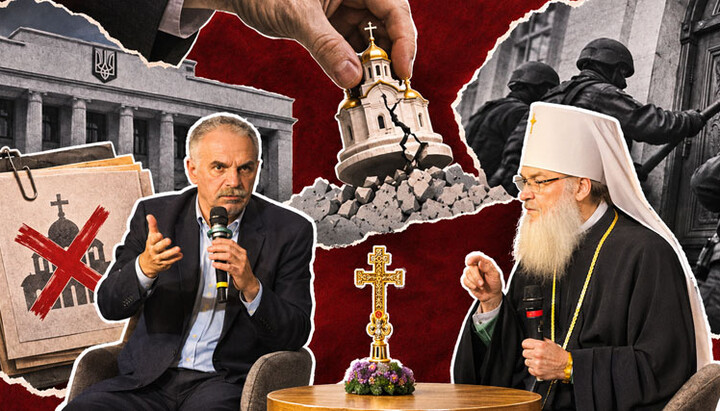
At a meeting with Zaporizhzhia clergy, the DESS head demanded that the UOC sever ties with the Russian Orthodox Church. But he left out the most important part. What was it? Let's take a closer look.
"And the state is asking you – I'm saying this for the 41st time now – to make just one decision," Viktor Yelensky declared at a meeting with clergy of the Zaporizhzhia Eparchy on November 13, 2026.
"We've already made it twice," someone in the audience replied.
This was not a conversation between two people talking past each other. It was an exchange between Viktor Yelensky, head of the State Service of Ukraine for Ethnopolitics and Freedom of Conscience (DESS), and clergy of the Zaporizhzhia Eparchy.
The meeting took place at the invitation of Metropolitan Luke of Zaporizhzhia. The participants discussed church seizures, believers' rights, the mobilization of clergy, and the independence of the Ukrainian Orthodox Church. But Yelensky kept returning to one demand: the Church must leave the Russian Orthodox Church (ROC).
A masterclass in demagoguery
It should be acknowledged that Yelensky came well prepared. He confidently cited laws, statistics, and international documents, and was quick to point out mistakes made by those questioning him. Metropolitan Luke, for his part, sometimes made Yelensky's job easier. The hierarch would ask several questions at once, interrupt his counterpart, and move on to another subject.
But Yelensky's most effective debating tactic was to change the subject.
For example, Metropolitan Luke asked whether the campaign of accusations against UOC clergy was contributing to an atmosphere of hatred. His question was prompted by the murder of Monk Varsonofy at the Sviatohirsk Lavra. Yelensky offered his condolences and immediately shifted the discussion elsewhere, speaking about priests killed in the war, destroyed churches, and the persecution of believers in Russian-occupied territories.
"The question was not about military operations, but about the vicious campaign of harassment against UOC clergy," Metropolitan Luke clarified. Yet he was unable to bring the conversation back to the issue.
Later, when the Metropolitan again raised the situation of believers in Ukrainian-controlled territory, Yelensky immediately returned to Russia.
"I'm talking about Ukraine," the hierarch interrupted.
And he was entirely right to do so, since Yelensky is a government official responsible for matters affecting the Church in Ukrainian-controlled territory.
The DESS head understands this perfectly well, yet skillfully redirects the discussion.
"Yes, I'm talking about Russia because Russia is destroying the Ukrainian Orthodox Church," the official replied.
When the discussion turned to the forcible transfer of UOC communities to the OCU, Yelensky stated that approximately 1,900 communities had joined the OCU since it received the Tomos, claiming that most transfers had been voluntary.
"Did the cathedral in Cherkasy transfer voluntarily?" Metropolitan Luke asked sarcastically, recalling the violent clashes of October 2024.
"No," Yelensky replied.
He also briefly acknowledged other incidents involving clashes and beatings.
For a moment, it seemed that an honest answer had finally been obtained from the official. But the opportunity was not pursued.
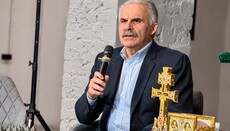
Metropolitan Luke never managed to get a clear explanation from Yelensky of what specific measures DESS had taken to protect citizens' religious rights. Yelensky confined himself to general assurances about safeguarding those rights.
Has the UOC met Yelensky's demands or not?
During his remarks in Zaporizhzhia, the DESS head once again outlined his demands for the UOC to "leave the ROC":
- The Kyiv Metropolia must submit a decision confirming the withdrawal of its eparchies, parishes, educational institutions, monasteries, brotherhoods, and sisterhoods from the ROC.
- Metropolitan Onuphry must submit a decision confirming his withdrawal from the ROC Holy Synod.
- The Kyiv Metropolia must submit a decision rejecting the ROC Statute.
- The Kyiv Metropolia must express its disagreement with Moscow's annexation of eight eparchies in Russian-occupied Ukraine.
Now let us recall the facts.
On May 27, 2022, the UOC held a Council in Feofaniya. Its resolutions stated that they "testify to the full autonomy and independence of the Ukrainian Orthodox Church."
On June 1, 2022, the Primate informed the then-head of DESS, Olena Bohdan, of these changes in letter No. 0464. In December, the agency published the letter and the revised Statute on its official website.
In his address marking the third anniversary of the Council, the UOC Primate once again reiterated what had been declared at Feofaniya.
One of the priests read this address aloud to Yelensky in Zaporizhzhia. But the DESS head responded: "We would like the UOC to provide a decision on withdrawing from the ROC – not that someone suspended or terminated [something] ... but that it left that Church."
The problem is that a reading of the Council's resolutions and Metropolitan Onuphry's letter to DESS makes one thing perfectly clear: the Ukrainian Orthodox Church formally fulfilled three of the four conditions set by the current DESS head long ago.
It is worth recalling the position of Yelensky's predecessor, Olena Bohdan. In May 2025, speaking on Suspilne, she stated that the UOC had effectively fulfilled the agency's requirements.
"As for the question of whether it 'left or did not leave,' I invite fact-checkers and all interested viewers to visit the website of the State Service for Ethnopolitics and Freedom of Conscience and open the 'Religion' section," Bohdan said.
"In particular, the UOC's letter states that the Metropolitan of Kyiv and All Ukraine terminated his membership in the Holy Synod of the ROC, and there are some other details."
Bohdan emphasized that government agencies possess documents signed by the UOC Primate, Metropolitan Onuphry.
"This is logical because, under the UOC's governing documents, the Primate represents the UOC in communications with state authorities. Letters bearing his signature, the Statute bearing his signature..."
Bohdan described DESS's expert findings concerning the UOC's ecclesiastical and canonical ties with the ROC as unsupported by evidence and filled with assumptions.
According to her, the examination proceeded from the premise that decisions of the ROC Bishops' Council were binding on the UOC under the charter issued by Alexy II. She argued, however, that this interpretation was debatable: the charter merely stated that the ROC "hoped" this would be the case.
Thus, the former and current heads of DESS hold directly opposing views on the matter. Bohdan believes that the UOC severed its ties with the Moscow Patriarchate and that the state has no grounds for complaints against it. Yelensky continues to insist otherwise. Yet Bohdan refers to documents that have been available on the DESS website for four years, while Yelensky acts as though they do not exist.
It is also worth recalling that before her appointment as head of DESS in 2020, Olena Bohdan underwent a rigorous competitive selection process, presenting a development program for the country's principal government agency responsible for relations with religious organizations.
Yelensky underwent no such competition.
He was appointed DESS head after Zelensky launched his campaign against the Ukrainian Orthodox Church.
In other words, he was placed in charge of the agency with a specific objective – to destroy the UOC.
One might also suppose that Bohdan was dismissed precisely because she refused to participate in destroying the Church.
Why does DESS examine ROC documents in its "investigation" of the UOC?
One of the most pointed questions concerned why Yelensky's agency had focused on studying Russian Church documents rather than the UOC Statute.
After all, virtually all the conclusions about the UOC's alleged "affiliation" with Moscow were based on Russian documents.
"Why did this commission use materials from Patriarchia.ru, a website subject to sanctions imposed by Ukraine's National Security and Defense Council, as evidence?" Metropolitan Luke asked Yelensky. "The legal contradiction is that the state restricts the dissemination of information from this resource because it is used in the interests of another country, while your agency uses its materials to justify restricting the rights of a Ukrainian religious organization."
The official replied: "We need this website because it is mentioned in the Law 'On the Protection of the Constitutional Order.'"
Yelensky also stated that the ROC website was not prohibited in Ukraine, even though it was blocked. He saw nothing wrong with his agency accessing it through a VPN. The DESS head then deftly moved on to another subject, effectively brushing aside one of the most uncomfortable questions he faced.
Yet there was much to discuss.
First, Patriarchia.ru was blocked in Ukraine under National Center for Operational and Technical Management of Telecommunications order No. 706/4501 at the request of the Security Service of Ukraine (SBU).
In other words, DESS relies on a resource that the Ukrainian state itself has blocked.
Second, references to this website have appeared in criminal cases against UOC hierarch as evidence of alleged criminal activity.
For example, in the case against Metropolitan Theodosiy, the prosecutor alleged that the Cherkasy Eparchy website had "rebroadcast destructive content from pro-Kremlin online resources."
These included Patriarchia.ru and Pravoslavie.ru, where, according to the prosecution, ROC propagandists justify Russia's armed aggression and war crimes committed by Russian forces.
Thus, to use the prosecutor's own language, DESS bases its "investigation" of the UOC's ties with Moscow on "destructive content from pro-Kremlin online resources."
But that is not even the main issue.
A war is underway, yet the state is making decisions affecting the fate of millions of its citizens based on documents produced by the enemy. It is an absurdity that would have been unimaginable not long ago.
Meanwhile, no one asked Yelensky a simple question.
Suppose UOC bishops went out into public squares and shouted through megaphones that they had no connection whatsoever with the ROC. Would Patriarchia.ru change as a result? Would the pages listing them as hierarchs of the Moscow Patriarchate be removed? Of course not.
That means DESS would still have formal grounds for banning the UOC. In other words, whatever declarations of separation Yelensky demands would change nothing. Everything depends solely on whether the official finds them satisfactory.
For example, Yelensky is not satisfied with the official documents signed by the UOC Primate mentioned above. What guarantee is there that he would accept any new ones?
There is none.
But Metropolitan Luke asked the most precise question, one that went straight to the heart of the state's accusations against the UOC, toward the end of the meeting:
"Can you give one specific example of the Moscow Patriarchate directing the UOC since February 24? Just one example."
He emphasized that he had been a bishop for 21 years and had never once received an instruction from Moscow.
Here it is worth recalling Olena Bohdan's words:
"A simple question arises: name the decisions that the UOC is currently making not in Kyiv but in Moscow. No one can name such a decision. All we hear in response are assumptions about secret coordination. But such assumptions should be investigated by the SBU. If coordination really exists, we need to know specifically what is being coordinated and how it has harmed Ukraine."
And Bohdan is absolutely right.
If the authorities believe that the UOC has ties to the ROC and that those ties threaten national security, they should provide specific examples.
What specific instruction did the Ukrainian Orthodox Church receive from Moscow? How exactly did it threaten Ukraine?
No such examples have been presented. And they have not been presented because no such instructions exist.
Unsurprisingly, Yelensky could not give Metropolitan Luke a direct answer. Instead, he resorted to a simple rhetorical maneuver: "I may or may not know the facts about whether the Moscow Patriarchate directs [the UOC]. I simply want to be convinced that it does not."
This resembles the logic of imprisoning an innocent person on the following grounds: "I don't know whether he committed a crime. I just want to be sure he won't commit one."
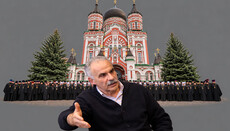
Is Yelensky "not responsible" for denying UOC clergy mobilization exemptions?
When the discussion turned to exemptions from military mobilization for priests, Yelensky again managed to evade the issue.
Explaining why UOC clergy were not being granted exemptions, he claimed that the statutes of UOC communities had supposedly lost their validity with respect to their names.
"I'm not responsible for that," he added.
On November 16, 2026, the UOC Legal Department responded to Yelensky's statement by demanding an explanation of the legal basis for his position. Law No. 3894-IX had removed the previous requirements concerning the names of religious organizations from Article 12 of the Law on Freedom of Conscience. Consequently, DESS had no right to impose restrictions without a clear legal basis currently in force.
Here Yelensky is plainly being disingenuous. DESS Order No. N-21/11 of February 5, 2025, which he himself signed, stipulates that a religious organization cannot be designated as critically important if it appears on the list of organizations affiliated with the ROC. And that list was compiled by Yelensky's own agency.
In other words, DESS itself established the criterion preventing clergy of such organizations from receiving mobilization exemptions and then, through its own decisions, created the conditions for applying that restriction to UOC structures.
The excuse "I'm not responsible" therefore does not hold up.
It is precisely DESS, under Yelensky's leadership, that bears responsibility.
Leave the ROC, but first – leave the Kyiv Metropolia
Here we encounter the central deception and the real objective of DESS, skillfully concealed behind its rhetoric.
At the meeting with Zaporizhzhia clergy, Yelensky insisted: "The Ukrainian state wants nothing from the UOC except its withdrawal from the ROC."
No transfer to the OCU, no change in the language of worship, no new calendar. Just a break with Moscow.
But let us examine his agency's documents.
On August 24, 2026, DESS identified three indicators of the Zaporizhzhia Eparchy's affiliation with the ROC. The first was the eparchy's membership in the UOC Kyiv Metropolia, which the agency had already declared affiliated with the ROC. The second was confirmation of that membership in the eparchy's governing documents. The third concerned provisions of the ROC Statute regarding the ruling bishop's participation in its governing bodies.
On October 14, DESS announced that the Zaporizhzhia Eparchy had failed to comply with Directive No. P-3 of August 26. The first unmet requirement was the absence of a decision by the eparchial assembly to withdraw from the structure of the UOC Kyiv Metropolia. Another requirement concerned the bishop's public rejection of his inclusion in ROC governing bodies.
There it is – the demand Yelensky preferred not to emphasize at the meeting. The Zaporizhzhia Eparchy is being told to sever ties, figuratively speaking, not with Moscow but with Kyiv.
From a legal – or rather, bureaucratic – standpoint, there is a certain logic to this.
If the central body has been declared affiliated with the ROC, then ties to that body are treated as evidence of an eparchy's affiliation.
But this reasoning leads to a strange practical conclusion: to demonstrate its separation from a foreign religious center, a Ukrainian eparchy must sever ties with its own Church leadership in Ukraine.
This is not an exception devised specifically for Zaporizhzhia.
The Pochaiv Lavra received a similar directive in July.
Its abbot and Spiritual Council were instructed to adopt a decision withdrawing the monastery from the structure of the Kyiv Metropolia.
Yelensky explained that if the Lavra complied, it could continue operating. If it did not, DESS would go to court to seek termination of its activities.
The process is now expanding to eparchies.
By November 13, 2026, the Zaporizhzhia, Boryspil, and Balta eparchies had received similar directives.
On the eve of the meeting, the agency announced the start of an examination of the Cherkasy Eparchy.
Yelensky himself stated that lawsuits against eparchial administrations would be filed sequentially as the relevant procedures were completed.
While the DESS head reassures clergy that the state does not interfere in Church governance, his agency is systematically demanding that eparchies sever their ties with the Kyiv Metropolia.
Dismantling Church piece by piece
This, the author argues, is the ultimate objective behind DESS's actions – one that Yelensky does not acknowledge: to dismantle the UOC piece by piece and incorporate it into the OCU.
Eventually, perhaps, the Church could even be pushed into a union with the Greek Catholics.
Religious and political figures periodically make statements about some future unity between the OCU and the UGCC.

So one should not be taken in by the sweet talk of Ukrainian officials: sever ties with the ROC (and precisely in the way we tell you), and happiness will be yours. That is, deferments from mobilization, the end of court cases, church seizures, and other perks.
Suppose the Zaporozhye Diocese declares once again that it is not subordinate to Moscow. Nothing will change as a result. It is being required to leave the Kyiv Metropolia, and until it does so, the pressure will continue – from both the SESS and various activists. The situation could change only if the state recognizes the Kyiv Metropolia as independent of the ROC. But that is not why the authorities began this whole campaign.
The SESS's true intentions are visible in one more telling episode. Priests explained to Elensky that a diocese is not an independent Church, and that its bishop is bound to the Primate and the Synod. The diocese's lawyer asked how a diocese can independently change the status of its administration if that administration was established by a decision of the Holy Synod of the UOC and operates on the basis of the UOC Charter. In response, Elensky offered the help of the SESS's lawyers.
It amounts to something like this: you decide to leave the Kyiv Metropolia, and we will advise you on how best to formalize it. The question of the canonical consequences of such a break was left unanswered.
In essence, the SESS is trying to destroy the organizational unity of the UOC. The agency offers diocesan administrations and monasteries a choice: either leave the structure of the Kyiv Metropolia, or risk the court-ordered termination of their legal entity.
On the question of the OCU, Elensky assures them: “No one is uniting you with the OCU.” And indeed, the directives contain no requirement to join the OCU automatically. But where are dioceses and monasteries supposed to go if they leave the Kyiv Metropolia? Create independent church structures? Seek some other center of governance? Elensky replies that the state does not decide questions of canonical structure. That is, the state demands that dioceses and monasteries violate the canonical order of the Church, and leaves it to the faithful themselves to deal with the consequences.
But the whole logic of the state's actions – toward dioceses and monasteries, and toward individual priests alike – points to something else: they are being pushed toward the OCU. At the meeting, Metropolitan Luke spoke of cases in which mobilized UOC priests were offered such a transfer for the sake of the opportunity to become chaplains.
Conclusion
In Zaporozhye, by his own account, Elensky spoke for the forty-first time about the need to leave the ROC. Why such persistence? Does it not remind you of anything?
In Virgil's «Aeneid», the priest Laocoön warned the Trojans: «Beware of Greeks bearing gifts». The Trojan Horse seemed a sign that the war was over, but it became the instrument of the city's destruction.
Does this ancient story not resemble Yelensky's proposals? Adopt one more decision to leave the ROC – and all the problems will end. But the documents of the SESC and the concrete actions of officials show: no, the problems will not end at all. The dioceses are being required not only to break with Moscow, but also to leave the Kyiv Metropolis. In essence, the Church is being persuaded, for the sake of illusory calm, to renounce its own unity.
Today it is especially important for the clergy and the faithful not to yield to the persuasive speeches of officials, but to judge their intentions by their real deeds and by the consequences of the decisions being made. Neither fear, nor compliance, still less bitterness, should determine the decisions of the faithful, the clergy, or the hierarchy, but prudence, courage, and faithfulness to Christ.
«Watch, stand fast in the faith, be brave, be strong. Let all that you do be done with love» (1 Cor. 16:13–14).
Kirill Alexandrov